Consider the following code:
\documentclass{article}

\usepackage{amsmath}
\usepackage{rotating}

\begin{document}

\begin{align*}
  \rotatebox[origin=c]{90}{$n$ parts}\left\{\overbrace{\begin{matrix}
    \bullet & \bullet & \bullet & \bullet & \bullet & \cdots & \bullet\\
    \bullet & \bullet & \bullet & \cdots & \bullet\\
    \bullet & \bullet & \bullet & \cdots & \bullet\\
    \bullet & \bullet & \bullet & \cdots & \bullet\\
    \bullet & \cdots & \bullet\\
    \bullet & \cdots & \bullet\\
  \end{matrix}}^{\text{Even number}}\right.
\end{align*}

\begin{align*}
  \rotatebox[origin=c]{90}{$n$ parts}\overbrace{\left\{\begin{matrix}
    \bullet & \bullet & \bullet & \bullet & \bullet & \cdots & \bullet\\
    \bullet & \bullet & \bullet & \cdots & \bullet\\
    \bullet & \bullet & \bullet & \cdots & \bullet\\
    \bullet & \bullet & \bullet & \cdots & \bullet\\
    \bullet & \cdots & \bullet\\
    \bullet & \cdots & \bullet\\
  \end{matrix}\right.}^{\text{Even number}}
\end{align*}

\end{document}
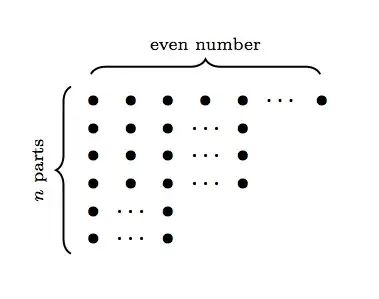
This produces the following output:

In both cases, one of the braces overlaps the other. I'd like to be able to have each brace start and end exactly at one of the dots in the diagram. How can I go about accomplishing this?




(),[], etc) around the array of dots, or not? – alexwlchan Mar 16 '14 at 17:18