Suppose I would like to have a title of assumption being Assumption 1-$\mathcal F$., Assumption 2-$\mathcal F$. and so on to be further called in the text with symbols different from $\mathcal F$. Let me give you an example:
\documentclass[10pt, a4paper]{amsart}
\usepackage{amsmath}
  {
      \theoremstyle{plain}
      \newtheorem{assumption}{Assumption}
  }
\begin{document}
\section{The first section}
\subsection{The first subsection}
There are three classes of interest: $\mathcal a$, $\mathcal b$ and $\mathcal c$.
Let $\mathcal f$ be a symbolic variable which takes its values
from the set $\{\mathcal a,\mathcal b,\mathcal c\}$.

\begin{assumption}-$\mathcal f$\label{as:1}
  The class $\mathcal f$ is not empty.
\end{assumption}

\begin{assumption}-$\mathcal f$\label{as:2}
  The derivative $\mathrm d(\mathcal f)$ is positive.
\end{assumption}

Examples of using the assumptions above are as follows:
\begin{itemize}
  \item By saying that Assumption \ref{as:1}-$\mathcal a$ is satisfied,
we mean that the class $\a$ is not empty.
  \item By saying that Assumption \ref{as:2}-$\mathcal c$ is satisfied,
we mean that the derivative $\mathrm d(\mathcal c)$ is positive.
\end{itemize}
\end{document}

In this example everything is fine but the titles of assumptions. Currently they are Assumption 1. -$\mathcal F$ whereas I need $\mathcal F$ to be the part of the title. As below. However, whenever I use \ref in the body text, the reference is of the form Assumption 1.1 rather than Assumption 1. In fact, the numbering does not work well: it seem to depend only on the number of section/subsection where the assumption was defined as here.
  {
      \theoremstyle{plain}
      \newtheorem*{assumption1f}{Assumption 1-$\mathcal f$}
      \newtheorem*{assumption2f}{Assumption 2-$\mathcal f$}
  }
\begin{document}
\section{The first section}
\subsection{The first subsection}
There are three classes of interest: $\mathcal a$, $\mathcal b$ and $\mathcal c$.
Let $\mathcal f$ be a symbolic variable which takes its values
from the set $\{\mathcal a,\mathcal b,\mathcal c\}$.

\begin{assumption1f}\label{as:1}
  The class $\mathcal f$ is not empty.
\end{assumption1f}

\begin{assumption2f}\label{as:2}
  The derivative $\mathrm d(\mathcal f)$ is positive.
\end{assumption2f}

Examples of using the assumptions above are as follows:
\begin{itemize}
  \item By saying that Assumption \ref{as:1}-$\mathcal a$ is satisfied,
we mean that the class $\mathcal a$ is not empty.
  \item By saying that Assumption \ref{as:2}-$\mathcal c$ is satisfied,
we mean that the derivative $\mathrm d(\mathcal c)$ is positive.
\end{itemize}
\end{document}

Is there any way to fix that? As suggested by egreg, I've implemented the following code. The titles are now fine, as above - but the numbering is still not ok: instead of Assumption 1-$\mathcal A$ that refers to the first assumption, I necessarily get $\mathcal F$ in the reference.
\newtheorem*{assumption*}{\assumptionnumber}
\providecommand{\assumptionnumber}{}
\makeatletter
\newenvironment{assumption}[2]
 {%
  \renewcommand{\assumptionnumber}{Assumption #1-$\mathcal{#2}$}%
  \begin{assumption*}%
  \protected@edef\@currentlabel{#1-$\mathcal{#2}$}%
 }
 {%
  \end{assumption*}
 }
\makeatother

\begin{document}
\section{The first section}
\subsection{The first subsection}

There are three classes of interest: $\mathcal a$, $\mathcal b$ and $\mathcal c$.
Let $\mathcal f$ be a symbolic variable which takes its values
from the set $\{\mathcal a,\mathcal b,\mathcal c\}$.

\begin{assumption}{1}{F}\label{as:1}
  The class $\mathcal f$ is not empty.
\end{assumption}

\begin{assumption}{2}{F}\label{as:2}
  The derivative $\mathrm d(\mathcal f)$ is positive.
\end{assumption}

Examples of using the assumptions above are as follows:
\begin{itemize}
  \item By saying that Assumption \ref{as:1}-$\mathcal a$ is satisfied,
we mean that the class $\mathcal a$ is not empty.
  \item By saying that Assumption \ref{as:2}-$\mathcal c$ is satisfied,
we mean that the derivative $\mathrm d(\mathcal c)$ is positive.
\end{itemize}
\end{document}
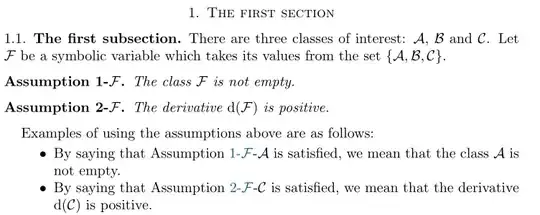
To summarize: in the first version references are the way I want, but titles are not. In the other two (my own attempt, and the code suggested by @egreg) the titles are good, but the references differ from the first case.


\refto produce when the assumption is called1-F, and possibly in other cases. – egreg Mar 24 '14 at 09:50Assumption 1-$\mathcal F$andAssumption 2-$\mathcal F$. At the same time, I would like to write in the textAssumption 1-$\mathcal A$,Assumption 1-$\mathcal B$andAssumption 1-$\mathcal C$so that each of them refers to the assumptionAssumption 1-$\mathcal F$. The same I would like to be able to do forAssumption 2-$\mathcal F$. Please, tell me whether this is clear. – SBF Mar 24 '14 at 10:15