Not Recommended:
One solution would be to change the margins before and _after the empheq. Below I have applied the solution from How can I change the margins for only part of the text? to adjust the margins:

However, I would recommend the alignat* solution below.
Notes:
- The
showframe package
was used just to show the page margins. It is not needed in your actual use.
- It is definitely an not automatic aolution, and I do now know why the margins had to be tweaked to be asymmetric in the use of the
ChangeMargin environment.
Recommended Solution:
While this does not really answer your question, I would recommend you re-format the equations so that are more readily parasable by humans by aligning the appropriate points:
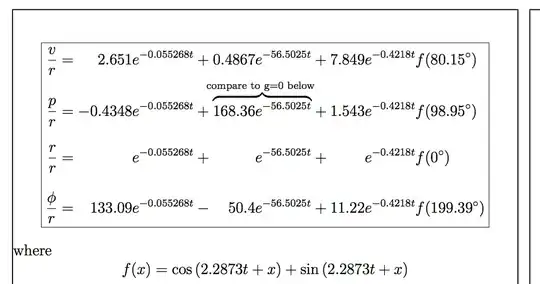
Notes:
- I also added some vertical space between the equations via the optional parameter to
\\.
\llap was used so that the \overset does not effect the alignment.
Code:
\documentclass[12pt,notitlepage]{article}%
\usepackage{amsmath}
\usepackage{empheq}
\usepackage{siunitx}
\usepackage{showframe}
% https://tex.stackexchange.com/questions/588/how-can-i-change-the-margins-for-only-part-of-the-text
\def\ChangeMargin#1#2{\list{}{\rightmargin#2\leftmargin#1}\item[]}%
\let\endChangeMargin=\endlist%
\begin{document}
\begin{ChangeMargin}{-10.0em}{-20.0ex}%
\begin{empheq}[box=\fbox]{align*}
\frac{v}{r}  & =2.651e^{-0.055268t}+0.4867e^{-56.5025t}+7.849e^{-0.4218t}
\left(  \cos\left(  2.2873t+\SI{80.15}{\degree}\right)  +\sin\left(  2.2873t+
\SI{80.15}{\degree}\right)  \right)  \
%
\frac{p}{r}  & =-0.4348e^{-0.055268t}+\overset{\text{compare to g=0
below}}{\overbrace{168.36e^{-56.5025t}}}+1.543e^{-0.4218t}\left(  \cos\left(
2.2873t-\SI{98.95}{\degree}\right)  +
\sin\left(  2.2873t-\SI{98.95}{\degree}\right)  \right)  \
%
\frac{r}{r}  & =e^{-0.055268t}+e^{-56.5025t}+e^{-0.4218t}\left(
\cos2.2873t+\sin2.2873t\right)  \
%
\frac{\phi}{r}  & =133.09e^{-0.055268t}-50.4e^{-56.5025t}+11.22e^{-0.4218t}
\left(  \cos\left(  2.2873t-\SI{199.39}{\degree}\right)

+\sin\left(  2.2873t-\SI{199.39}{\degree}\right)  \right)
\end{empheq}
\end{ChangeMargin}
\end{document}
Code: Recommended
\documentclass[12pt,notitlepage]{article}%
\usepackage{amsmath}
\usepackage{empheq}
\usepackage{siunitx}
\usepackage{showframe}
\begin{document}
\begin{empheq}[box=\fbox]{alignat*=5}
\frac{v}{r}   &={} &2.651 e^{-0.055268t}   &+{} &0.4867e^{-56.5025t}                                                    &+{} &7.849e^{-0.4218t} &f(\SI{80.15}{\degree}) \
\frac{p}{r}   &={} &-0.4348 e^{-0.055268t} &+{} &\overset{\llap{$\scriptstyle\text{compare to g=0 below}$}}{\overbrace{168.36e^{-56.5025t}}} &+{} &1.543e^{-0.4218t} &f(\SI{98.95}{\degree}) \[2ex]
\frac{r}{r}   &={} &e^{-0.055268t}         &+{} &      e^{-56.5025t}                                                    &+{} &e^{-0.4218t}      &f(\SI{0}{\degree})     \[2ex]
\frac{\phi}{r}&={} &133.09 e^{-0.055268t}  &-{} &  50.4e^{-56.5025t}                                                    &+{} &11.22e^{-0.4218t} &f(\SI{199.39}{\degree})
\end{empheq}
where
[ f(x) = \cos\left(  2.2873t + x\right) + \sin\left(  2.2873t+
x\right)  ]
\end{document}


\tikzmarkis better; but I wouldn't typeset such a thing for any amount of money. – egreg Apr 02 '14 at 22:19