\documentclass{article}

\begin{document}

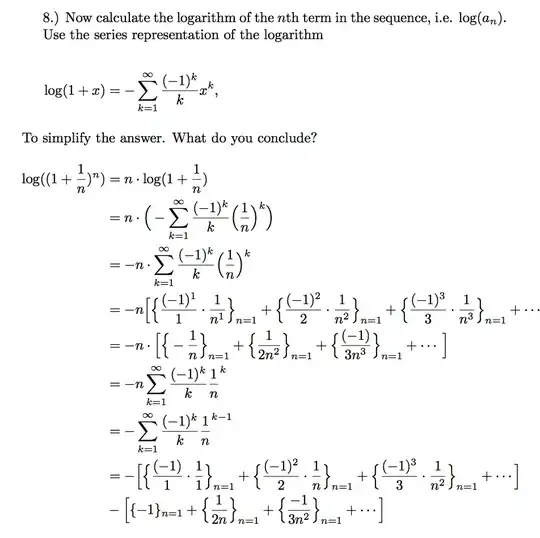
8.) Now calculate the logarithm of the $n$th term in the sequence, i.e. log($a_{n}$). \indent Use the series representation of the logarithm
\\
\\ \indent \indent log(1 + $x$) = - $   \sum\limits_{k=1}^{\infty}$ $ \frac {(-1)^{k}}{k} x^{k} $,
\\
\\ \indent \indent to simplify the answer. What do you conclude?
\\
\\ \indent \indent log((1 + $\frac{1}{n})^{n}}$)
\\
\\ \indent \indent \indent \indent  = n $\cdot$ log(1 + $\frac{1}{n}$)
\\
\\ \indent \indent \indent \indent = n $\cdot$ ( - $ \sum\limits_{k=1}^{\infty}$ $ \frac{(-1)^{k}}{k} (\frac{1}{n})^{k}$)
\\
\\ \indent \indent \indent \indent = -n $\cdot$ ($ \sum\limits_{k=1}^{\infty}$ $  \frac{(-1)^{k}}{k} (\frac{1}{n}^{k}})$
\\
\\ \indent \indent \indent \indent = -n [ $\{$$ \frac{(-1)^{1}}{1} \cdot \frac{1}{n^{1}}$$\}$$_{n=1} $ + {$ \frac{(-1)^{2}}{2} \cdot \frac{1}{n^{2}}$\}_{n=1} + \{$\frac{(-1)^{3}}{3}$ $\cdot$ $\frac {1}{n^{3}}$\}$_{n=1}$ + \indent \indent \indent \indent ...]
\\
\\ \indent \indent \indent \indent = -n $ \cdot$ [\{- $\frac{1}{n}$\}_{n=1} + \{ $\frac{1}{2n^{2}}$\} _{n=1} + \{$\frac{(-1)} {3n^{3}}$\}_{n=1} + ... \: ]
\\
\\ \indent \indent \indent \indent = - n $\sum\limits_{k=1}^{\infty} \frac{(-1)^{k}}{k} \frac{1}{n}^{k}$
\\
\\ \indent \indent \indent \indent = -$\sum\limits_{k=1}^{\infty} \frac{(-1)^{k}}{k} \frac{1}{n}^{k-1}$
\\
\\ \indent \indent \indent \indent = -[\{$\frac{(-1)}{1} \cdot \frac{1}{1}$\}_{n=1} + \{ $\frac{(-1)^{2}} {2}$ $\cdot$ $\frac{1}{n}$\}_{n=1} + \{ $\frac{(-1}^{3}}{3} \cdot \frac{1}{n^{2}}$ \}_{n=1} + ... ]
\\
\\ \indent \indent \indent \indent -[\{-1\}_{n=1} + \{ $\frac{1}{2n}$ $\}$_{n=1} + \{ $\frac{-1}{3n^2}}$ \}_{n=1} + ... ]
Asked
Active
Viewed 113 times
1

user47377
- 27
2 Answers
4
You should use the align environment from the amsmath package:
There were numerous problems with this. Here are a few them (not sure I got them all):
- Do not attempt to align that many things manually. A few tweaks are sometime necessary but the
alignenvironment does most of the work for you. - Instead of
...I useddotsas per Difference of the \dots* - I used
\intertextto insert textual content within thealignenvironment. - For resizing brackets, I used the fixed size of
\Big, but you can also use the\left/\rightconstruct. Although the manually sized braces are usually better. - Removed outer parenthesis on the line beginning with
-nas they are not needed.
Notes:
- Also, I may have messed up your math, so please do double check.
- An excellent reference for math mode is Herbert Voss' comprehensive review of mathematics in (La)TeX.
Code:
\documentclass{article}
\usepackage{amsmath}
\begin{document}
8.) Now calculate the logarithm of the $n$th term in the sequence, i.e. $\log(a_{n})$.
Use the series representation of the logarithm
\begin{align}
\log(1 + x) &= -    \sum_{k=1}^{\infty} \frac {(-1)^{k}}{k} x^{k}, \
\intertext{To simplify the answer. What do you conclude?}
\log((1 + \frac{1}{n})^{n})
    &=  n \cdot \log(1 + \frac{1}{n}) \
    &=  n \cdot \Big( -\sum_{k=1}^{\infty}  \frac{(-1)^{k}}{k} \Big(\frac{1}{n}\Big)^{k}  \Big) \
    &= -n \cdot   \sum_{k=1}^{\infty}  \frac{(-1)^{k}}{k} \Big(\frac{1}{n}\Big)^{k}  \
    &= -n \Big[ \Big{ \frac{(-1)^{1}}{1} \cdot \frac{1}{n^{1}} \Big}{n=1}  + \Big{ \frac{(-1)^{2}}{2} \cdot \frac{1}{n^{2}} \Big}{n=1} +
            \Big{\frac{(-1)^{3}}{3} \cdot \frac {1}{n^{3}} \Big}{n=1} +  \dotsb \Big] \
    &= -n  \cdot \Big[ \Big{- \frac{1}{n} \Big}{n=1} + \Big{ \frac{1}{2n^{2}} \Big} {n=1} + \Big{ \frac{(-1)} {3n^{3}} \Big}{n=1} + \dotsb : \Big] \
    &= - n \sum_{k=1}^{\infty} \frac{(-1)^{k}}{k} \frac{1}{n}^{k} \
    &= -\sum_{k=1}^{\infty} \frac{(-1)^{k}}{k} \frac{1}{n}^{k-1} \
    &= -\Big[ \Big{\frac{(-1)}{1} \cdot \frac{1}{1} \Big}{n=1} + \Big{ \frac{(-1)^{2}} {2} \cdot \frac{1}{n} \Big}{n=1} + \Big{ \frac{(-1)^{3}}{3} \cdot \frac{1}{n^{2}} \Big}{n=1} + \dotsb \Big] \
    &-\Big[ {-1}{n=1} + \Big{ \frac{1}{2n} \Big}{n=1} + \Big{ \frac{-1}{3n^2} \Big}{n=1} + \dotsb \Big]
\end{align}
\end{document}


Peter Grill
- 223,288
-
+1 You are a far faster typer than I… As a complement to this answer (mine uses a couple macros to ease understanding), OP should take a look at https://gist.github.com/vermiculus/9946499. – Sean Allred Apr 03 '14 at 01:06
-
-
Not to worry! I was going to post only a half-answer at any rate; I still haven't finished. Don't worry about it
:)[I should stop procrastinating on my thesis at any rate…] – Sean Allred Apr 03 '14 at 01:08 -
1
I am not sure what the question is and the code does not compile. Let us start at line 4, the first mistake.
log((1 + $\frac{1}{n})^{n}}$) returns a mistake because the first closing parenthesis is in math mode, whereas the corresponding opening parenthesis is not.
You also have a closing } that corresponds to no opening {.
Try $\log((1 + \frac{1}{n})^{n})$. Notice that the full mathematical expression should be in math mode. \log gives a better display of the log function.
This should give you some ideas for the rest of the document. There are many mistakes you should be able of handling.

Jhyn
- 151
\\not in a tabular or a document using\indentit's usually a sign that something is wrong..... – David Carlisle Apr 03 '14 at 00:42\end{document}so we can't run it, and you haven't said what you want it to do. – David Carlisle Apr 03 '14 at 00:45