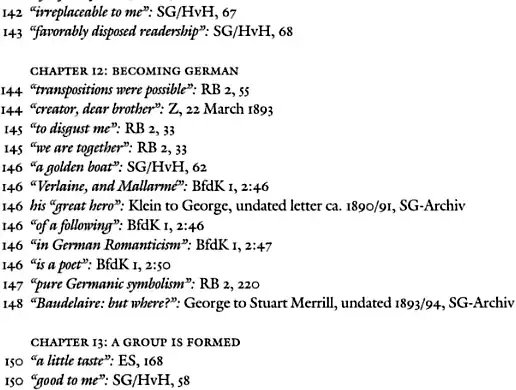
My solution builds off of the endnotes package, which is a LaTeX-only framework.
However, I think it solves the problem quite nicely.
Implementation:
Here is defined a new command to set the foot/endnote.
The first optional argument sets extra text in the endnote (but not in-line in the paragraph), such as appears in the third note of p. 146 in the original example, i.e. 146 his "great hero".
The second argument is the text that would normally appear in-line if there was no note at all. This is the text that appears enquoted in the notes section.
The third argument is the explanatory note that appears after the colon in the notes section.
% \myfootnote[<intro text>]{in-line text of paragraph}{endnote text}
\def\myfootnote{\@ifnextchar[\my@footoptnote\my@footnote}
\def\my@footoptnote[#1]{\my@@footoptnote{#1}}
      \def\my@footnote#1#2{#1\endnote{\emph{``#1''}: #2}}
\def\my@@footoptnote#1#2#3{#2\endnote{\emph{#1 ``#2''}: #3}}
The rest of the code performs the formatting, removal of the endnote marker in the regular text, labeling the endnote and referencing the page number in the notes section. Finally, we append to the \chapter command (just for numbered chapters, i.e.: with \@makechapterhead) to add a (sub)section in the notes to delineate the notes. This could obviously be repurposed to apply to starred chapters, or sections, as the case warrants.
Replica of Example
The excerpt shown in the original post would appear in the following manner with this code (code to recreate this appears at the end):

Example of practical usage
Typical usage may involve typesetting notes that reference citations from the bibliography. Here, we use biblatex and a few examples of how that would look:

Practical usage code:
The above example was typeset with this code:
\documentclass[]{report}

\usepackage{endnotes} % basic endnote structure, LaTeX only :(
\usepackage{etoolbox} % for patching chapter
\usepackage[fulloldstylenums]{kpfonts} % for nice fonts

\makeatletter

% \myfootnote[<intro text>]{in-line text of paragraph}{endnote text}
\def\myfootnote{\@ifnextchar[\my@footoptnote\my@footnote}
\def\my@footoptnote[#1]{\my@@footoptnote{#1}}
      \def\my@footnote#1#2{#1\endnote{\emph{``#1''}: #2}}
\def\my@@footoptnote#1#2#3{#2\endnote{\emph{#1 ``#2''}: #3}}

% Redefine the \endnote to remove \@endnotemark in regular text
\def\endnote{\@ifnextchar[\@xendnote{\stepcounter{endnote}%
     \protected@xdef\@theenmark{\theendnote}%
     \label{en:\@theenmark}%
     %\@endnotemark
     \@endnotetext}}

% Add a bit of space between page number and endnote text
\patchcmd{\@endnotetext}{#1}{\hspace{1ex} #1}{}{}

% Redefine the \@endnotemark (now only used in notes section)
% This is now the page number where the endnote was referenced
\def\@makeenmark{\pageref{en:\@theenmark}}

% Each \chapter should also make a new section in the endnotes for delineation
\apptocmd{\@makechapterhead}{\addtoendnotes{\protect\subsection*{\textsc{\MakeLowercase{\chaptername~\thechapter: #1}}}\indent}}{}{}
\makeatother

\usepackage[style=authortitle]{biblatex}
\addbibresource{biblatex-examples.bib}

\begin{document}

\LaTeX{} is \myfootnote{full of many good things}{\textcite[48]{companion}}.
It has the ability to typeset many \myfootnote{physical phenomena}{\textcite{aristotle:physics}} that aren't easily laid out with other systems.
Even \myfootnote{poetry}{\textcite{aristotle:poetics}} is no match for \LaTeX.

\theendnotes

% Modified to be a section so that everything is nicely on one page
\printbibliography[heading=subbibliography]

\end{document}
Replica Example Code:
As promised, this code was used to recreate the replica of the original post:
\documentclass[]{report}

\usepackage{endnotes} % basic endnote structure, LaTeX only :(
\usepackage{etoolbox} % for patching chapter
\usepackage[fulloldstylenums]{kpfonts} % for nice fonts

\makeatletter

% \myfootnote[<intro text>]{in-line text of paragraph}{endnote text}
\def\myfootnote{\@ifnextchar[\my@footoptnote\my@footnote}
\def\my@footoptnote[#1]{\my@@footoptnote{#1}}
      \def\my@footnote#1#2{#1\endnote{\emph{``#1''}: #2}}
\def\my@@footoptnote#1#2#3{#2\endnote{\emph{#1 ``#2''}: #3}}

% Redefine the \endnote to remove \@endnotemark in regular text
\def\endnote{\@ifnextchar[\@xendnote{\stepcounter{endnote}%
     \protected@xdef\@theenmark{\theendnote}%
     \label{en:\@theenmark}%
     %\@endnotemark
     \@endnotetext}}

% Add a bit of space between page number and endnote text
\patchcmd{\@endnotetext}{#1}{\hspace{1ex} #1}{}{}

% Redefine the \@endnotemark (now only used in notes section)
% This is now the page number where the endnote was referenced
\def\@makeenmark{\pageref{en:\@theenmark}}

% Each \chapter should also make a new section in the endnotes for delineation
\apptocmd{\@makechapterhead}{\addtoendnotes{\protect\subsection*{\textsc{\MakeLowercase{\chaptername~\thechapter: #1}}}\indent}}{}{}
\makeatother

\begin{document}

% A few things are contrived here to match the format of the original text
\setcounter{chapter}{10}
\setcounter{page}{142}

\chapter{Eleven}

\myfootnote{\label{en:one}irreplaceable to me}{SG/HvH, 67}
\newpage
\myfootnote{favorably disposed readership}{SG/HvH, 68}

\chapter{Becoming German}

\myfootnote{transpositions were possible}{RB 2, 55}
\myfootnote{creator, dear brother}{Z, 22 March 1893}
\newpage
\myfootnote{to disgust me}{RB 2, 33}
\myfootnote{we are together}{RB 2, 33}
\newpage
\myfootnote{a golden boat}{SH/HvH, 62}
\myfootnote{Verlaine, and Mallarm\'{e}}{BfdK 1, 2:42}

% Shows the alternate intro text example
\myfootnote[his]{great hero}{Klein to George, undated letter ca.\ 1890/91, SG-Archiv}
\myfootnote{of a following}{BfdK 1, 2:46}
\myfootnote{in German Romanticism}{BfdK 1, 2:47}
\myfootnote{is a poet}{BfdK 1, 2:50}
\newpage
\myfootnote{pure Germanic symbolism}{RB 2, 220}
\newpage
\myfootnote{Baudelaire: but where?}{George to Stuart Merrill, undated 1893/94, SG-Archiv}
\newpage
~
\chapter{A Group is Formed}
\myfootnote{a little taste}{ES, 168}
\myfootnote{good to me}{SG/HvH, 58}

\theendnotes

\end{document}