5

I have a formula and I want to increase the space between the rows to make the reading easier.

\begin{equation}
\begin{flalign*}
\epsilon \bm{\Xi}_n & = M_\epsilon(\bm{x}_{\epsilon,n-1} )  - M(\bm{x}_{n-1})  = \\   &=M_\epsilon(\bm{x}_{\epsilon, n-1} )  - M(\bm{x}_{\epsilon, n-1} ) + M(\bm{x}_{\epsilon,n-1})-M^n(\bm{x}) =  \\
&=\epsilon \bm{\xi}_n + M( M(\bm{x}_{\epsilon, n-2} ) +\epsilon \bm{\xi}_{n-1})  - M^n(\bm{x}) = \\
&=\epsilon \bm{\xi}_n + \epsilon DM(\bm{x}_{n-1}) \bm{\xi}_{n-1}+ M^2\left( M(\bm{x}_{\epsilon, n-3} + \epsilon \xibf_{n-2} \right) -M^n(\bm{x})  + O(\epsilon^2) \\
& = \epsilon \bm{\xi}_n + \epsilon DM(\bm{x}_{n-1})\bm{\xi}_{n-1}+\epsilon DM^2( \bm{x}_{n-2}) \bm{\xi}_{n-2} + 
M^3( \bm{x}_{\epsilon, n-3} )-M^n(\bm{x}).
\end{flalign*}
\end{equation}

I read this post Temporarily increase line spacing but there are a lot of different methods. Some of ones works only for text.

I use the following packages:

\usepackage{ws-rotating}     
\usepackage{graphicx}
\usepackage{epstopdf}
\usepackage[utf8]{inputenc}
\usepackage{amsmath}
\usepackage{mathtools}

4 Answers4

5

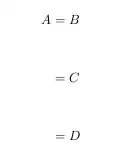
Just to collaborate on Ians suggestion, here is the same using spreadlines

\documentclass{article}
\usepackage{mathtools}
\begin{document}
\begin{spreadlines}{1cm}
  \begin{flalign*}
    A &= B \\
    &= C \\
    &= D
  \end{flalign*}
\end{spreadlines}
\end{document}
daleif
  • 54,450
3

If you want to increase row spacing uniformly in a multiline group of equations without having to type [vertical spacing] at each line break, you can use \setstretch (from the \setspace package) at the beginning of such an environment. Btw, if you load mathtools, you don't have to load amsmath. Also, I think what you need is the aligned environment, rather than flalign*, which doesn't work with equation.

The second example in the example is typeset with \setstretch{2}:

\documentclass{article}
\usepackage[utf8]{inputenc}
\usepackage[T1]{fontenc}
\usepackage{fourier}
\usepackage{heuristica}
\usepackage{mathtools}
\usepackage{bm}
\usepackage{setspace}

\begin{document}

\begin{equation}
\begin{aligned}
\epsilon \bm{\Xi}_n & = M_\epsilon(\bm{x}_{\epsilon,n-1} ) - M(\bm{x}_{n-1}) = \\
&=M_\epsilon(\bm{x}_{\epsilon, n-1} ) - M(\bm{x}_{\epsilon, n-1} ) + M(\bm{x}_{\epsilon,n-1})-M^n(\bm{x}) = \\
&=\epsilon \bm{\xi}_n + M( M(\bm{x}_{\epsilon, n-2} ) +\epsilon \bm{\xi}_{n-1}) - M^n(\bm{x}) = \\
&=\epsilon \bm{\xi}_n + \epsilon DM(\bm{x}_{n-1}) \bm{\xi}_{n-1}+ M^2\left( M(\bm{x}_{\epsilon, n-3} + \epsilon \bm{\xi}_{n-2} \right) -M^n(\bm{x}) + O(\epsilon^2) \\
& = \epsilon \bm{\xi}_n + \epsilon DM(\bm{x}_{n-1})\bm{\xi}_{n-1}+\epsilon DM^2( \bm{x}_{n-2}) \bm{\xi}_{n-2} +
M^3( \bm{x}_{\epsilon, n-3} )-M^n(\bm{x}).
\end{aligned}
\end{equation}

\begin{equation}
\setstretch{1.5}
\begin{aligned}
\epsilon \bm{\Xi}_n & = M_\epsilon(\bm{x}_{\epsilon,n-1} ) - M(\bm{x}_{n-1}) = \\
&=M_\epsilon(\bm{x}_{\epsilon, n-1} ) - M(\bm{x}_{\epsilon, n-1} ) + M(\bm{x}_{\epsilon,n-1})-M^n(\bm{x}) = \\
&=\epsilon \bm{\xi}_n + M( M(\bm{x}_{\epsilon, n-2} ) +\epsilon \bm{\xi}_{n-1}) - M^n(\bm{x}) = \\
&=\epsilon \bm{\xi}_n + \epsilon DM(\bm{x}_{n-1}) \bm{\xi}_{n-1}+ M^2\left( M(\bm{x}_{\epsilon, n-3} + \epsilon \bm{\xi}_{n-2} \right) -M^n(\bm{x}) + O(\epsilon^2) \\
& = \epsilon \bm{\xi}_n + \epsilon DM(\bm{x}_{n-1})\bm{\xi}_{n-1}+\epsilon DM^2( \bm{x}_{n-2}) \bm{\xi}_{n-2} +
M^3( \bm{x}_{\epsilon, n-3} )-M^n(\bm{x}).
\end{aligned}
\end{equation}

\end{document}

enter image description here

Bernard
  • 271,350
  • This adds unwanted space between the last line of text and the first line of the equation. I'm using it with align*. Any way to avoid that? – Jeff Nov 19 '18 at 04:32
  • 1
    @Jeff: You can use the \useshortskip directive, from nccmath, just before the equation, or something like \vspace{-0.5\baselineskip}. – Bernard Nov 19 '18 at 21:46
1

Use a length as an optional argument to \\. Here I have used 1cm to exaggerate the effect.

\documentclass{article}
\usepackage{mathtools}
\begin{document}
\begin{flalign*}
A &= B \\[1cm]
  &= C \\[1cm]
  &= D
\end{flalign*}
\end{document}

spacing

Ian Thompson
  • 43,767
1

Use the (secret) built-in method:

\documentclass{article}
\usepackage[utf8]{inputenc}
\usepackage[T1]{fontenc}
\usepackage{fourier}
\usepackage{heuristica}
\usepackage{mathtools}
\usepackage{bm}
\usepackage{setspace}

\begin{document}

\begin{equation}
\begin{aligned}
\epsilon \bm{\Xi}_n & = M_\epsilon(\bm{x}_{\epsilon,n-1} ) - M(\bm{x}_{n-1}) = \\
&=M_\epsilon(\bm{x}_{\epsilon, n-1} ) - M(\bm{x}_{\epsilon, n-1} ) + M(\bm{x}_{\epsilon,n-1})-M^n(\bm{x}) = \\
&=\epsilon \bm{\xi}_n + M( M(\bm{x}_{\epsilon, n-2} ) +\epsilon \bm{\xi}_{n-1}) - M^n(\bm{x}) = \\
&=\epsilon \bm{\xi}_n + \epsilon DM(\bm{x}_{n-1}) \bm{\xi}_{n-1}+ M^2\left( M(\bm{x}_{\epsilon, n-3} + \epsilon \bm{\xi}_{n-2} \right) -M^n(\bm{x}) + O(\epsilon^2) \\
& = \epsilon \bm{\xi}_n + \epsilon DM(\bm{x}_{n-1})\bm{\xi}_{n-1}+\epsilon DM^2( \bm{x}_{n-2}) \bm{\xi}_{n-2} +
M^3( \bm{x}_{\epsilon, n-3} )-M^n(\bm{x}).
\end{aligned}
\end{equation}

\begin{equation}
\setstretch{1.5}
\begin{aligned}
\epsilon \bm{\Xi}_n & = M_\epsilon(\bm{x}_{\epsilon,n-1} ) - M(\bm{x}_{n-1}) = \\
&=M_\epsilon(\bm{x}_{\epsilon, n-1} ) - M(\bm{x}_{\epsilon, n-1} ) + M(\bm{x}_{\epsilon,n-1})-M^n(\bm{x}) = \\
&=\epsilon \bm{\xi}_n + M( M(\bm{x}_{\epsilon, n-2} ) +\epsilon \bm{\xi}_{n-1}) - M^n(\bm{x}) = \\
&=\epsilon \bm{\xi}_n + \epsilon DM(\bm{x}_{n-1}) \bm{\xi}_{n-1}+ M^2\left( M(\bm{x}_{\epsilon, n-3} + \epsilon \bm{\xi}_{n-2} \right) -M^n(\bm{x}) + O(\epsilon^2) \\
& = \epsilon \bm{\xi}_n + \epsilon DM(\bm{x}_{n-1})\bm{\xi}_{n-1}+\epsilon DM^2( \bm{x}_{n-2}) \bm{\xi}_{n-2} +
M^3( \bm{x}_{\epsilon, n-3} )-M^n(\bm{x}).
\end{aligned}
\end{equation}

\end{document}

enter image description here

Note that the trailing equals sign is not necessary; also, I changed your \left( and \right) into \bigl( and \bigr) in order to get slightly bigger parentheses.

egreg
  • 1,121,712