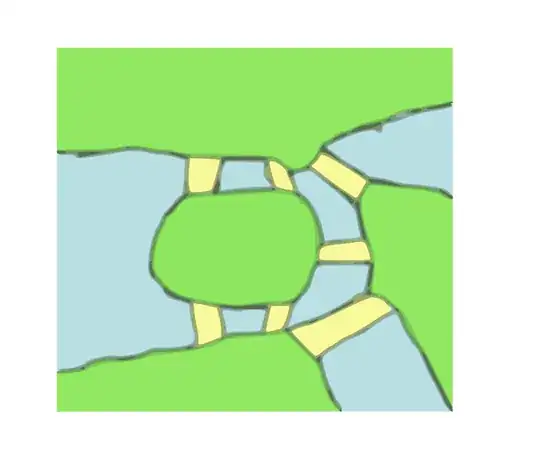
Just for fun, I was trying to draw the picture (which I found here):

However, I don't know how to create irregular shapes in tikz. Can anybody help?
If you don't mind not having an exact reproduction, it is possible to get the gist of the required image fairly simply:
\documentclass[tikz,border=5]{standalone}
\usetikzlibrary{decorations.pathmorphing,topaths}
\begin{document}
\tikzset{sketch/.style={decorate,
 decoration={random steps, amplitude=1pt, segment length=5pt},
 line join=round, draw=black!80, very thick, fill=#1
}}
\begin{tikzpicture}

\clip [preaction={fill=cyan!10}] (0,0) rectangle (10,10);

\foreach \p/\r/\w/\h in
  {(3,1)/5/1/4, (3,9)/-5/1/-4, (5,1)/-5/0.75/4, (5,9)/5/0.75/-4,
  (5,5)/-90/0.75/4, (5,1)/-50/1/4, (6,8)/50/0.75/-4}
\draw [sketch=yellow!25]
   [shift={\p}, rotate=\r] rectangle +(\w,\h);

\draw [sketch=green!50]
  (-1,-1) -- (-1,0) to [bend left, looseness=0.5] (6,2) to [bend left] (7,-1)
  (11,-1) to [bend left] (8,6) to [bend left] (11,6) -- cycle
  (-1,9) to [bend right, looseness=0.5] (7,8) to [bend left]
  (11,9) -- (11,11) -- (-1,11) -- cycle
  (2,4) to [bend left, looseness=0.5] (2.5,6) to [bend left]
  (6,6) to [bend left] (6,3.5) to [bend left] (2,4) -- cycle;
\end{tikzpicture}
\end{document}


Here is a possible reproduction of your figure.

I just scaled the image up, and manually traced coordinates (pixels) of the contours in Gimp, and then filled the necessary areas. The code is long, and it is not very nice. :)
\documentclass{article}

\usepackage{xcolor}

\usepackage{tikz}

\usetikzlibrary{decorations.pathmorphing, calc}

\definecolor{land}{HTML}{95EA64}
\definecolor{water}{HTML}{BBE0E3}
\definecolor{bridge}{HTML}{FEFF9E}

\tikzset{%
    contour/.style={%
        very thick,%
        decoration={%
            random steps,%
            segment length=4pt,%
            amplitude=0.5pt%
        },%
        rounded corners=1pt,%
        decorate%
    }%
}

\begin{document}

\begin{tikzpicture}[x=10cm, y=9.19cm]
    %\node[anchor=south west,inner sep=0, outer sep=0] (image) at (0,0)
    %   {\includegraphics[width=10cm, height=9.19cm]{OOeXi.png}};

    %water
    \filldraw[water] (0, 0) -- (0, 1) -- (1, 1) -- (1, 0) -- cycle;


    %bridge top 1
    \filldraw[bridge] ($(0, 1) + (0.329, -0.300)$) --
        ($(0, 1) + (0.423, -0.301)$) -- ($(0, 1) + (0.399, -0.399)$) --
        ($(0, 1) + (0.328, -0.404)$) -- cycle;
    \draw[contour] ($(0, 1) + (0.423, -0.301)$) -- ($(0, 1) + (0.399, -0.399)$)
        ($(0, 1) + (0.328, -0.404)$) -- ($(0, 1) + (0.329, -0.300)$);

    %bridge top 2
    \filldraw[bridge] ($(0, 1) + (0.532, -0.302)$) --
        ($(0, 1) + (0.558, -0.310)$) -- ($(0, 1) + (0.591, -0.338)$) --
        ($(0, 1) + (0.609, -0.404)$) -- ($(0, 1) + (0.549, -0.388)$) --
        cycle;
    \draw[contour] ($(0, 1) + (0.591, -0.338)$) -- ($(0, 1) + (0.609, -0.404)$)
        ($(0, 1) + (0.532, -0.302)$) -- ($(0, 1) + (0.549, -0.388)$) ;


    %bridge top 3
    \filldraw[bridge] ($(0, 1) + (0.635, -0.328)$) --
        ($(0, 1) + (0.656, -0.304)$) -- ($(0, 1) + (0.669, -0.276)$) --
        ($(0, 1) + (0.796, -0.364)$) --
        ($(0, 1) + (0.776, -0.396)$) -- ($(0, 1) + (0.762, -0.420)$) -- cycle;
    \draw[contour] ($(0, 1) + (0.635, -0.328)$) -- ($(0, 1) + (0.762, -0.420)$)
        ($(0, 1) + (0.669, -0.276)$) -- ($(0, 1) + (0.796, -0.364)$);

    %bridge middle right
    \filldraw[bridge] ($(0, 1) + (0.658, -0.590)$) --
        ($(0, 1) + (0.668, -0.546)$) -- ($(0, 1) + (0.778, -0.524)$) --
        ($(0, 1) + (0.792, -0.554)$) -- ($(0, 1) + (0.796, -0.590)$) --cycle;
    \draw[contour] ($(0, 1) + (0.668, -0.546)$) -- ($(0, 1) + (0.778, -0.524)$)
        ($(0, 1) + (0.658, -0.590)$) -- ($(0, 1) + (0.796, -0.590)$);

    %bridge bottom 1
    \filldraw[bridge] ($(0, 1) + (0.350, -0.826)$) --
        ($(0, 1) + (0.410, -0.804)$) -- ($(0, 1) + (0.422, -0.794)$) --
        ($(0, 1) + (0.412, -0.708)$) -- ($(0, 1) + (0.372, -0.702)$) --
        ($(0, 1) + (0.336, -0.695)$) -- cycle;
    \draw[contour] ($(0, 1) + (0.422, -0.794)$) -- ($(0, 1) + (0.412, -0.708)$)
    ($(0, 1) + (0.350, -0.826)$) -- ($(0, 1) + (0.336, -0.695)$);

    %bridge bottom 2
    \filldraw[bridge] ($(0, 1) + (0.596, -0.700)$) --
        ($(0, 1) + (0.535, -0.708)$) -- ($(0, 1) + (0.523, -0.784)$) --
        ($(0, 1) + (0.581, -0.777)$) -- cycle;
    \draw[contour] ($(0, 1) + (0.535, -0.708)$) -- ($(0, 1) + (0.523, -0.784)$)
        ($(0, 1) + (0.596, -0.700)$) -- ($(0, 1) + (0.581, -0.777)$);

    %bridge bottom 3
    \filldraw[bridge] ($(0, 1) + (0.581, -0.777)$) --
        ($(0, 1) + (0.660, -0.862)$) -- ($(0, 1) + (0.858, -0.717)$) --
        ($(0, 1) + (0.837, -0.702)$) -- ($(0, 1) + (0.826, -0.688)$) --
        ($(0, 1) + (0.785, -0.668)$) -- cycle;
    \draw[contour] ($(0, 1) + (0.581, -0.777)$) -- ($(0, 1) + (0.785, -0.668)$)
        ($(0, 1) + (0.660, -0.862)$) -- ($(0, 1) + (0.858, -0.717)$);


    %land top
    \filldraw[land] (0, 1) --
        ($(0, 1) + (0, -0.287)$) -- ($(0, 1) + (0.080, -0.287)$) --
        ($(0, 1) + (0.161, -0.281)$) -- ($(0, 1) + (0.178, -0.273)$) --
        ($(0, 1) + (0.257, -0.289)$) -- ($(0, 1) + (0.280, -0.287)$) --
        ($(0, 1) + (0.329, -0.300)$) -- ($(0, 1) + (0.423, -0.301)$) --
        ($(0, 1) + (0.532, -0.302)$) -- ($(0, 1) + (0.558, -0.310)$) --
        ($(0, 1) + (0.591, -0.338)$) -- ($(0, 1) + (0.635, -0.328)$) --
        ($(0, 1) + (0.656, -0.304)$) -- ($(0, 1) + (0.669, -0.276)$) --
        ($(0, 1) + (0.720, -0.246)$) -- ($(0, 1) + (0.741, -0.233)$) --
        ($(0, 1) + (0.780, -0.210)$) -- ($(0, 1) + (0.824, -0.206)$) --
        ($(0, 1) + (0.874, -0.178)$) -- ($(0, 1) + (0.931, -0.169)$) --
        ($(0, 1) + (0.969, -0.161)$) -- ($(1, 1) + (0, -0.149)$) --
        (1, 1) -- cycle;
    \draw[contour] ($(0, 1) + (0, -0.287)$) -- ($(0, 1) + (0.080, -0.287)$) --
        ($(0, 1) + (0.161, -0.281)$) -- ($(0, 1) + (0.178, -0.273)$) --
        ($(0, 1) + (0.257, -0.289)$) -- ($(0, 1) + (0.280, -0.287)$) --
        ($(0, 1) + (0.329, -0.300)$) -- ($(0, 1) + (0.423, -0.301)$) --
        ($(0, 1) + (0.532, -0.302)$) -- ($(0, 1) + (0.558, -0.310)$) --
        ($(0, 1) + (0.591, -0.338)$) -- ($(0, 1) + (0.635, -0.328)$) --
        ($(0, 1) + (0.656, -0.304)$) -- ($(0, 1) + (0.669, -0.276)$) --
        ($(0, 1) + (0.720, -0.246)$) -- ($(0, 1) + (0.741, -0.233)$) --
        ($(0, 1) + (0.780, -0.210)$) -- ($(0, 1) + (0.824, -0.206)$) --
        ($(0, 1) + (0.874, -0.178)$) -- ($(0, 1) + (0.931, -0.169)$) --
        ($(0, 1) + (0.969, -0.161)$) -- ($(1, 1) + (0, -0.149)$);


    %land bottom
    \filldraw[land] ($(0, 1) + (0, -0.890)$) -- ($(0, 1) + (0.067, -0.880)$) --
        ($(0, 1) + (0.067, -0.880)$) -- ($(0, 1) + (0.085, -0.860)$) --
        ($(0, 1) + (0.111, -0.858)$) -- ($(0, 1) + (0.139, -0.849)$) --
        ($(0, 1) + (0.161, -0.860)$) -- ($(0, 1) + (0.212, -0.847)$) --
        ($(0, 1) + (0.242, -0.830)$) -- ($(0, 1) + (0.350, -0.826)$) --
        ($(0, 1) + (0.410, -0.804)$) -- ($(0, 1) + (0.422, -0.794)$) --
        ($(0, 1) + (0.450, -0.784)$) -- ($(0, 1) + (0.523, -0.784)$) --
        ($(0, 1) + (0.581, -0.777)$) -- ($(0, 1) + (0.660, -0.862)$) --
        ($(0, 1) + (0.672, -0.882)$) -- ($(0, 1) + (0.679, -0.924)$) --
        ($(0, 1) + (0.698, -0.968)$) -- ($(0, 1) + (0.714, -0.990)$) --
        (0.718, 0) -- (0, 0) -- cycle;
    \draw[contour] ($(0, 1) + (0, -0.890)$) -- ($(0, 1) + (0.067, -0.880)$) --
        ($(0, 1) + (0.067, -0.880)$) -- ($(0, 1) + (0.085, -0.860)$) --
        ($(0, 1) + (0.111, -0.858)$) -- ($(0, 1) + (0.139, -0.849)$) --
        ($(0, 1) + (0.161, -0.860)$) -- ($(0, 1) + (0.212, -0.847)$) --
        ($(0, 1) + (0.242, -0.830)$) -- ($(0, 1) + (0.350, -0.826)$) --
        ($(0, 1) + (0.410, -0.804)$) -- ($(0, 1) + (0.422, -0.794)$) --
        ($(0, 1) + (0.450, -0.784)$) -- ($(0, 1) + (0.523, -0.784)$) --
        ($(0, 1) + (0.581, -0.777)$) -- ($(0, 1) + (0.660, -0.862)$) --
        ($(0, 1) + (0.672, -0.882)$) -- ($(0, 1) + (0.679, -0.924)$) --
        ($(0, 1) + (0.698, -0.968)$) -- ($(0, 1) + (0.714, -0.990)$) --
        (0.718, 0);


    %land right
    \filldraw[land] (1, 0) -- ($(0, 1) + (0.978, -0.975)$) --
        ($(0, 1) + (0.954, -0.908)$) -- ($(0, 1) + (0.921, -0.829)$) --
        ($(0, 1) + (0.900, -0.810)$) -- ($(0, 1) + (0.880, -0.775)$) --
        ($(0, 1) + (0.858, -0.717)$) -- ($(0, 1) + (0.837, -0.702)$) --
        ($(0, 1) + (0.826, -0.688)$) -- ($(0, 1) + (0.785, -0.668)$) --
        ($(0, 1) + (0.796, -0.623)$) -- ($(0, 1) + (0.796, -0.590)$) --
        ($(0, 1) + (0.792, -0.554)$) -- ($(0, 1) + (0.778, -0.524)$) --
        ($(0, 1) + (0.764, -0.466)$) -- ($(0, 1) + (0.762, -0.420)$) --
        ($(0, 1) + (0.776, -0.396)$) -- ($(0, 1) + (0.796, -0.364)$) --
        ($(0, 1) + (0.838, -0.368)$) -- ($(0, 1) + (0.864, -0.380)$) --
        ($(0, 1) + (0.910, -0.384)$) -- ($(0, 1) + (0.946, -0.392)$) --
        ($(0, 1) + (0.971, -0.394)$) -- ($(0, 1) + (1, -0.414)$) -- cycle;
    \draw[contour] (1, 0) -- ($(0, 1) + (0.978, -0.975)$) --
        ($(0, 1) + (0.954, -0.908)$) -- ($(0, 1) + (0.921, -0.829)$) --
        ($(0, 1) + (0.900, -0.810)$) -- ($(0, 1) + (0.880, -0.775)$) --
        ($(0, 1) + (0.858, -0.717)$) -- ($(0, 1) + (0.837, -0.702)$) --
        ($(0, 1) + (0.826, -0.688)$) -- ($(0, 1) + (0.785, -0.668)$) --
        ($(0, 1) + (0.796, -0.623)$) -- ($(0, 1) + (0.796, -0.590)$) --
        ($(0, 1) + (0.792, -0.554)$) -- ($(0, 1) + (0.778, -0.524)$) --
        ($(0, 1) + (0.764, -0.466)$) -- ($(0, 1) + (0.762, -0.420)$) --
        ($(0, 1) + (0.776, -0.396)$) -- ($(0, 1) + (0.796, -0.364)$) --
        ($(0, 1) + (0.838, -0.368)$) -- ($(0, 1) + (0.864, -0.380)$) --
        ($(0, 1) + (0.910, -0.384)$) -- ($(0, 1) + (0.946, -0.392)$) --
        ($(0, 1) + (0.971, -0.394)$) -- ($(0, 1) + (1, -0.414)$);


    %island
    \filldraw[land] ($(0, 1) + (0.241, -0.622)$) -- ($(0, 1) + (0.235, -0.587)$) --
        ($(0, 1) + (0.240, -0.540)$) -- ($(0, 1) + (0.249, -0.524)$) --
        ($(0, 1) + (0.252, -0.498)$) -- ($(0, 1) + (0.266, -0.482)$) --
        ($(0, 1) + (0.271, -0.462)$) -- ($(0, 1) + (0.288, -0.454)$) --
        ($(0, 1) + (0.300, -0.434)$) -- ($(0, 1) + (0.308, -0.418)$) --
        ($(0, 1) + (0.320, -0.412)$) -- ($(0, 1) + (0.328, -0.404)$) --
        ($(0, 1) + (0.399, -0.399)$) -- ($(0, 1) + (0.453, -0.393)$) --
        ($(0, 1) + (0.518, -0.386)$) -- ($(0, 1) + (0.549, -0.388)$) --
        ($(0, 1) + (0.609, -0.404)$) -- ($(0, 1) + (0.624, -0.410)$) --
        ($(0, 1) + (0.644, -0.438)$) -- ($(0, 1) + (0.663, -0.486)$) --
        ($(0, 1) + (0.670, -0.519)$) -- ($(0, 1) + (0.668, -0.546)$) --
        ($(0, 1) + (0.658, -0.590)$) -- ($(0, 1) + (0.648, -0.612)$) --
        ($(0, 1) + (0.636, -0.648)$) -- ($(0, 1) + (0.633, -0.666)$) --
        ($(0, 1) + (0.617, -0.677)$) -- ($(0, 1) + (0.596, -0.700)$) --
        ($(0, 1) + (0.535, -0.708)$) -- ($(0, 1) + (0.500, -0.709)$) --
        ($(0, 1) + (0.457, -0.717)$) -- ($(0, 1) + (0.412, -0.708)$) --
        ($(0, 1) + (0.372, -0.702)$) -- ($(0, 1) + (0.336, -0.695)$) --
        ($(0, 1) + (0.291, -0.679)$) -- ($(0, 1) + (0.268, -0.652)$) --
        cycle;
    \draw[contour] ($(0, 1) + (0.241, -0.622)$) -- ($(0, 1) + (0.235, -0.587)$) --
        ($(0, 1) + (0.240, -0.540)$) -- ($(0, 1) + (0.249, -0.524)$) --
        ($(0, 1) + (0.252, -0.498)$) -- ($(0, 1) + (0.266, -0.482)$) --
        ($(0, 1) + (0.271, -0.462)$) -- ($(0, 1) + (0.288, -0.454)$) --
        ($(0, 1) + (0.300, -0.434)$) -- ($(0, 1) + (0.308, -0.418)$) --
        ($(0, 1) + (0.320, -0.412)$) -- ($(0, 1) + (0.328, -0.404)$) --
        ($(0, 1) + (0.399, -0.399)$) -- ($(0, 1) + (0.453, -0.393)$) --
        ($(0, 1) + (0.518, -0.386)$) -- ($(0, 1) + (0.549, -0.388)$) --
        ($(0, 1) + (0.609, -0.404)$) -- ($(0, 1) + (0.624, -0.410)$) --
        ($(0, 1) + (0.644, -0.438)$) -- ($(0, 1) + (0.663, -0.486)$) --
        ($(0, 1) + (0.670, -0.519)$) -- ($(0, 1) + (0.668, -0.546)$) --
        ($(0, 1) + (0.658, -0.590)$) -- ($(0, 1) + (0.648, -0.612)$) --
        ($(0, 1) + (0.636, -0.648)$) -- ($(0, 1) + (0.633, -0.666)$) --
        ($(0, 1) + (0.617, -0.677)$) -- ($(0, 1) + (0.596, -0.700)$) --
        ($(0, 1) + (0.535, -0.708)$) -- ($(0, 1) + (0.500, -0.709)$) --
        ($(0, 1) + (0.457, -0.717)$) -- ($(0, 1) + (0.412, -0.708)$) --
        ($(0, 1) + (0.372, -0.702)$) -- ($(0, 1) + (0.336, -0.695)$) --
        ($(0, 1) + (0.291, -0.679)$) -- ($(0, 1) + (0.268, -0.652)$) --
        ($(0, 1) + (0.241, -0.622)$);
\end{tikzpicture}

\end{document}

Challenge accetped!
Start: 01:22 o'clock
...
First Milestome: 01:30 o'clock
Traced it using Portrace and having a svg file now
Original:

SVG:

Sure the tracing can be optimised...justr aiming for speed.
Next step: Seaching a svg2tikz converter...
Update: 01:46 o'clock
Found How to convert an SVG image with LaTeX in Inkscape, to PNG? (svg2tikz)
End: 01:59 o'clock
LaTeX code too large too be posted (received an error message here)
I put the code here:
https://github.com/manuelkuehner/tex.stackexchange.com/blob/master/2014-06-09_01
Here are the first lines:
\documentclass{article}
\usepackage[utf8]{inputenc}
\usepackage{tikz}

\begin{document}
\definecolor{cf7f899}{RGB}{247,248,153}
\definecolor{cb9dee1}{RGB}{185,222,225}
\definecolor{c90aba4}{RGB}{144,171,164}
\definecolor{c93e862}{RGB}{147,232,98}
\definecolor{c8ee760}{RGB}{142,231,96}
\definecolor{c9ca86a}{RGB}{156,168,106}
\definecolor{c79c956}{RGB}{121,201,86}
\definecolor{c78948a}{RGB}{120,148,138}
\definecolor{c6b9e58}{RGB}{107,158,88}
\definecolor{c586d50}{RGB}{88,109,80}


\begin{tikzpicture}[y=0.80pt,x=0.80pt,yscale=-1, inner sep=0pt, outer sep=0pt]
\begin{scope}[shift={(0.06625,0)}]% g2995
  % path3015
  \path[fill=cf7f899] (0.0000,148.0000) -- (0.0000,0.0000) -- (161.0000,0.0000) --
    (322.0000,0.0000) -- (322.0000,148.0000) -- (322.0000,296.0000) --
    (161.0000,296.0000) -- (0.0000,296.0000) -- (0.0000,148.0000) -- cycle;

  % path3013
  \path[fill=cb9dee1] (0.0000,148.0000) -- (0.0000,0.0000) -- (161.0000,0.0000) --
    (322.0000,0.0000) -- (322.0000,148.0000) -- (322.0000,296.0000) --
    (161.0000,296.0000) -- (0.0000,296.0000) -- (0.0000,148.0000) --
    cycle(216.5000,247.0000) .. controls (219.2500,244.8117) and
    (221.8897,243.0165) .. (222.3660,243.0106) .. controls (222.8423,243.0046) and
    (225.4437,241.3765) .. (228.1468,239.3922) .. controls (230.8499,237.4079) and
    (235.4102,234.9010) .. (238.2808,233.8213) .. controls (241.1514,232.7416) and
    (248.4500,228.5664) .. (254.5000,224.5430) .. controls (260.5500,220.5197) and
    (266.9625,216.4900) .. (268.7500,215.5882) .. controls (270.5375,214.6865) and
    (272.0000,213.4879) .. (272.0000,212.9247) .. controls (272.0000,212.3616) and
    (270.4756,210.3313) .. (268.6125,208.4129) .. controls (265.1773,204.8757) and
    (260.7332,203.0000) .. (255.7880,203.0000) .. controls (254.2891,203.0000) and
    (242.6651,208.1750) .. (229.9570,214.5000) .. controls (217.0891,220.9045) and
    (205.6141,226.0000) .. (204.0590,226.0000) .. controls (201.0839,226.0000) and
    (191.0000,229.8125) .. (191.0000,230.9373) .. controls (191.0000,231.9585) and
TikZ output:
Zoomed in:

How it is done in Inkscape:


Not using Export to Clipboard lead to an error:
Traceback (most recent call last):

  File "tikz_export.py", line 1415, in <module>

    main_inkscape()

  File "tikz_export.py", line 1403, in main_inkscape

    effect.affect()

  File "C:\Program Files (x86)\Inkscape\share\extensions\inkex.py", line 216, in affect

    if output: self.output()

  File "tikz_export.py", line 1346, in output

    f = codecs.open(self.options.outputfile, 'w', 'utf8')

  File "C:\Program Files (x86)\Inkscape\python\Lib\codecs.py", line 870, in open

    file = __builtin__.open(filename, mode, buffering)

IOError: [Errno 13] Permission denied: 'Test'
I had to sign in to Github in order to download the files from https://github.com/kjellmf/svg2tikz. Then I put the files from the extensions and the inkexlib folder directly to C:\Program Files (x86)\Inkscape\share\extensions. Some of them were already there.
Last words:
The answer was down voted. Don't know why...thought it was a "just for fun" question.


random decorations: decorating-with-random-steps-a-filling-pattern, torn-paper-matching-up-the-torn-edges – Ignasi Jun 09 '14 at 06:04plot coordinatesand a sequence of coordinates, usingsmoothoption, or you can usehoobypackage which allows metapost syntax and results for a smooth curve passing throug a sequence of points. – JLDiaz Jun 09 '14 at 07:20