Here I use a "table of contents" approach, by which I mean I explicitly write information to the aux file, and process it from there. EDITED to present two approaches: 1) where the "XYZecutive summary" is contained in the original document, and 2) where the summary is an external document.
In both cases, I have my tex file in which I can repeatedly use the macro \addxyzline{type}{content} to add various lines to the aux file. I also have the \writexyz macro, which will read the .aux file and create an .xyz file. It can appear in the source document after \begin{document}, either before any sectioning has occurred, or after all sectioning has occurred.
APPROACH 1: XYZecutive Summary in Same Document
In this approach, not only does the \writexyz macro write things to the .xyz file, it also processes that document on the second pass, formatting the contents appropriately.
The executive summary (containing all the \addxyzline information) appears at the invocation of \writexyz. In this MWE, I place it after the toc but before the document matter. I play with the \addtocontents macro definition so that the executive summary sectioning doesn't end up as duplicative sectioning in the toc.
\documentclass{article}
\newcommand\addxyzline[2]{\addtocontents {xyz}{\protect \xyzline {#1}{#2}}}
\let\svaddtocontents\addtocontents
\makeatletter
\newcommand\writexyz{%
  \renewcommand\addtocontents[2]{\relax}%
  \clearpage\setcounter{section}{0}\noindent%
  {\Huge\hrulefill XYZecutive Summary\hrulefill\par}%
  \newcommand\xyzline[2]{\expandafter\csname##1\endcsname{##2}}\@starttoc{xyz}%
  \par\noindent\hrulefill\clearpage\setcounter{section}{0}%
  \let\addtocontents\svaddtocontents
}
\makeatother
\begin{document}
\tableofcontents% CAN UNCOMMMENT TO SEE THAT toc WORKS FINE
\writexyz

\section{Introduction}
\addxyzline{section}{Introduction}

\addxyzline{begin}{itemize}
\addxyzline{item}{1.0 Visually tracking balls is an interesting problem.}
Text related to why tracking balls is important, blah, blah, blah.
Blah, blah, blah.

\addxyzline{item}{1.1 Tracking balls is difficult because of these challenges.}
Text relating the challenges, blah, blah, blah.
More blah, blah, blah.

\addxyzline{item}{2.0 Previous work.}
Text relating the existing work on tracking balls, blah, blah, blah.
Blah, blah, blah.
\addxyzline{end}{itemize}

\end{document}

APPROACH 2: Separate Summary Document
Here, I create my document body as before, but the \writexyz will not write the summary to the same document, but merely to the .xyz file.
\documentclass{article}
\newcommand\addxyzline[2]{\addtocontents {xyz}{\protect \xyzline {#1}{#2}}}
\makeatletter
\newcommand\writexyz{\newcommand\xyzline[2]{}\@starttoc{xyz}}
\makeatother
\begin{document}
%\tableofcontents% CAN UNCOMMMENT TO SEE THAT toc WORKS FINE
\section{Introduction}
\addxyzline{section}{Introduction}

\addxyzline{begin}{itemize}
\addxyzline{item}{1.0 Visually tracking balls is an interesting problem.}
Text related to why tracking balls is important, blah, blah, blah.
Blah, blah, blah.

\addxyzline{item}{1.1 Tracking balls is difficult because of these challenges.}
Text relating the challenges, blah, blah, blah.
More blah, blah, blah.

\addxyzline{item}{2.0 Previous work.}
Text relating the existing work on tracking balls, blah, blah, blah.
Blah, blah, blah.
\addxyzline{end}{itemize}

\writexyz
\end{document}
As far as screen output, the compilation produces the output of the original document, without regard to the \addxyzline content:

However, it also creates a .xyz file (in this case xyz.xyz, since I had called my original file xyz.tex), with the following information:
\xyzline {section}{Introduction}
\xyzline {begin}{itemize}
\xyzline {item}{1.0 Visually tracking balls is an interesting problem.}
\xyzline {item}{1.1 Tracking balls is difficult because of these challenges.}
\xyzline {item}{2.0 Previous work.}
\xyzline {end}{itemize}
containing all of my \addxyzline information.
Then, I have a very simple second tex file:
\documentclass{article}
\newcommand\xyzline[2]{\csname#1\endcsname {#2}\par}
\begin{document}
\input{xyz.xyz}% NAME OF .xyz FILE GOES HERE IN THE ARGUMENT
\end{document}
which provides the xyz summary info
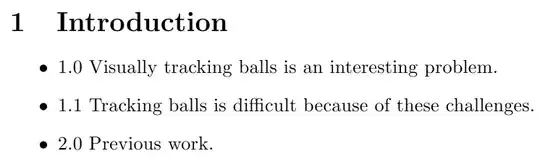
POSTSCRIPT
As one can see, the first argument of \addxyzline is the text of any macro name. In my MWE, I have used "section", "begin", "item", and "end". Other useful incantations might include
\addxyzline{relax}{this is just text added on the same line}
\addxyzline{newline}{this is just text on a new line}


\tableofcontentsdoes, using information that has been written out to the .toc file. Maybe something could be adapted along those lines. – Steven B. Segletes Sep 22 '14 at 16:18\addcontentslinetoo. – Symbol 1 Sep 22 '14 at 16:22