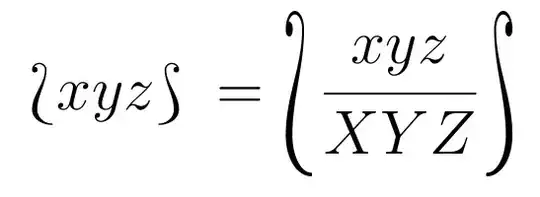
The \scaleleftright and stretchleftright macros of the scalerel package give similar functionality to the \left ... \right syntax. In this case, the optional argument gives the maximum width allowed on the scale. If the width is exceeded, the aspect ratio is adjusted to preserve the limiting width.
\documentclass{arlticle}
\usepackage{stmaryrd,scalerel}
\begin{document}
\[\Lbag xyz \Rbag\ = \scaleleftright[1.2ex]{\Lbag}{\frac{xyz}{XYZ}}{\Rbag}\]
\end{document}

And if you add a \strut to the numerator and denominator of the \frac, it will look like this:
In the comments discussion, I raised the question on what an extensible version of this glyph might look like. For fun, I constructed one by hand. I don't recommend the implementation, but thought it would be interesting to compare, in visual appearance, to my proposed solution above:
\documentclass{arlticle}
\usepackage{stmaryrd,scalerel,stackengine}
\setstackgap{S}{0pt}
\usepackage{adjustbox}
\def\LbagT{\clipbox{0pt 2.6pt 0pt 0pt}{$\Lbag$}}
\def\LbagB{\clipbox{0pt 0pt 0pt 8.5pt}{$\Lbag$}}
\def\RbagT{\clipbox{0pt 2.6pt 0pt 0pt}{$\Rbag$}}
\def\RbagB{\clipbox{0pt 0pt 0pt 8.5pt}{$\Rbag$}}
\begin{document}
\[\Lbag xyz \Rbag\ = \scaleleftright[1.2ex]{\Lbag}{\frac{xyz}{XYZ}}{\Rbag}\]

\[
\raisebox{-6pt}{\Shortstack{{\LbagT} {\rule{1pt}{2ex}\kern3pt} {\LbagB}}}
\frac{xyz}{XYZ}
\raisebox{-6pt}{\Shortstack{{\RbagT} {\kern2.95pt\rule{1pt}{2ex}} {\RbagB}}}
\]
\end{document}


scalerelpackage scales individual glyphs, which is not the way that extensible characters like braces are constructed. On the other hand, it is hard to envision this character in an extensible fashion. – Steven B. Segletes Sep 23 '14 at 19:00