This exploits the fact that the tokens to count are digits:
\documentclass{article}
\usepackage{xparse}

\ExplSyntaxOn
\NewDocumentCommand{\countoccurrences}{ O{default} m }
 {
  \svend_count_occurrences:nn { #1 } { #2 }
 }
\DeclareExpandableDocumentCommand{\getoccurrences}{ O{default} m }
 {
  % just retrieve the property corresponding to the requested digit
  \prop_item:cn { g_svend_occurrences_#1_prop } { #2 }
 }

\prop_new:N \g_svend_occurrences_default_prop
\tl_new:N \l__svend_input_tl
\tl_new:N \l__svend_temp_tl

\cs_new_protected:Npn \svend_count_occurrences:nn #1 #2
 {
  % make a new property list, if necessary, or clear an existing one
  \prop_gclear_new:c { g_svend_occurrences_#1_prop }
  % store the string
  \tl_set:Nn \l__svend_input_tl { #2 }
  % the items are octal digits so do a loop on them
  \int_step_inline:nnnn { 0 } { 1 } { 7 }
   {
    % make a copy of the given string
    \tl_set_eq:NN \l__svend_temp_tl \l__svend_input_tl
    % remove all items that are the same as the current digit
    \tl_remove_all:Nn \l__svend_temp_tl { ##1 }
    % put in the property list the current digit as property
    % and the difference between the number of items of the
    % full list and the temporary one (count the number of removed items)
    \prop_gput:cnx { g_svend_occurrences_#1_prop }
     { ##1 }
     { \int_eval:n { \tl_count:N \l__svend_input_tl - \tl_count:N \l__svend_temp_tl } }
   }
 }
\ExplSyntaxOff

\begin{document}

\countoccurrences[new]{1 1 1 1 2 2 2 2}
\getoccurrences[new]{0}\quad
\getoccurrences[new]{1}\quad
\getoccurrences[new]{2}

\bigskip

\countoccurrences{1 2 4 0 3 1 0 0 2 1 7 1 4 2 3 0 0 6 5 2 1 2 3 0}

\begin{tabular}{cc}
  0 & \getoccurrences{0} \\
  1 & \getoccurrences{1} \\
  2 & \getoccurrences{2} \\
  3 & \getoccurrences{3} \\
  4 & \getoccurrences{4} \\
  5 & \getoccurrences{5} \\
  6 & \getoccurrences{6} \\
  7 & \getoccurrences{7} \\
\end{tabular}

\end{document}
For arbitrary items more complex code is needed.
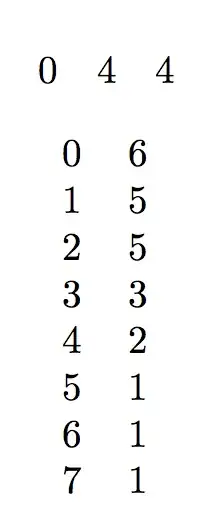
Arbitrary sequences of characters can be coped with regular expressions. Note that here \countoccurrences takes as optional argument a key-value pair list: name sets a name for the list (default is default) and list the list of sequences to count. In \setsearchlist only the list should be specified as optional argument and in \getoccurrences the name.
If the optional argument to \countoccurrences contains self (that implies self=true), then list should not appear and the list of items will be constructed from the mandatory argument and given the same name as the token list. In particular
\countoccurrences[self]{0 1 2 3}
would set up the list in the same way as issuing
\setsearchlist{0 1 2 3}
beforehand.
Complete example:
\documentclass{article}
\usepackage{xparse,l3regex}

\ExplSyntaxOn
\NewDocumentCommand{\countoccurrences}{ O{} m }
 {
  \group_begin:
  \keys_set:nn { svend/occurrences } { #1 }
  % if the self key appeared, make the list name equal to the sequence name
  \bool_if:NT \l_svend_occurrences_self_bool
   {
    \tl_set_eq:NN \l__svend_occurrences_list_tl \l__svend_occurrences_name_tl
   }
  \svend_count_occurrences:n { #2 }
  \group_end:
 }
\NewDocumentCommand{\setsearchlist}{ O{default} m }
 {
  \svend_occurrences_set_searchlist:nn { #1 } { #2 }
 }
\DeclareExpandableDocumentCommand{\getoccurrences}{ O{default} m }
 {
  \prop_item:cn { g_svend_occurrences_#1_prop } { #2 }
 }

\keys_define:nn { svend/occurrences }
 {
  name .tl_set:N   = \l__svend_occurrences_name_tl,
  name .initial:n  = default,
  list .tl_set:N   = \l__svend_occurrences_list_tl,
  list .initial:n  = default,
  self .bool_set:N = \l_svend_occurrences_self_bool,
  self .default:n  = true,
  self .initial:n  = false,
 }

\prop_new:N \g_svend_occurrences_default_prop
\seq_new:N \g_svend_occurrences_default_list_seq
\int_new:N \l__svend_occurrences_matches_int

\cs_new_protected:Npn \svend_count_occurrences:n #1
 {
  % create a new property list for storing the values for the current string
  % or clear an existing one
  \prop_gclear_new:c { g_svend_occurrences_ \l__svend_occurrences_name_tl _prop }
  % populate the search list, if self is used
  \bool_if:NT \l_svend_occurrences_self_bool
   {
    \svend_occurrences_set_searchlist:Vn \l__svend_occurrences_name_tl { #1 }
   }
  % map through the search list
  \seq_map_inline:cn { g_svend_occurrences_ \l__svend_occurrences_list_tl _list_seq }
   {
    % store the current search item; using the token list in
    % the regex search expression should avoid problems with
    % special characters
    \tl_set:Nn \l__svend_occurrences_temp_tl { ##1 }
    % count the number of times “search item/space” appears
    % (a trailing space is added) and store it in an integer variable
    % (in a regex, \u{tl variable name} stands for the contents of the variable
    \regex_count:nnN { \u{l__svend_occurrences_temp_tl}\s } { #1~ } \l__svend_occurrences_matches_int
    % put the number of matches in the property list, corresponding to
    % the current item as key
    \prop_gput:cnx { g_svend_occurrences_ \l__svend_occurrences_name_tl _prop }
     { ##1 }
     { \int_to_arabic:n { \l__svend_occurrences_matches_int } }
   }
 }

% populate a search list (with duplicates removed)
\cs_new_protected:Npn \svend_occurrences_set_searchlist:nn #1 #2
 {
  \seq_gclear_new:c { g_svend_occurrences_#1_list_seq }
  \seq_gset_split:cnn { g_svend_occurrences_#1_list_seq } { ~ } { #2 }
  \seq_gremove_duplicates:c { g_svend_occurrences_#1_list_seq }
 }
\cs_generate_variant:Nn \seq_gset_split:Nnn { c }
\cs_generate_variant:Nn \svend_occurrences_set_searchlist:nn { V }

\ExplSyntaxOff

\begin{document}

\setsearchlist{0 1 2 3 4 5 6 7}

\countoccurrences[name=new]{1 1 1 1 2 2 2 2}
\getoccurrences[new]{0}\quad
\getoccurrences[new]{1}\quad
\getoccurrences[new]{2}

\bigskip

\countoccurrences{1 2 4 0 3 1 0 0 2 1 7 1 4 2 3 0 0 6 5 2 1 2 3 0}

\begin{tabular}{cc}
  0 & \getoccurrences{0} \\
  1 & \getoccurrences{1} \\
  2 & \getoccurrences{2} \\
  3 & \getoccurrences{3} \\
  4 & \getoccurrences{4} \\
  5 & \getoccurrences{5} \\
  6 & \getoccurrences{6} \\
  7 & \getoccurrences{7} \\
\end{tabular}

\bigskip

\setsearchlist[alph]{a b c ce}
\countoccurrences[name=letters,list=alph]{a b c a d b b ce f}

\begin{tabular}{cc}
  a & \getoccurrences[letters]{a} \\
  b & \getoccurrences[letters]{b} \\
  c & \getoccurrences[letters]{c} \\
  ce & \getoccurrences[letters]{ce} \\
\end{tabular}

\bigskip

\countoccurrences[name=letters,self]{a b c a d b b ce f}

\begin{tabular}{cc}
  a & \getoccurrences[letters]{a} \\
  b & \getoccurrences[letters]{b} \\
  c & \getoccurrences[letters]{c} \\
  ce & \getoccurrences[letters]{ce} \\
  d & \getoccurrences[letters]{d} \\
  f & \getoccurrences[letters]{f} \\
\end{tabular}


\end{document}

A version that allows also control sequences, so long as they expand to characters. When control sequences are expected in the list to count in, a separator must be specified with the key sep= (a semicolon in the example), because spaces are ignored after control sequence (unless you want to input it as
\countoccurrences{
  \fravaerElevEn\space
  \fravaerElevTo\space
  \fravaerElevTre\space
  ...
}
Here's the example
\documentclass{article}
\usepackage{xparse,l3regex}

\ExplSyntaxOn
\NewDocumentCommand{\countoccurrences}{ O{} m }
 {
  \group_begin:
  \keys_set:nn { svend/occurrences } { #1 }
  % if the self key appeared, make the list name equal to the sequence name
  \bool_if:NT \l__svend_occurrences_self_bool
   {
    \tl_set_eq:NN \l__svend_occurrences_list_tl \l__svend_occurrences_name_tl
   }
  \svend_count_occurrences:x { #2 }
  \group_end:
 }
\NewDocumentCommand{\setsearchlist}{ O{default} m }
 {
  \svend_occurrences_set_searchlist:nn { #1 } { #2 }
 }
\DeclareExpandableDocumentCommand{\getoccurrences}{ O{default} m }
 {
  \prop_item:cn { g_svend_occurrences_#1_prop } { #2 }
 }

\keys_define:nn { svend/occurrences }
 {
  name .tl_set:N   = \l__svend_occurrences_name_tl,
  name .initial:n  = default,
  list .tl_set:N   = \l__svend_occurrences_list_tl,
  list .initial:n  = default,
  self .bool_set:N = \l__svend_occurrences_self_bool,
  self .default:n  = true,
  self .initial:n  = false,
  sep  .tl_set:N   = \l__svend_occurrences_sep_tl,
  sep  .initial:n  = {~},
 }

\prop_new:N \g_svend_occurrences_default_prop
\seq_new:N \g_svend_occurrences_default_list_seq
\int_new:N \l__svend_occurrences_matches_int
\tl_new:N \l__svend_occurrences_input_tl

\cs_new_protected:Npn \svend_count_occurrences:n #1
 {
  \tl_set:Nn \l__svend_occurrences_input_tl { #1~ } % add a trailing space
  \tl_replace_all:NVn \l__svend_occurrences_input_tl \l__svend_occurrences_sep_tl { ~ }
  % create a new property list for storing the values for the current string
  % or clear an existing one
  \prop_gclear_new:c { g_svend_occurrences_ \l__svend_occurrences_name_tl _prop }
  % populate the search list, if self is used
  \bool_if:NT \l__svend_occurrences_self_bool
   {
    \svend_occurrences_set_searchlist:Vn \l__svend_occurrences_name_tl { #1 }
   }
  % map through the search list
  \seq_map_inline:cn { g_svend_occurrences_ \l__svend_occurrences_list_tl _list_seq }
   {
    % store the current search item; using the token list in
    % the regex search expression should avoid problems with
    % special characters
    \tl_set:Nn \l__svend_occurrences_temp_tl { ##1 }
    % count the number of times “search item/space” appears
    % (a trailing space is added) and store it in an integer variable
    % (in a regex, \u{tl variable name} stands for the contents of the variable
    \regex_count:nVN
     { \u{l__svend_occurrences_temp_tl}\s } % search expression
     \l__svend_occurrences_input_tl % token list to search in
     \l__svend_occurrences_matches_int % store the result here
    % put the number of matches in the property list, corresponding to
    % the current item as key
    \prop_gput:cnx { g_svend_occurrences_ \l__svend_occurrences_name_tl _prop }
     { ##1 }
     { \int_to_arabic:n { \l__svend_occurrences_matches_int } }
   }
 }
\cs_generate_variant:Nn \tl_replace_all:Nnn { NV }
\cs_generate_variant:Nn \regex_count:nnN { nV }
\cs_generate_variant:Nn \svend_count_occurrences:n { x }

% populate a search list (with duplicates removed)
\cs_new_protected:Npn \svend_occurrences_set_searchlist:nn #1 #2
 {
  \seq_gclear_new:c { g_svend_occurrences_#1_list_seq }
  \seq_gset_split:cnn { g_svend_occurrences_#1_list_seq } { ~ } { #2 }
  \seq_gremove_duplicates:c { g_svend_occurrences_#1_list_seq }
 }
\cs_generate_variant:Nn \seq_gset_split:Nnn { c }
\cs_generate_variant:Nn \svend_occurrences_set_searchlist:nn { V }

\ExplSyntaxOff

\begin{document}

\setsearchlist{0 1 2 3 4 5 6 7}

\countoccurrences[name=new]{1 1 1 1 2 2 2 2}
\getoccurrences[new]{0}\quad
\getoccurrences[new]{1}\quad
\getoccurrences[new]{2}

\bigskip

\countoccurrences{1 2 4 0 3 1 0 0 2 1 7 1 4 2 3 0 0 6 5 2 1 2 3 0}

\begin{tabular}{cc}
  0 & \getoccurrences{0} \\
  1 & \getoccurrences{1} \\
  2 & \getoccurrences{2} \\
  3 & \getoccurrences{3} \\
  4 & \getoccurrences{4} \\
  5 & \getoccurrences{5} \\
  6 & \getoccurrences{6} \\
  7 & \getoccurrences{7} \\
\end{tabular}

\bigskip

\setsearchlist[alph]{a b c ce}
\countoccurrences[name=letters,list=alph]{a b c a d b b ce f}

\begin{tabular}{cc}
  a & \getoccurrences[letters]{a} \\
  b & \getoccurrences[letters]{b} \\
  c & \getoccurrences[letters]{c} \\
  ce & \getoccurrences[letters]{ce} \\
\end{tabular}

\bigskip

\countoccurrences[name=letters,self]{a b c a d b b ce f}

\begin{tabular}{cc}
  a & \getoccurrences[letters]{a} \\
  b & \getoccurrences[letters]{b} \\
  c & \getoccurrences[letters]{c} \\
  ce & \getoccurrences[letters]{ce} \\
  d & \getoccurrences[letters]{d} \\
  f & \getoccurrences[letters]{f} \\
\end{tabular}

\bigskip

\def\fravaerElevEn{1}
\def\fravaerElevTo{2}
\def\fravaerElevTre{4}
\def\fravaerElevFire{0}
\def\fravaerElevFem{3}
\def\fravaerElevSeks{1}
\def\fravaerElevSyv{0}
\def\fravaerElevOtte{0}
\def\fravaerElevNi{2}
\def\fravaerElevTi{1}
\def\fravaerElevElleve{7}
\def\fravaerElevTolv{1}
\def\fravaerElevTretten{4}
\def\fravaerElevFjorten{2}
\def\fravaerElevFemten{3}
\def\fravaerElevSeksten{0}
\def\fravaerElevSytten{0}
\def\fravaerElevAtten{6}
\def\fravaerElevNitten{5}
\def\fravaerElevTyve{2}
\def\fravaerElevEnogtyve{1}
\def\fravaerElevToogtyve{2}
\def\fravaerElevTreogtyve{3}
\def\fravaerElevFireogtyve{0}

\setsearchlist{0 1 2 3 4 5 6 7}

\countoccurrences[sep={;}]{
  \fravaerElevEn;
  \fravaerElevTo;
  \fravaerElevTre;
  \fravaerElevFire;
  \fravaerElevFem;
  \fravaerElevSeks;
  \fravaerElevSyv;
  \fravaerElevOtte;
  \fravaerElevNi;
  \fravaerElevTi;
  \fravaerElevElleve;
  \fravaerElevTolv;
  \fravaerElevTretten;
  \fravaerElevFjorten;
  \fravaerElevFemten;
  \fravaerElevSeksten;
  \fravaerElevSytten;
  \fravaerElevAtten;
  \fravaerElevNitten;
  \fravaerElevTyve;
  \fravaerElevEnogtyve;
  \fravaerElevToogtyve;
  \fravaerElevTreogtyve;
  \fravaerElevFireogtyve;
}

\begin{tabular}{cc}
  0 & \getoccurrences{0} \\
  1 & \getoccurrences{1} \\
  2 & \getoccurrences{2} \\
  3 & \getoccurrences{3} \\
  4 & \getoccurrences{4} \\
  5 & \getoccurrences{5} \\
  6 & \getoccurrences{6} \\
  7 & \getoccurrences{7}
\end{tabular}

\end{document}
The last table is the same as the first one.


\defs) to make the code work or can I make you give a solution that allows me to use\defs in the way I've shown? – Svend Tveskæg Dec 15 '14 at 23:06;-)– egreg Dec 15 '14 at 23:18