You have not balanced \left and \rights across line break. Further, better not use eqnarray but use amsmath facilities like align etc.
\documentclass{article}
\usepackage{mathtools}
\DeclareMathOperator*{\argmin}{arg\,min}
\begin{document}
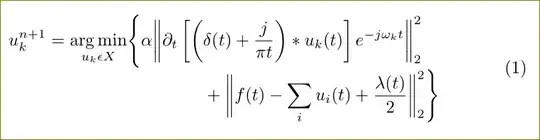
  \begin{equation}
  \begin{multlined}
u_k^{n+1}=\argmin_{u_k \epsilon X}
 \left\lbrace \alpha \left|\left|\partial_t\left[\left(\delta(t)+\frac{j}{\pi t}\right)*u_k(t)\right]e^{-j\omega_kt}\right|\right|_2^2 \right.\\
\left.+\left|\left| f(t)-\sum_i u_i(t) + \frac{\lambda(t)}{2} \right|\right|_2^2  \right\rbrace
\end{multlined}
\end{equation}
\end{document}
I have used multlined from mathtools (which also loads amsmath).

Improved version:
Instead of using \left and \right pair (which gives more space as noted by Mico and needs to be balanced across lines), you can use Biggl and Biggr from amsmath. Here is a screen shot from amsldoc page 15, (texdoc amsldoc):

And for double bar use a \DeclarePairedDelimiter like
\DeclarePairedDelimiter{\norm}{\lVert}{\rVert}
and use it like \norm[\bigg]{<content>} (Thanks to Mico)
\documentclass{article}
\usepackage{mathtools}
\DeclareMathOperator*{\argmin}{arg\,min}
\DeclarePairedDelimiter{\norm}{\lVert}{\rVert}
\begin{document}
  \begin{equation}
  \begin{multlined}
    u_k^{n+1}=\argmin_{u_k \epsilon X}
        \Biggl\lbrace \alpha \norm[\bigg]{\partial_t\left[\left(\delta(t)+\frac{j}
            {\pi t}\right)*u_k(t)\right]e^{-j\omega_kt}}_2^2 \\
        +\norm[\bigg]{f(t)-\sum_i u_i(t) + \frac{\lambda(t)}{2}}_2^2  \Biggr\rbrace
\end{multlined}
\end{equation}
\end{document}
One could, as suggested by @MaxNoe, get automatic sizing of the double vertical bars by using the "starred" version of the command, viz., \norm*{<content>}. However, in the example at hand, doing so would generate delimiters that are too large -- hence the use of the explicit sizing directive, \norm[\bigg]{<content>}, in the code above.


\left ... \rightsyntax across multiple lines of anarray. See: http://tex.stackexchange.com/questions/49890/linebreak-between-left-and-right, http://tex.stackexchange.com/questions/21290/how-to-make-left-right-pairs-of-delimiter-work-over-multiple-lines, http://tex.stackexchange.com/questions/73964/left-and-right-in-equation-across-multiple-lines – Steven B. Segletes Feb 04 '15 at 11:18\big,\bigg,\Bigand\Biggas alternatives. – Steven B. Segletes Feb 04 '15 at 11:24\documentclass...\begin{document}...\end{document}, it should compile and contain close to the minimal amount of code needed to explain/demonstrate what you are asking. This saves everyone time:) – Feb 04 '15 at 12:07