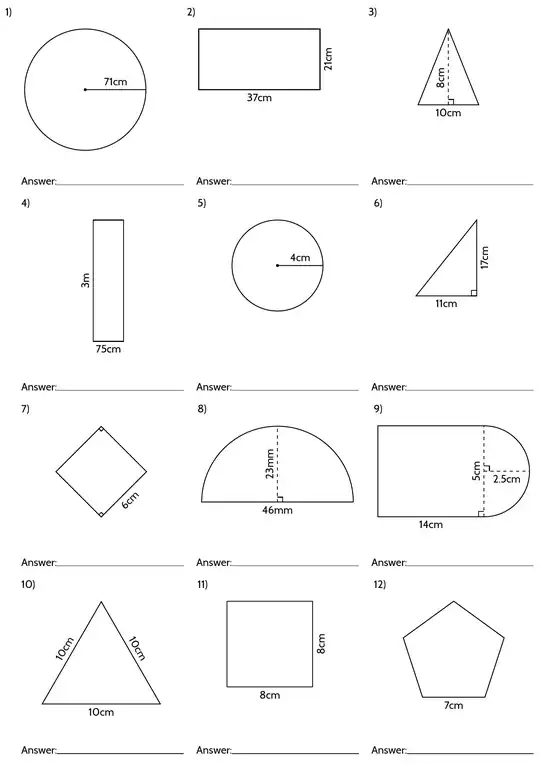
Here is something to get you started. The configuration assumes that each row of the worksheet will include 3 questions. However, you can easily adapt it if necessary.
As far as the figures are concerned, the only one which seems worth making a little more automatic is the circle because that always follows the same structure. In other cases, the labels etc. vary and, since the shapes are simple, you might just as soon draw them as you wish.
tikzqn is an environment which will automatically number the questions and insert answer spaces.
\documentclass[a4paper]{article}
\usepackage[scale=.85]{geometry}
\usepackage{tikz}
\usetikzlibrary{shapes.geometric}
\newcounter{tikzqn}
\newcounter{tikzrow}
\newenvironment{tikzqn}%
{%
  \stepcounter{tikzqn}%
  \stepcounter{tikzrow}%
  \begin{minipage}[t]{.3\textwidth}
    \sffamily\thetikzqn)\par\centering
    \begin{tikzpicture}[baseline=(current bounding box.north), font=\sffamily, thick]
}{%
    \end{tikzpicture}
    \bigskip\vfill\par
  \end{minipage}\hfill
  \ifnum\value{tikzrow}=3\setcounter{tikzrow}{0}%
  \bigskip\par
  \foreach \i in {1,2,3}
  {\begin{minipage}{.3\textwidth}
    \sffamily Answer:\hrulefill\bigskip\par
  \end{minipage}\hfill}%
\fi}
\pagestyle{empty}
\usepackage{cabin}
\begin{document}
\tikzset{
  pics/my circle/.style 2 args={
    code={
      \draw circle (#1);
      \draw [fill] (0,0) circle (1pt) -- (#1,0) node [midway, above] {#2};
    }
  },
}
\noindent
\begin{tikzqn}
   \pic {my circle={20mm}{71cm}};
\end{tikzqn}
\begin{tikzqn}
  \draw (0,0) -- ++(40mm,0) node [midway, below] {37cm} -- ++(0,20mm) node [midway, right, anchor=north, sloped] {21cm} -| cycle;
\end{tikzqn}
\begin{tikzqn}
  \draw (0,0) coordinate (a) -- ++(20mm,0) node [midway, below] {10cm} -- ++(-10mm,25mm) coordinate (c) -- cycle;
  \draw [dashed] (a -| c) -- (c) node [pos=.35, right, anchor=south, sloped] {8cm};
  \draw (a -| c) ++ (0,5pt) -| ++(5pt,-5pt);
\end{tikzqn}

\begin{tikzqn}
  \draw (0,0) -- ++(0,40mm) node [midway, right, anchor=south, sloped] {3m} -| ++(10mm,-40mm) -- cycle node [midway, below, anchor=north] {75cm};
\end{tikzqn}
\begin{tikzqn}
  \pic {my circle={15mm}{4cm}};
\end{tikzqn}
\begin{tikzqn}
  \draw (0,0) -| ++(20mm,25mm) coordinate [midway] (b) coordinate (c) -- cycle;
  \path (0,0) -- (b) node [midway, below, anchor=north] {11cm} -- (c) node [midway, right, anchor=north, sloped] {17cm};
  \draw (b) rectangle ++(-5pt,5pt);
\end{tikzqn}

\begin{tikzqn}
  \node (dia) [draw, shape=diamond, minimum size=30mm] {};
  \node [rotate=45, anchor=north] at (dia.south east)  {6cm};
  \draw (dia.north) ++(-2.5pt,-2.5pt) -- ++(2.5pt,-2.5pt) -- ++(2.5pt,2.5pt);
  \draw (dia.south) ++(-2.5pt,2.5pt) -- ++(2.5pt,2.5pt) -- ++(2.5pt,-2.5pt);
\end{tikzqn}
\begin{tikzqn}
  \node (sc) [draw, shape=semicircle, minimum size=25mm, label=below:46mm] {};
  \draw [dashed] (sc.south) -- (sc.north) node [midway, left, anchor=south, sloped] {23mm};
  \draw (sc.south) ++(5pt,0) |- ++(-5pt,5pt);
\end{tikzqn}
\begin{tikzqn}
  \draw (0,0) -- ++(35mm,0) coordinate (a) node [midway, below, anchor=north] {14cm} arc (-90:90:15mm) coordinate (b) -| cycle;
  \draw [dashed] (a -| b) -- (b) node [midway, right, anchor=south, sloped] {5cm};
  \draw [dashed] ([yshift=15mm]a) coordinate (c) -- ++(15mm,0) node [midway, below, anchor=north] {2.5cm};
  \draw (a) ++(-5pt,0) |- ++(5pt,5pt) (c) ++(5pt,0) |- ++(-5pt,5pt);
\end{tikzqn}

\begin{tikzqn}
  \node (tri) [draw, regular polygon, regular polygon sides=3, label=-90:10cm, minimum size=45mm] {};
  \path (tri.corner 2) -- (tri.corner 1) node [midway, left, anchor=south, sloped] {10cm};
  \path (tri.corner 3) -- (tri.corner 1) node [midway, left, anchor=south, sloped] {10cm};
\end{tikzqn}
\begin{tikzqn}
  \node (sq) [draw, regular polygon, regular polygon sides=4, label=-90:8cm, minimum size=40mm] {};
  \path (sq.south east) -- (sq.north east) node [midway, right, sloped, anchor=north] {8cm};
\end{tikzqn}
\begin{tikzqn}
  \node [draw, regular polygon, regular polygon sides=5, label=-90:7cm, minimum size=35mm] {};
\end{tikzqn}

\end{document}
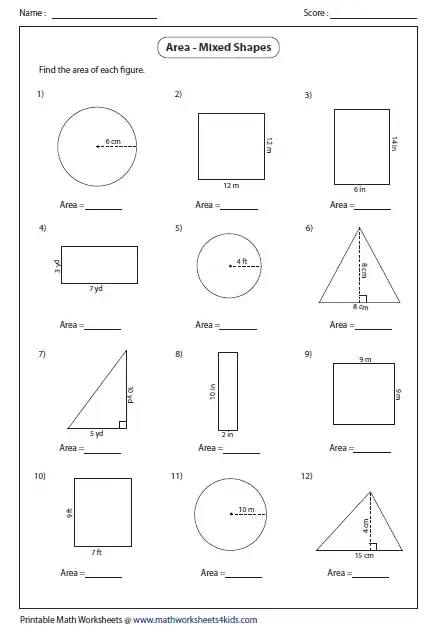


shapes.greometriclibrary; the measuring is a little more manual. In any case, I think you should rephrase your question and give more exact details. Welcome to the site, anyways! – Manuel Jul 10 '15 at 18:53