3

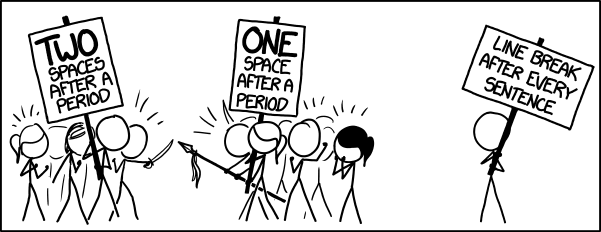
Athough discussion on that question is still going on (even if third ways exists), it seems that larger spaces after the end of a sentence is preferable in English. By default, LaTeX puts wider spaces after a period (full stop).

I took the habit of escaping spaces (i.e., writing i.e.\, or to make it more clear, i.e.\␣) after

  • Latin locutions, as

    • etc.
    • cf.
  • Mathematical expressions, as

    • s.t. (such that)
    • w.r.t. (with respect to)
    • resp. (respectively)

However, according to this post, which quotes Chapter 14 of the Texbook, and according to any bbl file, spaces after names initial should not be escaped. That is, one write

Donald~E. Knuth

and not

Donald~E.\ Knuth

I'm confused: shouldn't that space be escaped as well?

Clément
  • 5,591
  • 6
    There is no way that a wider space should appear after an abbreviated middle initial. I can't imagine it being proper in any sense. – Steven B. Segletes Nov 10 '15 at 16:14
  • 1
    @StevenB.Segletes True but the normal advice for bibliographies is based on the fact they (almost) always set \frenchspacing so the issue 'goes away'. – Joseph Wright Nov 10 '15 at 16:15
  • 1
    @JosephWright That I can believe. 1) That there should not be a wider gap, but 2) that the space should not be escaped in a bibliography (because the bibliography style takes care of it). – Steven B. Segletes Nov 10 '15 at 16:17
  • So, in my acknowledgments, I should write that I am eternally grateful to D.~E.\ Knuth, is that correct? – Clément Nov 10 '15 at 16:21
  • 4
    Related http://tex.stackexchange.com/q/134840/36686 – Bordaigorl Nov 10 '15 at 16:25
  • 4
    Am I missing something (this is from the Not So Short Intro.): If a period follows an uppercase letter, this is not taken as a sentence ending, since periods after uppercase letters normally occur in abbreviations. – jak123 Nov 10 '15 at 16:26
  • 3
    @jak123 This does not cover all the cases. For instance, in French, if your name is Christophe, then you abbreviate it as Ch., and not as C.. But thanks for your remark, which solve partially my problem. – Clément Nov 10 '15 at 16:30
  • 1
    BTW, you should use cf. not c.f. since it is an abbreviation of a single word "confer". See https://en.wikipedia.org/wiki/Cf. – Augustin Nov 10 '15 at 16:40
  • 4
    +1 for citing the cartoon. the comment by @jak123 covers the situation where the abbreviation is just a single (uppercase) initial. where a different abbreviation style ("Ch." for "Christophe") is applied, then a "slash-space" should be used; this is probably a good idea even if \frenchspacing is used for a bibliography (as it often is), to accommodate such things as author-year citations, which take the string in question out of its original context. – barbara beeton Nov 10 '15 at 17:04
  • 1
    the proper way is not etc.\ etc.\ but etc.\@ etc.\@ (if I recall correctly) –  Nov 10 '15 at 17:06
  • @jfbu : only if you use it in macros, cf. http://tex.stackexchange.com/a/116530/34551 and http://tex.stackexchange.com/a/15017/34551 – Clément Nov 10 '15 at 17:12
  • 1
    @Clément: still, \@ is the preferable way (as it shows in the source its intent). –  Nov 10 '15 at 17:15

0 Answers0