Question
I have these glossary entries:
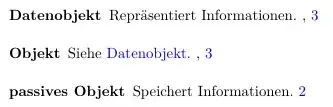
I just created the document and it is empty except for test text and a few definitions. The glossary is on page 3. As you can see, there is a comma before the page numbers linking to where the entries have been referred to for Datenobjekt and Objekt. You can also see that Objekt refers to Datenobjekt.
On my search for a solution, I came across this question. \glsaddallunused already is at the end of the document and when I created test text referring to passives Objekt (which isn't referred to by a different glossary entry), no comma appeared before the page number. So it seems to be caused by referring to a glossary entry in a glossary entry and calling \glsaddallunused in the document.
How can the commas be removed?
Example Document
I cut my document down content-wise as much as possible without breaking any reference dependencies and removed all other command definitions.
\documentclass[a4paper,11pt]{report}
\usepackage[T1]{fontenc}
\usepackage[utf8]{inputenc}
\usepackage[german]{babel}
\usepackage[a4paper, total={6in, 10in}]{geometry}
\usepackage{booktabs}
\usepackage[colorlinks]{hyperref}
\usepackage[acronym,toc]{glossaries}

\title{UTF-8's Example Document}
\author{UTF-8}

\hypersetup{
    colorlinks,
    citecolor=black,
    filecolor=black,
    linkcolor=blue,
    urlcolor=black,
    pdftitle={\@title},
    pdfauthor={\@author},
    bookmarks=true
}

\newcommand{\glsquotation}[1]{
    \paragraph{\gls{#1}:} \glsdesc*{#1}.
}


\makeglossaries

\newglossaryentry{Objekt}
{
    name=Objekt,
    plural=Objekte,
    description={Siehe \gls{Datenobjekt}},
}

\newglossaryentry{Datenobjekt}
{
    name=Datenobjekt,
    plural=Datenobjekte,
    description={Repräsentiert Informationen},
}

\newglossaryentry{Subjekt}
{
    name=Subjekt,
    plural=Subjekte,
    description={Benutzer eines Systems oder Objekt, das im Auftrag von Benutzern im System aktiv sein kann (z.B. Prozess, Server, Prozedur)},
}

\newglossaryentry{Autorisierung}
{
    name=Autorisierung,
    plural=Autorisierungen,
    description={Besitzt ein \gls{Subjekt} die Berechtigung, auf ein \gls{Objekt} zuzugreifen, so nennt man das Subjekt für diesen Datenzugriff autorisiert},
}

\newglossaryentry{Authentizitaet}
{
    name=Authentizität,
    plural=Authentizitäten,
    description={Echtheit und Glaubwürdigkeit eines \glslink{Objekt}{Objekts} bzw. \glslink{Subjekt}{Subjekts}, die anhand seiner Identität und seiner charakteristischen Eigenschaften überprüfbar ist},
}

\newglossaryentry{vertraulich}
{
    name=vertraulich,
    description={System ermöglicht keine \glslink{Autorisierung}{unautorisierte} Informationsgewinnung},
}

\newglossaryentry{integer}
{
    name=integer,
    description={Subjekten ist es nicht möglich, Daten \glslink{Autorisierung}{unautorisiert} und unbemerkt zu manipulieren},
}

\newglossaryentry{verfuegbar}
{
    name=verfügbar,
    description={Authentifizierte und \glslink{Autorisierung}{autorisierte} \glspl{Subjekt} werden in der Wahrnehmung ihrer Berechtigungen nicht \glslink{Autorisierung}{unautorisiert} beeinträchtigt},
}

\begin{document}
\maketitle
\tableofcontents

\chapter{Chapter}
\section{Section}
\glsquotation{Authentizitaet}\\

Das klassische Schutzziel-Trio besteht aus Vertraulichkeit, Integrität, und Verfügbarkeit:

\glsquotation{vertraulich}
\glsquotation{integer}
\glsquotation{verfuegbar}


\glsaddallunused
\printglossaries

\end{document}
I wrote this script to build it (but you obviously can't use the cleaning option without the cleaning script):
# Builds the document specified by 'documentname'.
# Call with option '-c' or '--clean' to clean the top-levl directory before building.

#!/bin/bash

# CONFIGURATION
documentname="ENTER WHAT YOU CALLED THE FILE HERE (WITHOUT FILE EXTENSION)"
# END OF CONFUGURATION

if [ $1 == "-c" ] || [ $1 == "--clean" ]; then
    ./clean.sh
fi


pdflatex "$documentname.tex"
makeglossaries "$documentname"
pdflatex "$documentname.tex"
pdflatex "$documentname.tex"
makeindex -s "$documentname.ist" -o "$documentname.gls" "$documentname.glo"
pdflatex "$documentname.tex"
echo finished
sleep 2


\documentclassand ending with\end{document}that illustrates your problem. Without this information, it is hard/impossible to analyze the problem. – gernot Oct 29 '16 at 21:18