One way to get the symbol you want is to take a look at how mathtools creates any of those arrows.
For example, \xRightarrow is defined as
\providecommand*\xRightarrow[2][]{%
  \ext@arrow 0055{\Rightarrowfill@}{#1}{#2}}
amsmath defines \Rightarrowfill@ to produce a \cleaders with overlapping boxes.
Since we want space between them rather than overlapping, this approach doesn't quite work. Instead, we can modify the definition to use \xleaders and some positive space.
Here's a small suite of dashed, extensible arrows.
\usepackage{amsmath}
\usepackage{mathtools}

\makeatletter
\def\dasharrowfill@#1#2#3#4{%
        $\m@th
        \thickmuskip0mu
        \medmuskip\thickmuskip
        \thinmuskip\thickmuskip
        \relax
        #4#1\mkern2mu
        \xleaders\hbox{$#4\mkern2mu#2\mkern2mu$}\hfill
        \mkern2mu
        #3$%
}

\def\dashleftarrowfill@{\dasharrowfill@\leftarrow\relbar\relbar}
\def\dashrightarrowfill@{\dasharrowfill@\relbar\relbar\rightarrow}
\def\dashleftrightarrowfill@{\dasharrowfill@\leftarrow\relbar\rightarrow}
\def\dashLeftarrowfill@{\dasharrowfill@\Leftarrow\Relbar\Relbar}
\def\dashRightarrowfill@{\dasharrowfill@\Relbar\Relbar\Rightarrow}
\def\dashLeftrightarrowfill@{\dasharrowfill@\Leftarrow\Relbar\Rightarrow}

\providecommand*\xdashleftarrow[2][]{%
  \ext@arrow 0055{\dashleftarrowfill@}{#1}{#2}}
\providecommand*\xdashrightarrow[2][]{%
  \ext@arrow 0055{\dashrightarrowfill@}{#1}{#2}}
\providecommand*\xdashleftrightarrow[2][]{%
  \ext@arrow 0055{\dashleftrightarrowfill@}{#1}{#2}}
\providecommand*\xdashLeftarrow[2][]{%
  \ext@arrow 0055{\dashLeftarrowfill@}{#1}{#2}}
\providecommand*\xdashRightarrow[2][]{%
  \ext@arrow 0055{\dashRightarrowfill@}{#1}{#2}}
\providecommand*\xdashLeftrightarrow[2][]{%
  \ext@arrow 0055{\dashLeftrightarrowfill@}{#1}{#2}}
\makeatother
You can use them as normal. E.g., \xdashRightarrow[subscript]{superscript}.
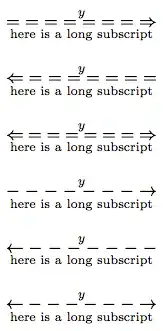
The major downside to using \xleaders is the space between the boxes that make up the arrows will be spread evenly between them. Thus the dashing is inconsistent.

One solution would be to constrain the subscripts and superscripts to have an integral number of boxes necessary to make up the \xleaders, potentially by producing a modification of \ext@arrow.



\documentclassand ending with\end{document}. – Bobyandbob Jun 13 '17 at 15:58