Delimiters come in discrete sizes, so, when the material between them exceeds a certain threshold, the next size is employed. It's not that \tilde and \bar do not change the height, it's rather that the threshold is not exceeded.
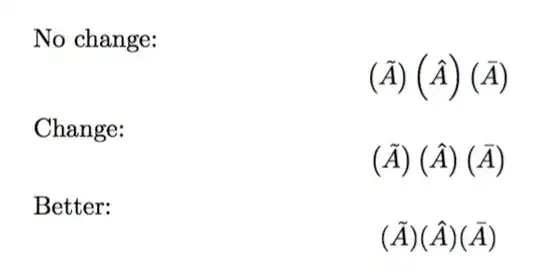
In your examples, \big size is chosen with \tilde and \bar, but \Big size turns up with \hat.
In most cases, \left and \right are not needed and in general fences are not required to cover the entire vertical extension of the material between them. Look at the output of the following example, where also a \rhat (reduced hat) is defined (but not recommended).
\documentclass{article}
\usepackage{amsmath}
\usepackage{lmodern}

\newcommand{\shat}[1]{%
  \smash{\hat{#1}}%
  \vphantom{\bar{#1}}%
}

\begin{document}

No change:
\[
\left( \tilde{A} \right)
\left( \hat{A} \right)
\left( \bar{A} \right)
\]

Change:
\[
\left( \tilde{A} \right)
\left( \shat{A} \right)
\left( \bar{A} \right)
\]

Better:
\[
(\tilde{A})
(\hat{A})
(\bar{A})
\]

\end{document}
In my opinion, the last example is the one to be followed.
Note: $$ should never be used in LaTeX, see Why is \[ ... \] preferable to $$ ... $$?


\bigland the like. – Skillmon Aug 31 '17 at 08:21\tildeand\bardo not change the height, it's rather that the threshold is not exceeded. In most cases,\leftand\rightare not needed and in general fences are not required to cover the entire vertical extension of the material between them. – egreg Aug 31 '17 at 08:41