What about inserting one extra column between c and d?
\documentclass{article}
\usepackage{tikz}
\usepackage{tikz-cd}
\begin{document}
$$\begin{tikzcd}[column sep=small]
 a \arrow[dash]{dr} \arrow[dash]{dd} \arrow[dash]{drrr} & & \\
             & c \arrow[dash]{rr} & & d  \\
 b \arrow[dash]{ur} \arrow[dash]{urrr}&&
 \end{tikzcd}$$
\end{document}
However, this is not an equilateral triangle, nor c is at the true center. For this case I would prefer to use a tikzpicture:
\begin{tikzpicture}
    \node (c) {$c$};
    \foreach \angle/\name in {0/d,120/a,240/b}
      \node (\name) at (\angle:1) {$\name$};
    \draw (a) -- (d) -- (b) -- (a);
    \foreach \name in {a,b,d} \draw (c) -- (\name);
\end{tikzpicture}
Compare the three versions:
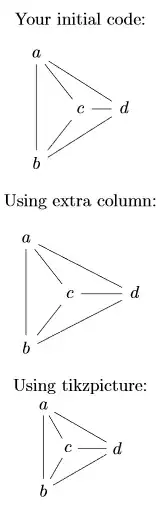
If (a) and (b) are not required to be vertically aligned, I would prefer to make horizontal the edge (b)--(d), which gives a better optical impression of (c) being at center:

This can be easily achieved by changing the angles in the tikzpicture version:
\begin{tikzpicture}
    \node (c) {$c$};
    \foreach \angle/\name in {-30/d,90/a,210/b}
      \node (\name) at (\angle:1) {$\name$};
    \draw (a) -- (d) -- (b) -- (a);
    \foreach \name in {a,b,d} \draw (c) -- (\name);
\end{tikzpicture}


\documentclassand ending with\end{document}. – Bobyandbob Nov 03 '17 at 10:00$$ .. $$for displayed math in LaTeX, see Why is\[ … \]preferable to$$?. Use\[ ... \]instead. – Torbjørn T. Nov 03 '17 at 12:41