In the following I will use note instead of source (since source is not known in the default data model it will not be passed on to the .bbl file - I assume you have a custom .dbx set up).
Use \setunit{\addspace} instead of literal space
You only need a \setunit{\addspace} between the two \print... commands to get things working
%\RequirePackage{filecontents}
\begin{filecontents}{\jobname.bib}
@image{MyImg,
    author = {{Addison-Wesley}},
    note = {\cite{Rossing1990}},
}

@image{MyImg2,
    author = {{Addison-Wesley}},
    note = {\cite[45]{Rossing1990}},
}

@book{Rossing1990,
    author = {Thomas D. Rossing},
    date = {1990},
}
\end{filecontents}

\documentclass{article}

\usepackage[style=authoryear-comp]{biblatex}
\addbibresource{\jobname.bib}

\DeclareCiteCommand{\mycite}{}{%
  \printfield{note}%
  \setunit{\addspace}%
  \printnames[given-family]{author}%
}{}{}

\begin{document}

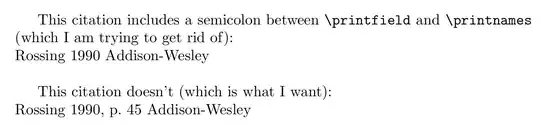
This citation includes a semicolon between \verb|\printfield| and \verb|\printnames| (which I am trying to get rid of):\\
\mycite{MyImg}\\

This citation doesn't (which is what I want):\\
\mycite{MyImg2}\\
\end{document}
Why does \setunit help?
The punctuation tracker
biblatex has a special approach to punctuation between fields or in general \print... commands. Punctuation should not be inserted directly, instead it s stored in a buffer and printed out only on demand. This asynchronous approach to punctuation vis-à-vis text makes it easy to avoid unwanted double punctuation.
You can read all about the punctuation tracker in §4.11.7 Using the Punctuation Tracker of the biblatex manual, the short version is as follows:
Whenever punctuation is desired, that punctuation is not inserted directly, it is wrapped in \setunit (the often used \newunit is equivalent to \setunit{\newunitpunct} with \newunitpunct defaulting to \addperiod\space). A typical snippet would be (from volume+number+eid in standard.bbx)
\printfield{volume}%
\setunit*{\adddot}%
\printfield{number}%
\setunit{\addcomma\space}%
\printfield{eid}
When \setunit is encountered (we'll come to the starred version \setunit* in a second), biblatex stores its argument in the punctuation buffer, the command itself prints nothing. The punctuation buffer can be overwritten by subsequent \setunits and so \setunit{X}\setunit{Y} leaves only Y in the buffer. The buffer is printed and emptied at the next \print... command that actually prints anything.
Suppose that in our example above, the entry has a volume and an eid field, but no number field. When the snippet is processed the volume will be printed, \setunit* inserts \adddot into the punctuation buffer. There is no number, so \printfield{number} does nothing. \setunit{\addcomma\space} sends \addcomma\space to the buffer and replaces its earlier value \adddot. Then \printfield{eid} prints the eid, but before that the punctuation buffer is printed and emptied. This results in
<volume>, <eid>
If a number had been present, we would have ended up with
<volume>.<number>, <eid>
The starred version \setunit* checks if the \print... command immediately preceding it printed something. If that is the case it behaves like \setunit, if not it discards it argument and does nothing. So in the example a difference would be visible if there was a number but no volume. Suppose that before the snippet above \printtext{Blah}\setunit{\addcomma\space} had inserted \addcomma\space into the punctuation buffer. With volume we would get
Blah, <volume>.<number>, <eid>
But if there is no volume and \setunit were used, the \adddot would overwrite the \addcomma\space to give
Blah.<number>, <eid>
With \setunit* nothing happens to the punctuation buffer if volume is missing and so we get
Blah, <number>, <eid>
because \addcomma\space remains in the buffer even after \printfield{volume} that did nothing and \setunit*{\adddot}.
Punctuation in authoryear-comp's \cite
The cite macros of authoryear-comp can be simplified to the following scheme (have a look at \DeclareCiteCommand{\cite} and \newbibmacro{cite} in authoryear-comp.cbx)
Loopcode
<Lots of `\print...` commands>
\setunit{\multicitedelim}
postcode
\iffieldundef{postnote}
  {}
  {\setunit{\postnotedelim}%
   \printfield{postnote}}
The loopcode is executed once for every entry you cite (so \cite{sigfridsson,nussbaum} would go through the loopcode once for sigfridsson and then for nussbaum), the postcode is executed at the end after the loop.
If you \cite something without a postnote the \cite command leaves a \multicitedelim in the punctuation buffer even after it is finished. This is because the last line of the loopcode is \setunit{\multicitedelim} and the postcode is effectively skipped if postnote is empty. Normally this is not a problem, since \cite is usually called in a context where the punctuation tracker does not control its surroundings as well - normally \cite is not followed by a \print... command - and so the buffer remains set, but is not printed. The next \cite (or any high-level biblatex command for that matter) clears the buffer before it does its work, so there is no harm in leaving the buffer non-empty after you are done. In your application, however, there is a \printfield after the \cite and so that \printfield sees the non-empty punctuation buffer and inserts it before it prints its contents.
If you have a postnote, then after the loopcode has done its thing and left \multicitedelim in the punctuation buffer, we enter the loopcode, take the second branch and are met with \setunit{\postnotedelim}. So \multicitedelim in the buffer is replaced with \postnotedelim, then \printfield{postnote} prints and empties the punctuation buffer and finally prints the postnote. Note that after this chain of events the punctuation buffer is empty. The \printfield that comes after the \cite has no punctuation to insert and simply prints its text.
Note that this situation came about specifically because of the implementation details of authoryear-comp's citation macros. This would not have happened with authoryear's citation commands. authoryear does not end its loopcode with \setunit{\multicitedelim}, the \multicitedelim is inserted with the sepcode argument to \DeclareCiteCommand. This can't be done for authoryear-comp and so there the (generally) stylistically questionable \setunit{\multictedelim} at the end of the loopcode had to be used.
Conclusion
Punctuation and spaces should always be handled by the punctuation tracker with \setunit. Never insert spaces or punctuation directly between \print... commands.
I should add that if at all possible \cite should be avoided in .bib entries and the bibliography. For some applications the related function might be a better fit, but I assume in other cases a work-around is not readily available and needs some thought.
What you are doing here in effect nests citation commands. Usually biblatex actively discourages nested citation commands (anyone who has tried \cite[\cite{nussbaum}]{sigfridsson} knows that), because they could lead to confusion for biblatex's many tracking features (after \cite[\cite{nussbaum}]{sigfridsson} what should "ibid." refer to? - and even if we decide that it would be sensible to mean sigfridsson that would be hard to enforce since nussbaum is actually processed last and biblatex's trackers have to be global, so no amount of grouping can help us). This might be less of an issue for this highly specialised citation command that is only used in a controlled environment, but it could definitely lead to confusion and unexpected behaviour in normal cite commands.


biblatexprovides. Do you know them? – gusbrs Jun 05 '18 at 23:14relatedfacilities would be sufficient to implement this. Essentially I am (mis)using biblatex as a database for my figures. – Florian H. Jun 05 '18 at 23:21\newcommand{\mycaption}[3][]{\cite[#1]{#2} #3}to be then used as\mycaption[45]{Rossing1990}{Addison-Wesley}? – gusbrs Jun 05 '18 at 23:43\newcommand{\MyImg2}{\cite[45]{Rossing1990} Addison-Wesley}, to be used simply as\MyImg2. – gusbrs Jun 05 '18 at 23:58\DeclareCiteCommand. – Florian H. Jun 06 '18 at 00:22