As mentioned by @AxelSommerfeldt, the default document classes evaluates the \caption{<stuff>} twice in the case when <stuff> is wider than a single line. Here's where the decision is made - \caption is originally defined in latex.ltx, which subsequently calls \@makecaption; taken from article.cls:
\long\def\@makecaption#1#2{%
  \vskip\abovecaptionskip
  \sbox\@tempboxa{#1: #2}%
  \ifdim \wd\@tempboxa >\hsize
    #1: #2\par
  \else
    \global \@minipagefalse
    \hb@xt@\hsize{\hfil\box\@tempboxa\hfil}%
  \fi
  \vskip\belowcaptionskip}
It first stores the entire caption (say, Figure 1: <stuff>) inside a box:
\sbox\@tempboxa{#1: #2}%
In your case, this evaluates \footnotemark. Then it tests to see whether the width of the box is wider than \hsize (the width of the text block). If this is true, it sets the caption again which evaluates \footnotemark for the second time:
\ifdim \wd\@tempboxa >\hsize
  #1: #2\par
If the box width is less than \hsize, it centres it in another box of width \hsize:
\else
  \global \@minipagefalse
  \hb@xt@\hsize{\hfil\box\@tempboxa\hfil}%
\fi
The latter part motives the dual evaluation - the possibility to either set the caption as a paragraph block, or as a single, centred line. It's both a feature and a drawback in your particular case.
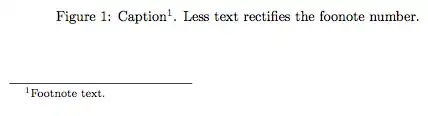
You may question that you were able to provide an example of a single caption that also yielded an incorrect \footnotemark. This is possible because the box-storing command
\sbox\@tempboxa{#1: #2}
is set without regard for \hsize (the text block width). This implies that no stretching/shrinking occurs between words. If you add the geometry option showframe to your example, you'll note that the caption fits exactly within the text block because of the inter-word glue that can shrink. However, setting the same in a box that doesn't require any glue usage shows that it is actually wider than \hsize:

\documentclass{article}
\usepackage[hmargin=1.9in,vmargin=5in,showframe]{geometry}% http://ctan.org/pkg/geometry
\begin{document}
\begin{figure}
\makebox[\hsize][l]{Figure 1: Caption\textsuperscript{2}. Some more text added here changes the footnote number.}
\caption[Caption for LOF]{Caption\footnotemark. Some more text added here changes the footnote number.}\par
\label{fig:temp}
\end{figure}
\footnotetext{Footnote text.}
\end{document}
How do you avoid this? You can either load the caption package that redefines \caption appropriately (preferred), or set the \footnotemark in a box that doesn't re-expand (or re-evaluate) when the caption is set twice:
\sbox0{\footnotemark}% Store \footnotemark
\caption[Caption for LOF]{Caption\usebox0. Some more text added here changes the footnote number.}
Although this works, it removes any hyperref capability.



\caption(like mycaptionpackage) offers a different behaviour. – Feb 08 '12 at 06:07captionpackage, which indeed resolved the issue. I had suspected that the change in the footnote number was related to the number of lines in the caption, but I have been able to reproduce the errant numbering with a single-line caption, as you will see in my edited post. How can this be explained? Perhaps a new line was inserted since the caption text occupies nearly the entire first line? Lastly, could you speculate on why evaluating the caption text twice if it exceeds a single line would be a useful feature? – user001 Feb 08 '12 at 07:13\sloppy.) Regarding your 2nd question: It's just a side-effect of the implementation, I don't think this behaviour was intended. – Feb 08 '12 at 07:39