Well, it's almost automatic. ;-)
\documentclass{article}
\usepackage{amsmath}
\usepackage{graphicx}

\makeatletter
\newcommand{\rsum}{\DOTSB\rsum@\slimits@}
\newcommand{\rsum@}{\mathop{\mathpalette\rsum@@\relax}}
\newcommand{\rsum@@}[2]{\reflectbox{$\m@th#1\sum@$}}
\makeatother

\begin{document}

\[
\sum_{i=1}^n\rsum_{i=1}^n
\qquad
\textstyle
\sum_{i=1}^n\rsum_{i=1}^n
\]

\end{document}

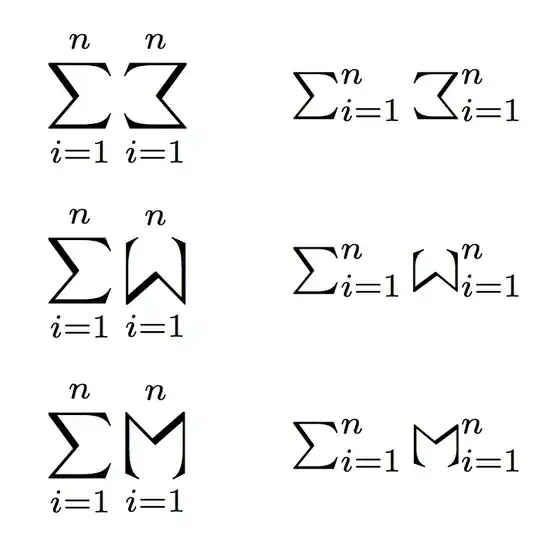
The main idea is to reflect the symbol in the appropriate math style; some bells and whistles for amsmath have been added.
Should you need also rotated versions, here they are:
\documentclass{article}
\usepackage{amsmath}
\usepackage{graphicx}

\makeatletter
\newcommand{\rsum}{\DOTSB\rsum@\slimits@}
\newcommand{\rsum@}{\mathop{\mathpalette\rsum@@\relax}}
\newcommand{\rsum@@}[2]{\reflectbox{$\m@th#1\sum@$}}

\newcommand{\usum}{\DOTSB\usum@\slimits@}
\newcommand{\usum@}{\mathop{\mathpalette\udsum@@{90}}}
\newcommand{\dsum}{\DOTSB\dsum@\slimits@}
\newcommand{\dsum@}{\mathop{\mathpalette\udsum@@{-90}}}
\newcommand{\udsum@@}[2]{%
  \vcenter{%
    \sbox\z@{$\m@th#1\sum@$}%
    \hbox to \wd\z@{%
      \hss
      \resizebox{\ifx\displaystyle#1\else0.9\fi\wd\z@}{\dimexpr\ht\z@}{%
        \rotatebox[origin=c]{#2}{$\m@th#1\sum@$}%
      }%
      \hss
    }%
  }%
}
\makeatother

\begin{document}

\[
\sum_{i=1}^n\rsum_{i=1}^n
\qquad
\textstyle
\sum_{i=1}^n\rsum_{i=1}^n
\]

\[
\sum_{i=1}^n\usum_{i=1}^n
\qquad
\textstyle
\sum_{i=1}^n\usum_{i=1}^n
\]

\[
\sum_{i=1}^n\dsum_{i=1}^n
\qquad
\textstyle
\sum_{i=1}^n\dsum_{i=1}^n
\]

\end{document}


rversion\rotatebox{180}instead of\reflectboxbecause of the width of different lines? And similar, in theuanddversions, may be those should be a rotation of a reflectbox (or a reflectbox of your rotation)? – Manuel Oct 18 '18 at 23:02