\scalerel is a fragile command. Either you define \antishriek with \DeclareRobustCommand
\DeclareRobustCommand{\antishriek}{\scalerel*{$¡$}{!}}
or use \protect when in a moving argument (sectional titles or captions)
\subsection{\texorpdfstring{$a^{\protect\antishriek}$}{TEXT}}
Maybe you're interested in a different definition for \antishriek:
\documentclass{article}
\usepackage[utf8]{inputenc}
\usepackage[T1]{fontenc}
\usepackage[nochapters]{classicthesis}
\usepackage{amsmath}

\DeclareMathSymbol{\antishriek}{\mathord}{operators}{'74}

\begin{document}

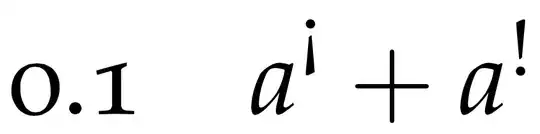
\subsection{\texorpdfstring{$a^{\antishriek}+a^{!}$}{TEXT}}

\end{document}

If you want the reverse exclamation mark to be raised at the same level as the exclamation mark, you can do as follows
\documentclass{article}
\usepackage[utf8]{inputenc}
\usepackage[T1]{fontenc}
\usepackage[nochapters]{classicthesis}
\usepackage{amsmath}

\DeclareMathSymbol{\antishrieksymbol}{\mathord}{operators}{'74}

\makeatletter
\DeclareRobustCommand{\antishriek}{{\mathpalette\anti@shriek\relax}}
\newcommand\anti@shriek[2]{%
  \raisebox{\depth}{$\m@th#1\antishrieksymbol$}%
}
\makeatother


\begin{document}

\subsection{\texorpdfstring{$a^{\antishriek}+a^{!}$}{TEXT}}

\end{document}