Just for fun: if you were to consider plain TikZ, then the answer is that you can determine the ordering yourself with the sort by key. The plain TikZ version of your scenario is
\documentclass[tikz,border=3.14mm]{standalone}
\usetikzlibrary{through,intersections}
\begin{document}
\begin{tikzpicture}
\path (2,0) coordinate (A) (-2,0) coordinate (B)  (0,1)
coordinate (C) (0,0) coordinate (O);
\node[draw,name path=circ] (Circ) at (O) [circle through={(C)}]{};
\draw[name path=line] (A) -- (B);
\draw[thick,blue,->,name intersections={of=circ and line,sort by=circ}] (intersection-1) -- (intersection-2);
\end{tikzpicture}
\end{document}
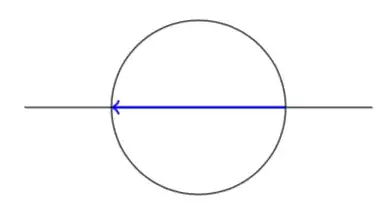
The arrow is drawn from the first intersection to the second one. This is because the intersections are ordered according to the circle, and the circle path starts at 0 degrees and runs to 360. Thus, if you rotate the line
\documentclass[tikz,border=3.14mm]{standalone}
\usetikzlibrary{through,intersections}
\begin{document}
\begin{tikzpicture}
\path (-45:2) coordinate (A) (135:2) coordinate (B)  (0,1)
coordinate (C) (0,0) coordinate (O);
\node[draw,name path=circ] (Circ) at (O) [circle through={(C)}]{};
\draw[name path=line] (A) -- (B);
\draw[thick,blue,->,name intersections={of=circ and line,sort by=circ}] (intersection-1) -- (intersection-2);
\end{tikzpicture}
\end{document}
you'll get

However, if you sort along a straight line, the results can be unexpected, but you can cure this.


sort bykey that comes with theintersectionslibrary. – Apr 30 '19 at 04:46\documentclasscommand, have a minimal preamble and then\begin{document}...\end{document}. The code should compile and be as small as possible to demonstrate your problem. – Apr 30 '19 at 04:54