How to draw a circled transistor in circuitikz?

I did not find any info about circled transistors in circuitikzmanual.pdf.
How to draw a circled transistor in circuitikz?
I did not find any info about circled transistors in circuitikzmanual.pdf.
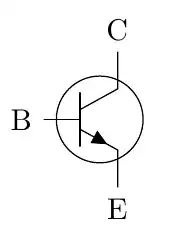
Since circuitikz is built upon TikZ, you can use \draw to draw a circle:
\documentclass{article}
\usepackage{circuitikz}

\begin{document}

\begin{circuitikz}
\draw (0,0) node[npn] (npn) {}
(npn.base) node[anchor=east] {B}
(npn.collector) node[anchor=south] {C}
(npn.emitter) node[anchor=north] {E};
\draw ($(npn)-(0.18,0)$) circle [radius=18pt];
\end{circuitikz}

\end{document}

As it is noted in the comments, in the original solution the circle was wrong centered; Kroll suggested using the barycentre of the triangle with vertices in the base, the collector and the emitter, but this also produces the wrong result, as can be seen in the example below (which uses barycentric coordinates to easily obtain the coordinates for the center; the calculations are done automatically using a \CalcC command whose argument is the name used for the transistor):
\documentclass{article}
\usepackage{circuitikz}

\def\CalcC#1{%
\coordinate (base) at (#1.base);
\coordinate (collector) at (#1.collector);
\coordinate (emitter) at (#1.emitter);
\draw (barycentric cs:base=0.5,collector=0.5,emitter=0.5) circle [radius=14pt];
}

\begin{document}

\begin{circuitikz}
\draw (0,0) node[npn] (name) {}
(name.base) node[anchor=east] {B}
(name.collector) node[anchor=south] {C}
(name.emitter) node[anchor=north] {E};
\CalcC{name}
\end{circuitikz}

\end{document}

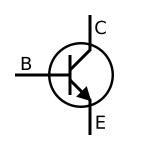
A little horizontal shift (obtained with a variation of the barycentric coordinate associated to the base anchor), produces a much better result:
\documentclass{article}
\usepackage{circuitikz}

\def\CalcC#1{%
\coordinate (base) at (#1.B);
\coordinate (collector) at (#1.C);
\coordinate (emitter) at (#1.E);
\draw (barycentric cs:base=0.32,collector=0.5,emitter=0.5) circle [radius=14pt];
}

\begin{document}

\begin{circuitikz}
\draw (0,0) node[npn] (name) {}
(name.base) node[anchor=east] {B}
(name.collector) node[anchor=south] {C}
(name.emitter) node[anchor=north] {E};
\CalcC{name}
\end{circuitikz}

\end{document}


\CalcCto place the center automatically in the desired position. Of course, the ultimate solution would be to ask the author ofcircuitikzto define this kind of transistor. – Gonzalo Medina Apr 19 '12 at 01:04