The example only needs a few changes to compile: remove the unnecessary definition of the amharic environment, which polyglossia defined for you when you enabled the Amharic language. Then uncomment the definition of \amharicfont.
However, the results you get with the default settings will be terrible, because LaTeX does not recognize the Ethiopic word separator as a word-breaking character. Even if you fix that, the line-breaking algorithm and hyphenation patterns are completely unsuited for Amharic, and you will get incredibly ugly results.
So, fair warning, this is a hack I came up with based on these guidelines, despite not knowing any Amharic. I apologize for any errors, and I’d appreciate a native speaker improving this code.
The first part of the trick was to insert a space after all Ethiopic punctuation, and the rest was to set the spacing of the Ethiopic font to be tiny, but extremely stretchy. I also loaded microtype, which, on LuaLaTeX at least, will enable font expansion and should cut down on the amount of hyphenation and extra inter-word spacing Amharic needs. Finally, I turned on \sloppypar to make the inter-word spacing more flexible. If you intend to use it, you probably want to define a new environment that automatically turns \sloppypar on inside a group.
\documentclass[12pt]{article}
\usepackage{polyglossia}
\usepackage{microtype, newunicodechar}
\usepackage[sf, bf, big]{titlesec}

\defaultfontfeatures{Scale=MatchUppercase}
\setmainfont{Abyssinica SIL}[Scale=1]
\setsansfont{Libertinus Sans}

\setmainlanguage{english}
\setotherlanguage{amharic}

% The default hyphenation patterns for Ethiopic script in both polyglossia and
% babel do not properly treat ፡  as a word separator, so the sample you gave
% never hyphenates or line breaks.  Based on the guidelines in
% https://www.w3.org/TR/elreq/#ethiopic_hyphenation this inserts spaces after
% all Ethiopic punctuation.  It then makes the interword space tiny, but very
% stretchy.
\newunicodechar{፡}{፡\ }
\newunicodechar{።}{\@{።} }
\newunicodechar{፣}{፣ }
\newunicodechar{፤}{፤ }
\newunicodechar{፥}{፥ }
\newunicodechar{፦}{፦ }
\newunicodechar{፧}{\@{፧} }
\newunicodechar{፨}{\@{፨} }
\newunicodechar{፠}{\@{፠} }

\newfontfamily{\amharicfont}{Abyssinica SIL}[
  Script=Ethiopic,
  Ligatures=Common,
  WordSpace = {0.1,30.0,1.0}]

\begin{document}

\section*{Sample in Amharic}

This is english text.

\begin{amharic}\begin{sloppypar}
በዩኔስኮ፡ተዘጋጅቶ፡በኢትዮጵያ፡ብሄራዊ፡ኮሚሽን፡ተተረጎመ

የሰው፡ልጅ፡ሁሉ፡ሲወለድ፡ነጻና፡በክብርና፡በመብትም፡እኩልነት፡ያለው፡ነው።፡የተፈጥሮ፡ማስተዋልና፡ሕሊና፡ስላለው፡አንዱ፡ሌላውን፡በወንድማማችነት፡መንፈስ፡መመልከት፡ይገባዋል።

እያንዳንዱ፡ሰው፡የዘር፡የቀለም፡የጾታ፡የቋንቋ፡የሃይማኖት፡የፖለቲካ፡ወይም፡የሌላ፡ዓይነት፡አስተሳሰብ፡የብሔራዊ፡ወይም፡የኀብረተሰብ፡ታሪክ፡የሀብት፡የትውልድ፡ወይም፡የሌላ፡ደረጃ፡ልዩነት፡ሳይኖሩ፡በዚሁ፡ውሳኔ፡የተዘረዘሩት፡መብቶችንና፡ነጻነቶች፡ሁሉ፡እንዲከበሩለት፡ይገባል።

ከዚህም፡በተቀረ፡አንድ፡ሰው፡ከሚኖርበት፡አገር፡ወይም፡ግዛት፡የፖለቲካ፡የአገዛዝ፡ወይም፡የኢንተርናሽናል፡አቋም፡የተነሳ፡አገሩ፡ነጻም፡ሆነ፡በሞግዚትነት፡አስተዳደር፡ወይም፡እራሱን፡ችሎ፡የማይተዳደር፡አገር፡ተወላጅ፡ቢሆንም፡በማንኛውም፡ዓይነት፡ገደብ፡ያለው፡አገዛዝ፡ሥር፡ቢሆንም፡ልዩነት፡አይፈጸምበትም።

እያንዳንዱ፡ሰው፡የመኖር፣፡በነጻነትና፡በሰላም፡የመኖሩ፡መጠበቅ፡መብት፡አለው።
\end{sloppypar}\end{amharic}

\end{document}
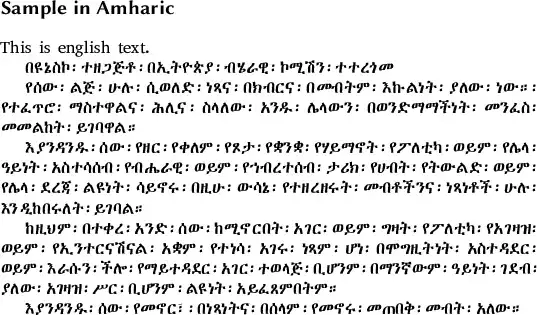
If you’d rather have ragged-right paragraphs and not insert any extra spacing, you can tell TeX that it’s allowed to break lines at the end of words by inserting \linebreak[1] or \hspace{0} instead of spaces. Or you could turn down the stretchiness (the second number after WordSpace=) to have more hyphenation and fewer lines ending with the same punctuation.
The text should be an excerpt from the UN Declaration on Human Rights, not that I’d know it from the Generations of Adam. I also took the liberty of redefining the section-header style, since Abysinnica SIL does not come in bold.


