Edit2:
The small wrapper made its way to CTAN. So the below code with an up to date LaTeX distribution is now just:
\documentclass{article}
\usepackage{pgfplots}
\usepackage{pgfmath-xfp}
\pgfmxfpdeclarefunction{lognormal}{3}
  {exp(-((ln(#1) - #2)^2) / (2 * (#3)^2)) / (#1 * #3 * sqrt(2 * pi))}
\begin{document}

\begin{tikzpicture}
\begin{axis}[ domain=0.01:10, samples=100 ]
  \addplot {lognormal(x,ln(5),0.02)};
\end{axis}
\end{tikzpicture}
\end{document}
Edit:
I've created a small wrapper to define pgfmath-functions using l3fp first posted here. With it the MWE here boils down to the following (the things between \ExplSyntaxOn and \ExplSyntaxOff is the wrapper):
\documentclass{article}
\usepackage{pgfplots}
\ExplSyntaxOn
\tl_new:N \l_pgffpeval_function_body_tl
\tl_new:N \l_pgffpeval_function_definition_tl
\int_new:N \l_pgffpeval_tmp_int
\cs_new_protected:Npn \pgffpeval_declare_function:nnn #1#2#3
  {
    __pgffpeval_initialize_body:
    \int_step_inline:nn {#2}
      {
        \tl_put_right:Nx \l_pgffpeval_function_body_tl
          {
            \exp_not:n { \pgfmathsetmacro } \exp_not:c { __pgffpeval_arg##1 }
              { \exp_not:n {####} ##1 }
          }
      }
    __pgffpeval_define_function:nnnn {#2} {#1} {#2} {#3}
  }
\cs_new_protected:Npn \pgffpeval_declare_function_processed_args:nnnn #1#2#3#4
  {
    __pgffpeval_initialize_body:
    \int_zero:N \l_pgffpeval_tmp_int
    \clist_map_inline:nn {#3}
      {
        \int_incr:N \l_pgffpeval_tmp_int
        \tl_put_right:Nx \l_pgffpeval_function_body_tl
          {
            \exp_not:n { \pgfmathsetmacro }
              \exp_not:c { __pgffpeval_arg \int_use:N \l_pgffpeval_tmp_int }
              { \exp_not:n {##1} }
          }
      }
    \exp_args:NV
    __pgffpeval_define_function:nnnn \l_pgffpeval_tmp_int {#1} {#2} {#4}
  }
\cs_new_protected:Npn __pgffpeval_initialize_body:
  {
    \tl_set:Nn \l_pgffpeval_function_body_tl
      {
        \group_begin:
        \pgfkeys{/pgf/fpu=true, /pgf/fpu/output~format=sci}%
      }
  }
\cs_new:Npn __pgffpeval_process_function_aux:n #1 { \exp_not:n {## #1} }
\cs_new_protected:Npn __pgffpeval_process_function:nnn #1#2#3
  {
    \exp_last_unbraced:Nx
    \cs_set_protected:cpn
      {
        { __pgffpeval_function_ #2 cmd }
        \int_step_function:nN {#1} __pgffpeval_process_function_aux:n
      }
      { \group_end: \exp_args:Nf \pgfmathparse { \fp_eval:n {#3} } }
  }
\cs_new_protected:Npn __pgffpeval_define_function:nnnn #1#2#3#4
  {
    __pgffpeval_process_function:nnn {#1} {#2} {#4}
    \tl_put_right:Nx \l_pgffpeval_function_body_tl
      {
        \use:x
          {
            \exp_not:c { __pgffpeval_function #2 _cmd }
            \int_step_function:nN {#1} __pgffpeval_define_function_aux:n
          }
      }
    \exp_args:Nnno
    \pgfmathdeclarefunction {#2} {#3} \l_pgffpeval_function_body_tl
  }
\cs_new:Npn __pgffpeval_define_function_aux:n #1
  { { \exp_not:c { __pgffpeval_arg#1 } } }
\NewDocumentCommand \pgfmathdeclarefpevalfunction { m m o m }
  {
    \IfValueTF {#3}
      { \pgffpeval_declare_function_processed_args:nnnn {#1} {#2} {#3} }
      { \pgffpeval_declare_function:nnn {#1} {#2} }
      {#4}
  }
\ExplSyntaxOff
\pgfmathdeclarefpevalfunction{lognormal}{3}
  {exp(-((ln(#1) - #2)^2) / (2 * (#3)^2)) / (#1 * #3 * sqrt(2 * pi))}
\begin{document}

\begin{tikzpicture}
\begin{axis}[ domain=0.01:10, samples=100 ]
  \addplot {lognormal(x,ln(5),0.02)};
\end{axis}
\end{tikzpicture}
\end{document}
Output and explanation like below.
The following uses xfp for the actual calculation, and \pgfmathsetmacro with the options /pgf/fpu=true and /pgf/fpu/output format=sci applied locally to ensure the input number format is understandable for xfp (as pgfmath uses a custom internal number representation when the FPU is used, which isn't understood by xfp).
The \romannumeral is used to ensure that \fpeval is fully done when the group is closed and therefore \argA, \argB, and \argC don't have the correct meaning anymore. The result is then again parsed by \pgfmathparse to make sure that \pgfmathresult holds the correct format for pgf outside of the function.
\documentclass{article}
\usepackage{pgfplots}
\usepackage[]{xfp}
\begin{document}

\pgfmathdeclarefunction{lognormal}{3}{%
  \begingroup
    \pgfkeys{/pgf/fpu=true, /pgf/fpu/output format=sci}%
    \pgfmathsetmacro\argA{#1}%
    \pgfmathsetmacro\argB{#2}%
    \pgfmathsetmacro\argC{#3}%
    \expandafter
  \endgroup
  \expandafter\pgfmathparse\expandafter
    {%
      \romannumeral`^^@%
      \fpeval{exp(-((ln(\argA)-\argB)^2)/(2\argC^2))/(\argA\argCsqrt(2pi))}%
    }%
}
\begin{tikzpicture}
\begin{axis}[ domain=0.01:10, samples=100 ]
  \addplot {lognormal(x,ln(5),0.02)};
\end{axis}
\end{tikzpicture}
\end{document}
Is it fast? No. Does it work? Yes:
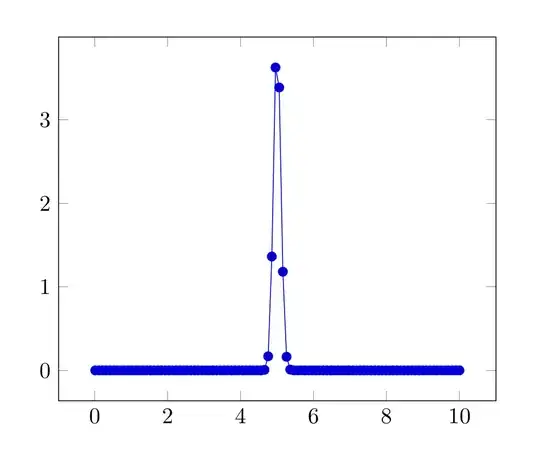


lognormal(x,ln(5),0.02)but it is fast forlognormal(x,ln(5),0.2), as if larger values made the computation slower. If fpu is used, where is exactly the bottleneck? – scriptfoo Feb 26 '21 at 14:47pgfmath's FPU andl3fp. – Skillmon Feb 26 '21 at 16:15l3fp(the thing behindxfp) is only marginally affected by the bigger value. An entire sweep with 100 values from0.01to10takes about 2.6% more time in the calculation for the smaller value, whereas a single assignment using\pgfmathsetmacro\tmp{<num>}takes 13.6% more time for the smaller value. So the choke ispgfmath's number parsing. – Skillmon Feb 26 '21 at 16:38