If your question is related with your last reference, with a first part starting in the page before the last, and a second part fragmented into two columns, in the last page of the document, you should reformulate the question to make it more clear.
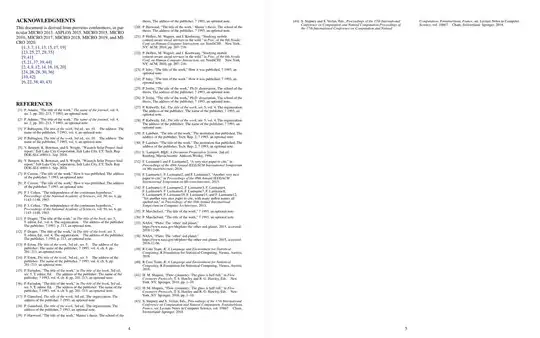
I was able to simulate the undesirable behavior you showed: part of my last reference (#44) going to the next page and the remaining lines spread over two columns. I didn't like it either.

The simplest solution I found was tho add some vertical space before the REFERENCES section.
In my case \vspace*{2\baselineskip} to push the complete reference #44 to the next page.
This is the time when the author applies some manual touch-ups before delivering the final document.
In your case, I think it will be to try to save some vertical space, perhaps by rewriting a few paragraphs or shortening a figure, so that all the references end up on the last page.

As a guide this is the last part of the modified main.tex delivered with the class as example. I collected more references from two sources to fill the two columns.
 %%%%%%% -- PAPER CONTENT ENDS -- %%%%%%%%
\vspace*{2\baselineskip} % <<<<<<<<<<< added
%%%%%%%%% -- BIB STYLE AND FILE -- %%%%%%%%
\bibliographystyle{IEEEtranS}
\bibliography{refsx}
%%%%%%%%%%%%%%%%%%%%%%%%%%%%%%%%%%%%
\end{document}
The sig-alternate.cls class has been designed to produce a "tighter"
document in response to page budget concerns.
As a consequence, the last paragraph of the document will always have two balanced columns.


\usepackage[keeplastbox]{flushend}inmain.tex? – Mico Dec 13 '22 at 06:32