If you do, from a terminal, latexdef -c amsart lim, you obtain
\lim:
macro:->\qopname \relax m{lim}
You cannot go the way you do, because TeX expands macros and, with your definitions, you get successively
\lim
\li\limits
\lim\limits
\li\limits\limits
\lim\limits\limits
...
so you see that an infinite loop is created that soon fills TeX's memory (the input stack, as the error message says).
You might do
\documentclass[oneside,10pt]{amsart}
\usepackage[T1]{fontenc}
\usepackage[utf8]{inputenc}
\usepackage[english]{babel}
\usepackage{amsmath}
\usepackage{amsthm}
\usepackage{amssymb}
\usepackage{mathtools}
\usepackage{mathrsfs}
\NewCommandCopy{\originallim}{\lim}
\renewcommand{\lim}{\originallim\limits}
If you have an older TeX system (Overleaf is a candidate to not support \NewCommandCopy yet), you can replace the line
\NewCommandCopy{\originallim}{\lim}
with
\let\originallim\lim
because the initial latexdef tells us that this is safe.
However, you don't really want this. Let me show an example
\documentclass[oneside,10pt]{amsart}
\usepackage{lipsum}
\NewCommandCopy{\originallim}{\lim}
\renewcommand{\lim}{\originallim\limits}
\begin{document}
\lipsum[1][1-2]
$\lim_{x\to0}x^2=0$
\lipsum[2][1-3]
$\lim_{x\to0}x^2=0$
\lipsum[3][1-3]
$\lim_{x\to0}x^2=0$
\lipsum[4][1-3]
\end{document}
You get the output

that you should compare to what you'd get without the redefinition
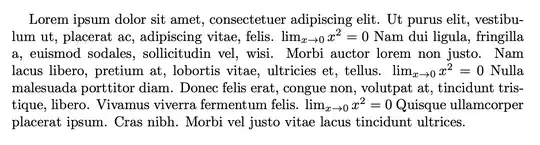
I have no doubt on which one is better (the latter, of course). But the choice is yours.


\limexpands to\li\limitswhich expands to\lim\limits, which gives\li\limits\limitsand so on. And you don't want to apply\limitsindiscriminately, trust me. – egreg Jul 21 '21 at 16:30