6

With all due respect, can anyone help me please: all dotted letters (used for Arabic-Latin transliteration purposes) enter image description heredisappear in footnotes and references. Thank you in advance.

\documentclass[a4paper]{article}

\usepackage[T1]{fontenc} \usepackage[utf8]{inputenc} \usepackage{lmodern}

\usepackage[english]{babel} \usepackage{csquotes}

\usepackage[backend=biber,autolang=other,bibencoding=inputenc,footmarkoff]{biblatex-chicago} \usepackage[bottom]{footmisc} \bibliography{sample}

\begin{document} \title{Letters with a Dot Below Disappear from Footnotes and References} \author{} \date{} \maketitle

\section{Introduction}

The book entitled \textit{al-Jāmi’ li A\d{h}kām al-Qur’ān} is the work of Mu\d{h}ammad bin A\d{h}mad al-An\d{s}ārī al-Qur\d{t}ubī.\autocite{al-qurtubiAlJamiLiAhkam2003}\ The book entitled \textit{al-Tawshī\d{h} Shar\d{h} al-Jāmi’ al-\d{S}a\d{h}ī\d{h}} is the work of Jalāl al-Dīn al-Suyu\d{t}ī. \autocite{al-suyutiAlTawshihSharhAlJami1998a}\ The book entitled \textit{Asbāb al-Nuzūl wa bi Hāmisih al-Nāsikh wa al-Mansūkh} is the work of ‘Alī bin A\d{h}mad al-Wā\d{h}idī.\autocite{al-wahidiAsbabAlNuzulWa2000}

\printbibliography

\end{document}

@book{al-qurtubiAlJamiLiAhkam2003, title = {al-{{J=ami}}' li {{A\d{h}k=am}} al-{{Qur}}'=an}, author = {al-An{\d s}{=a}r{=i} {al-Qur{\d t}ub{=i}}, Mu{\d h}ammad bin A{\d h}mad}, year = {2003}, volume = {18}, publisher = {{D=ar \=Alam al-Kutub}}, address = {{al-Riy\=a\d{d}}} } @book{al-suyutiAlTawshihSharhAlJami1998a, title = {al-{{Tawshi\d{h} Shar\d{h}}} al-{{J\=ami}}' al-{{\d{S}a\d{h}\=i\d{h}}}}, author = {al-D{\=i}n {al-Suy{\=u}{\d t}{\=i}}, Jal{\=a}l}, editor = {Ri{\d d}w{\=a}n, Ri{\d d}w{\=a}n J{\=a}mi'}, year = {1998}, publisher = {{Maktabat al-Rushd}}, address = {{al-Riy\=a\d{d}}} } @book{al-wahidiAsbabAlNuzulWa2000, title = {Asb\=ab Al-{{Nuz\=ul}} wa bi {{H\=amisih}} al-{{N\=asikh}} wa al-{{Mans\=ukh}}}, author = {{al-W{\=a}{\d h}id{\=i}},Al{=i} bin A{\d h}mad}, editor = {al-L{=a}h Ibn Sal{=a}mah, Hibat}, year = {2000}, publisher = {{`=Alam al-Kutub}}, address = {{Bayr=ut}} }

Mico
  • 506,678

2 Answers2

11

If your document contains many Unicode characters like this, Mico's suggestion to go for a Unicode engine like LuaLaTeX or XeLaTeX is definitely a good one. But even with pdfLaTeX we can make this example work.


When compiled with pdfLaTeX and a current version of the LaTeX kernel (I use LaTeX2e <2021-06-01> patch level 1), your example produces only one type of error, namely

! Package inputenc Error: Unicode character Ṣ (U+1E62)
(inputenc)                not set up for use with LaTeX.

That is to say, LaTeX does not know how to deal with .

The reason for that is that LaTeX only sets up a limited range of Unicode characters that it can actually produce. With the standard font settings (and most contributed font packages) you will for example not be able to produce CJK characters, so these are not covered. Most bits of Latin-based characters are supported out of the box, but the occasional combination can be missing (cf. e.g. https://github.com/latex3/latex2e/issues/484, which added support for and , but not ).

For this can be fixed easily along the lines of inputenc Error: Unicode char \u8: not set up for use with LaTeX with a definition that tells LaTeX that is an S with a dot below, i.e. \d{S}

\DeclareUnicodeCharacter{1E62}{\d{S}}

With older kernels other letters like might also be unknown. The solution is the same in each case: Provide a suitable replacement definition.

Thus

\documentclass[a4paper]{article}
\usepackage[T1]{fontenc}
\usepackage[utf8]{inputenc}
\usepackage{lmodern}
\usepackage[english]{babel}
\usepackage{csquotes}
\usepackage[backend=biber]{biblatex-chicago}

\DeclareUnicodeCharacter{1E62}{\d{S}} \DeclareUnicodeCharacter{1E63}{\d{s}}

\begin{filecontents}{\jobname.bib} @book{al-qurtubiAlJamiLiAhkam2003, title = {al-J{=a}mi' li A{\d h}k{=a}m al-Qur'{=a}n}, author = {al-An\d s=ar=i al-Qur{\d t}ub{=i}, Mu{\d h}ammad bin A{\d h}mad}, year = {2003}, volume = {18}, publisher = {D{=a}r {\=A}lam al-Kutub}, address = {al-Riy{\=a}{\d d}}, } @book{al-suyutiAlTawshihSharhAlJami1998a, title = {al-Tawshi{\d h} Shar{\d h} al-J{\=a}mi' al-{\d S}a{\d h}{\=i}{\d h}}, author = {al-D{\=i}n al-Suy{\=u}{\d t}{\=i}, Jal{\=a}l}, editor = {Ri{\d d}w{\=a}n, Ri{\d d}w{\=a}n J{\=a}mi'}, year = {1998}, publisher = {{Maktabat al-Rushd}}, address = {al-Riy{\=a}{\d d}}, } @book{al-wahidiAsbabAlNuzulWa2000, title = {Asb\=ab Al-Nuz{\=ul} wa bi H{\=a}misih al-N{\=a}sikh wa al-Mans{\=u}kh}, author = {al-W{\=a}{\d h}id{\=i},Al{=i} bin A{\d h}mad}, editor = {al-L{=a}h Ibn Sal{=a}mah, Hibat}, year = {2000}, publisher = {`{=A}lam al-Kutub}, address = {Bayr{=u}t}, } \end{filecontents} \addbibresource{\jobname.bib}

\begin{document}

The book entitled \emph{al-Jāmi’ li A\d{h}kām al-Qur’ān} is the work of Mu\d{h}ammad bin A\d{h}mad al-An\d{s}ārī al-Qur\d{t}ubī.% \autocite{al-qurtubiAlJamiLiAhkam2003}

The book entitled \emph{al-Tawshī\d{h} Shar\d{h} al-Jāmi’ al-\d{S}a\d{h}ī\d{h}} is the work of Jalāl al-Dīn al-Suyu\d{t}ī.% \autocite{al-suyutiAlTawshihSharhAlJami1998a}

The book entitled \emph{Asbāb al-Nuzūl wa bi Hāmisih al-Nāsikh wa al-Mansūkh} is the work of ‘Alī bin A\d{h}mad al-Wā\d{h}idī.% \autocite{al-wahidiAsbabAlNuzulWa2000}

\printbibliography \end{document}

produces
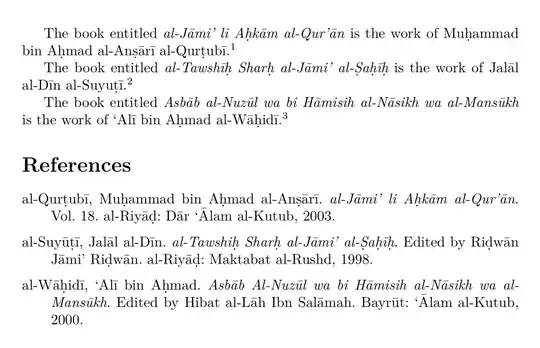
al-Qurṭubī, Muḥammad bin Aḥmad al-Anṣārī. al-Jāmi’ li Aḥkām al-Qur’ān. Vol. 18. al-Riyāḍ: Dār ‘Ālam al-Kutub, 2003.
al-Suyūṭī, Jalāl al-Dīn. al-Tawshiḥ Sharḥ al-Jāmi’ al-Ṣaḥīḥ. Edited by Riḍwān Jāmi’ Riḍwān. al-Riyāḍ: Maktabat al-Rushd, 1998.
al-Wāḥidī, ‘Alī bin Aḥmad. Asbāb Al-Nuzūl wa bi Hāmisih al-Nāsikh wa al-Mansūkh. Edited by Hibat al-Lāh Ibn Salāmah. Bayrūt: ‘Ālam al-Kutub, 2000.

as desired.


But why do I need to declare (to be equal to \d S), when I only ever use \d S myself?

That has to do with how Biber operates. In order to be able to sort your entries properly, Biber needs to convert macro-escapes like \"a and \d S into their respective Unicode meaning (ä and ). Since the conversion has already taken place, Biber then passes on this Unicode-ified string to biblatex. So even though you have

title = {al-J{\=a}mi' li A{\d h}k{\=a}m al-Qur'{\=a}n},
title = {al-Tawshi{\d h} Shar{\d h} al-J{\=a}mi' al-{\d S}a{\d h}{\=i}{\d h}},

in your .bib file, LaTeX gets to see

\field{title}{al-Jāmi' li Aḥkām al-Qur'ān}
\field{title}{al-Tawshiḥ Sharḥ al-Jāmi' al-Ṣaḥīḥ}

Which then goes wrong because of the .

You can use the option safeinputenc (as in \usepackage[backend=biber, safeinputenc]{biblatex-chicago}) to tell Biber not to output Unicode, but to re-encode things into LaTeX macros. Then the two titles above come out as

\field{title}{al-J\={a}mi' li A\d{h}k\={a}m al-Qur'\={a}n}
\field{title}{al-Tawshi\d{h} Shar\d{h} al-J\={a}mi' al-\d{S}a\d{h}\={\i}\d{h}}

which compiles fine just as it did when you wrote these macro escapes into the .tex file directly.

moewe
  • 175,683
3

I would like to recommend that you switch from pdfLaTeX to either XeLaTeX or LuaLaTeX. Making the switch is very simple -- see the code adjustments below -- and results in the letter \d{S} no longer causing a problem.

I've highlighted all dot-under characters in the References section of the following screenshot.

enter image description here

% !TEX TS-program = lualatex
\documentclass[a4paper]{article}
\begin{filecontents}[overwrite]{mybib.bib}
@book{al-qurtubiAlJamiLiAhkam2003,
  title = {al-{{J\=ami}}' li {{A\d{h}k\=am}} al-{{Qur}}'\=an},
  author = {al-An{\d s}{\=a}r{\=i} {al-Qur{\d t}ub{\=i}}, Mu{\d h}ammad bin A{\d h}mad},
  year = {2003},
  volume = {18},
  publisher = {{D\=ar `\=Alam al-Kutub}},
  address = {{al-Riy\=a\d{d}}}
}
@book{al-suyutiAlTawshihSharhAlJami1998a,
  title = {al-{{Tawshi\d{h} Shar\d{h}}} al-{{J\=ami}}' al-{{\d{S}a\d{h}\=i\d{h}}}},
  author = {al-D{\=i}n {al-Suy{\=u}{\d t}{\=i}}, Jal{\=a}l},
  editor = {Ri{\d d}w{\=a}n, Ri{\d d}w{\=a}n J{\=a}mi'},
  year = {1998},
  publisher = {{Maktabat al-Rushd}},
  address = {{al-Riy\=a\d{d}}}
}
@book{al-wahidiAsbabAlNuzulWa2000,
  title = {Asb\=ab Al-{{Nuz\=ul}} wa bi {{H\=amisih}} al-{{N\=asikh}} wa al-{{Mans\=ukh}}},
  author = {{al-W{\=a}{\d h}id{\=i}}, `Al{\=i} bin A{\d h}mad},
  editor = {al-L{\=a}h Ibn Sal{\=a}mah, Hibat},
  year = {2000},
  publisher = {{`\=Alam al-Kutub}},
  address = {{Bayr\=ut}}
}
\end{filecontents}

\usepackage{iftex} \ifpdftex \usepackage[T1]{fontenc} \usepackage[utf8]{inputenc} \usepackage{lmodern} \else % either LuaLaTeX or XeLaTeX \usepackage{fontspec} \setmainfont{Latin Modern Roman} \fi

\usepackage[english]{babel} %\usepackage{csquotes}

\usepackage[backend=biber,autolang=other,bibencoding=inputenc, footmarkoff]{biblatex-chicago} \addbibresource{mybib.bib} \usepackage[bottom]{footmisc}

\setlength\textheight{10cm} % just for this example

\begin{document}

The book entitled \emph{al-Jāmi’ li A\d{h}kām al-Qur’ān} is the work of Mu\d{h}ammad bin A\d{h}mad al-An\d{s}ārī al-Qur\d{t}ubī.\autocite{al-qurtubiAlJamiLiAhkam2003}

The book entitled \emph{al-Tawshī\d{h} Shar\d{h} al-Jāmi’ al-\d{S}a\d{h}ī\d{h}} is the work of Jalāl al-Dīn al-Suyu\d{t}ī. \autocite{al-suyutiAlTawshihSharhAlJami1998a}

The book entitled \emph{Asbāb al-Nuzūl wa bi Hāmisih al-Nāsikh wa al-Mansūkh} is the work of ‘Alī bin A\d{h}mad al-Wā\d{h}idī.\autocite{al-wahidiAsbabAlNuzulWa2000}

\printbibliography \end{document}

Mico
  • 506,678