As far as I understand how the development took place, there was first e-TeX that was written using change files for the standard tex.web. The new primitives were added in the main code, not as extensions such as \special (which was written by Knuth as an extension in order to provide an example), because this would make it too difficult to interact with the rest of the program.
However, the “change file” strategy became too heavy for pdftex, so a whole new .web source was written that contains the original tex.web and also the changes by e-TeX.
You can find pdftex.web in the repository for TeX Live at https://tug.org/svn/texlive/trunk/Build/source/texk/web2c/pdftexdir/pdftex.web?revision=63056&view=co
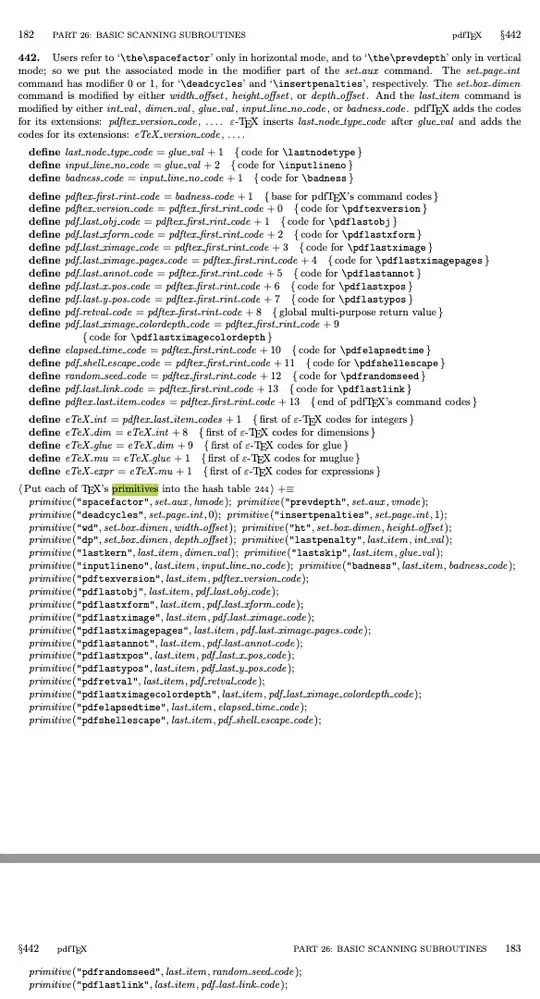
It can be weaved and compiled normally. As an example, here is module 442 that shows some new primitives alongside original ones.
Compilation of pdftex requires C, because it needs to be linked to standard C libraries, but nowadays every implementation of TeX and friends is compiled with web2c that proved to be very reliable in the last thirty years.


\expandedone, this is not e-tex. – user202729 Jun 11 '22 at 10:31pdftex.weband read it after weaving: https://tug.org/svn/texlive/trunk/Build/source/texk/web2c/pdftexdir/pdftex.web?revision=63056&view=co – egreg Jun 11 '22 at 11:55\defor\let. – Heiko Theißen Jun 12 '22 at 06:06