Simple macros like these can be created with expkv-cs quite comfortably.
The \ekvcSplit macro sets up a command that takes one mandatory argument (hence we use a \NewDocumentCommand-defined wrapper for the optional argument), and splits it into separate arguments in the order of the defined primary keys, so that you can use #1 for the first key in the definition. Additional keys that don't correspond to arguments directly can be set up using \ekvcSecondaryKeys (which we can use to set up your flag-like keys, which will then just forward specific values to your underlying keys).
\documentclass{article}
\usepackage{expkv-cs}
\makeatletter
% grabbing argument as an optional argument
\NewDocumentCommand\VerticalStep{O{}}{\VerticalStep@{#1}}
\ekvcSplit\VerticalStep@
  {
     length = 0pt % value doesn't matter, will be set by ekvcChange
    ,sign = {} % empty for positive, else -
    ,star = {}
  }{\vspace#3{#2#1}}
\ekvcSecondaryKeys\VerticalStep@
  {
     nmeta negative = {sign=-}
    ,nmeta small = {length=1cm}
    ,nmeta standard = {length=2cm}
    ,nmeta force = {star=*}
  }
\ekvcChange\VerticalStep@{standard}
\makeatother
\begin{document}
abc
\VerticalStep
def
\VerticalStep[negative]
ghi
\VerticalStep[small,negative]
jkl
\VerticalStep[length=5cm]% arbitrary sizes also possible
mno
\end{document}
Another solution using a more traditional key=value interface as provided by expkv-def. This uses a skip-register to store the length, the standard and small keys change the length in that register, and the negative-key works as a Boolean (so can be set true or false).
\documentclass{article}
\usepackage{expkv-def}
\makeatletter
\ekvdefinekeys{VerticalStep}
  {
     skip    length   = \VerticalStep@length
    ,nmeta   standard = {length = 2cm}
    ,initial standard
    ,nmeta   small    = {length = 1cm}
    ,boolTF  negative = \VerticalStep@negative
  }
\ekvsetdef\VerticalStepSetup{VerticalStep}
\NewDocumentCommand\VerticalStep{O{}}
  {%
    \begingroup
      \VerticalStepSetup{#1}%
      \vspace{\VerticalStep@negative{-}{}\VerticalStep@length}%
    \endgroup
  }
\makeatother
\begin{document}
abc
\VerticalStep
def
\VerticalStep[negative]
ghi
\VerticalStep[small,negative]
jkl
\VerticalStep[length=5cm]% arbitrary sizes also possible
mno
\end{document}
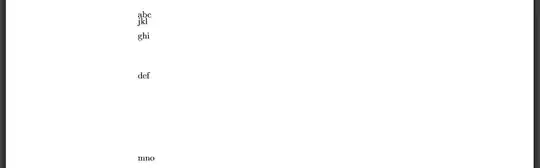
Outputs of both look identical:


define@boolkey, but examples on the site are sparse e.g. macros - How to define a key=value that has an equivalent boolean value key - TeX - LaTeX Stack Exchange. – user202729 Jul 06 '22 at 07:45keyval, you just need to give some default argument to allow omitting the value (see texdoc keyval) – user202729 Jul 06 '22 at 07:47