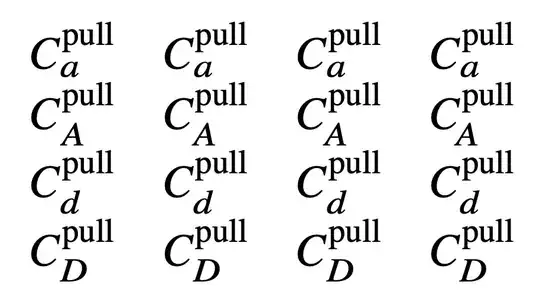
The more I look at the picture, the less I feel a need for “fixing”. Anyway, here's the experiment: I define a \fixA command that emits a negative kern. In the four columns, the kerns are zero, -1mu, -2mu and -3mu respectively, the last being the same as \!.
\documentclass{article}
\usepackage{amsmath}
\newcommand{\fixA}[1][1]{\mkern-#1mu}
\begin{document}
\spaceskip=1em
(C_{a}^{\mathrm{pull}}) (C_{a}^{\mathrm{pull}}) (C_{a}^{\mathrm{pull}}) (C_{a}^{\mathrm{pull}})
(C_{A}^{\mathrm{pull}}) (C_{\fixA A}^{\mathrm{pull}}) (C_{\fixA[2] A}^{\mathrm{pull}}) (C_{\fixA[3] A}^{\mathrm{pull}})
(C_{d}^{\mathrm{pull}}) (C_{d}^{\mathrm{pull}}) (C_{d}^{\mathrm{pull}}) (C_{d}^{\mathrm{pull}})
(C_{D}^{\mathrm{pull}}) (C_{D}^{\mathrm{pull}}) (C_{D}^{\mathrm{pull}}) (C_{D}^{\mathrm{pull}})
\end{document}

If you use IEEEtran, I recommend using newtx in order to get Times font also in math (the standard Computer Modern is really unsuited to go with Times). Now you can compare and see that using something like \fixA is better than hardwiring \!.
\documentclass{article}
\usepackage{amsmath}
\usepackage{newtx}
\newcommand{\fixA}[1][1]{\mkern-#1mu}
\begin{document}
\spaceskip=1em
(C_{a}^{\mathrm{pull}}) (C_{a}^{\mathrm{pull}}) (C_{a}^{\mathrm{pull}}) (C_{a}^{\mathrm{pull}})
(C_{A}^{\mathrm{pull}}) (C_{\fixA A}^{\mathrm{pull}}) (C_{\fixA[2] A}^{\mathrm{pull}}) (C_{\fixA[3] A}^{\mathrm{pull}})
(C_{d}^{\mathrm{pull}}) (C_{d}^{\mathrm{pull}}) (C_{d}^{\mathrm{pull}}) (C_{d}^{\mathrm{pull}})
(C_{D}^{\mathrm{pull}}) (C_{D}^{\mathrm{pull}}) (C_{D}^{\mathrm{pull}}) (C_{D}^{\mathrm{pull}})
\end{document}


Athan to capital letters in general, sinceAis the only one with stuff in its bottom left corner but not its top left corner. But I think the question still remains forA. – Teepeemm Sep 19 '22 at 20:00Das well – alper Sep 19 '22 at 20:41AandDlooks like they shifted 1 space to right compared toaord– alper Sep 22 '22 at 10:36$C_{D}^{\mathit{pull}}$\llap{$C_{d}^{\mathit{pull}}$}.Dcontains the serif at the bottom. – Sigur Sep 22 '22 at 13:44