A description of the problem by way of a minimal working example
I will describe two experiments: "control", and "treatment". I will first describe a "control" experiment, which demonstrates what I consider to be normal behavior. I will then describe a second, "treatment", experiment, which exhibits a different behavior to that observed in the first case. The behavior exhibited in the second experiment is the one I consider problematic.
1. Control
I saved the following LaTeX code in the file ~/Test.tex.
\documentclass{article}
%\usepackage[bidi=basic,hebrew,provide=*]{babel}
%\babelfont{rm}[Renderer=HarfBuzz]{FreeSerif}
\usepackage{amsmath}
\usepackage{lipsum}
\begin{document}
\lipsum[1-1][1-2]
\begin{alignat}{2}
a&=b&&+c\
d&=e&&+f\
ֿ\intertext{and}
x&=y&&+z
\end{alignat}
\lipsum[1-1][3-4]
\end{document}
I then executed the following commands in the Terminal.
> cd ~
> lualatex Test
This resulted in the file ~/Test.pdf being created. When opened in a PDF viewer, the file displayed as follows. (I screenshot only the relevant part of the display.)

Note that the equations are centered in the text area, and that the intertext is left-aligned.
2. Treatment
Repeat the first experiment but in a Hebrew document whose language is set via the babel package. In other words, in the code above uncomment the two commented-out lines, and replace the argument to the \intertext command (i.e. and) by \foreignlanguage{hebrew}{and}. The PDF output is now

Note that
- The equations are right-aligned.
- The intertext is left-aligned.
Considering that Hebrew is a right-to-left language in which mathematics is treated as embedded English (hence left-to-right) text, this output is incorrect. The correct behavior would be that the equations be centered, as in the "control" experiment, and that the word "and" be right-aligned.
Questions
- Why weren't the equations centered in the Hebrew document? How can this be corrected?
- Why wasn't the intertext right-aligned in the Hebrew document? How can this be corrected?
Remarks
No warnings were found in
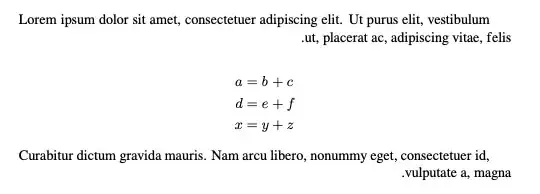
~/Test.logat the end of the Hebrew experiment.The right-alignment of the equations in the Hebrew experiment occurs even when no intertext is present. However, in this case there's a workaround: to replace the
alignat*environment by anequation*environment with an embeddedalignedatenvironment:\begin{equation*} \begin{alignedat}{2} a&=b&&+c\\ d&=e&&+f\\ x&=y&&+z \end{alignedat} \end{equation*}This produces the correct output:
However, the
\intertextcommand cannot be embedded in analignedatenvironment. But even in the absence of an\intertextcommand, I would prefer not to resort to theequation*workaround; I'd like thealignat*environment to behave as it does in an English document.I tried to center the equations with
adjustboxas follows.... \usepackage{adjustbox} ... \begin{document} ... \begin{adjustbox}{center} \begin{alignat*}{2} a&=b&&+c\\ d&=e&&+f\\ x&=y&&+z \end{alignat*} \end{adjustbox}{center} ...However, this resulted in a compilation failure, and the following message appeared in
~/Test.log.! Missing \endgroup inserted. <inserted text> \endgroup l.17 \end{alignat*}? ! Emergency stop. <inserted text> \endgroup l.17 \end{alignat*}
End of file on the terminal!
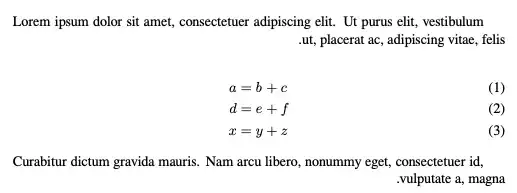
In contrast to the
alignat*environment, thealignatenvironment (without an asterisk) works properly in the absence of intertext:\begin{alignat}{2} a&=b&&+c\\ d&=e&&+f\\ x&=y&&+z \end{alignat}produces
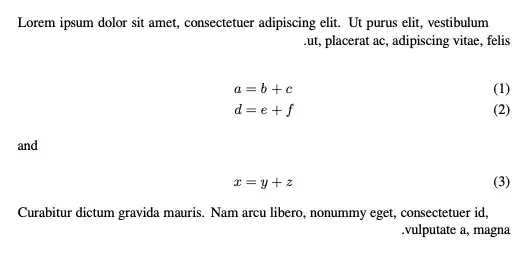
However, Hebrew intertext is still wrongly aligned:
 \begin{alignat}{2}
    a&=b&&+c\\
    d&=e&&+f\\
    \intertext{\foreignlanguage{hebrew}{and}}
    x&=y&&+z
 \end{alignat}
produces
The
align*environment behaves as it ought to. For instance the following code\begin{align*} a&=b&&+c\nonumber\\ d&=e&&+f\nonumber\\ \intertext{\foreignlanguage{hebrew}{and}} x&=y&&+z\nonumber \end{align*}produces

In contrast, the
alignenvironment right-aligns both the equations and the intertext.


alignatexample, why do the numbers go up to 4 rather than to 3? – Evan Aad Jan 14 '23 at 05:52