Showed image is part of explanation how channel coding works with using of CRC.
I have imagined, that in package \longdivision for computation of long division has build in some module for calculations with decimal numbers and that this module can be replaced with module, which perform binary calculation. It seems, that for this problem only me or few people are interested for this.
Since I'm not skilled to write a LaTeX package code, and I need to finish other part of textbook, I left my experimenting for summer or autumn, when (hopefully I will finish temporary project.
So I decide for temporary solution write long division by hand using tabularray package for writing of table:
\documentclass[border=1mm, 11pt]{standalone}
\usepackage{xcolor}
\usepackage{tabularray}
\UseTblrLibrary{amsmath}
%---------------------------------------------------------------%
\begin{document}
%%%%%%%%%%%%%%%%%%%%%%%%%%%%%%%%%%%%%%%%%%%%%%%%%%%%%%%%%%%%%%%%%
\SetTblrInner{colsep=1pt,
             rowsep=0.5pt, stretch=-1,
             cells = {font=\footnotesize},
             cell{odd[2-Z]}{18} = {l, bg=gray!10},
             cell{2-Z}{14-17} = {fg=blue},
             hline{2}={6-17}{0.5pt},
             hline{3}={5-5}{0.5pt}, vline{6}={2}{0.5pt}, vline{14}={2-Z}{dashed,0.5pt}
             }
%---------------------------------------------------------------%
\begin{tblr}{colspec={*{17}{Q[c,mode=math]} Q[r, fg=black!70, font=\tiny, mode=math, leftsep=6pt] },
             cell{odd[2-Z]}{18} = {l},
             }
    &   &   &   &   & 0 & 0 & 0 & 0 & 1 & 0 & 0 & 1 & 0 & 0 & 1 & 0 &                       \

  1 & 1 & 0 & 0 & 1 & 1 & 1 & 1 & 0 & 0 & 1 & 1 & 0 & 0 & 0 & 0 & 0 &             1<11001 \
    &   &   &   & - & 0 &   &   &   &   &   &   &   &   &   &   &   &   \gets 0{\cdot}11001 \

                        \cline{6-7}
    &   &   &   &   & 1 & 1 &   &   &   &   &   &   &   &   &   &   &       11<11001        \
    &   &   &   & - & 0 & 0 &   &   &   &   &   &   &   &   &   &   &   \gets 0{\cdot}11001 \

                        \cline{6-8}
    &   &   &   &   & 1 & 1 & 1 &   &   &   &   &   &   &   &   &   &       111<11001       \

    &   &   &   &   & - & 0 & 0 &   &   &   &   &   &   &   &   &   &   \gets 0{\cdot}11001 \
                        \cline{6-9}
    &   &   &   &   & 1 & 1 & 1 & 0 &   &   &   &   &   &   &   &   &        1110<11001     \

    &   &   &   & - & 0 & 0 & 0 & 0 &   &   &   &   &   &   &   &   &   \gets 0{\cdot}11001 \

                        \cline{6-10}
    &   &   &   &   & 1 & 1 & 1 & 0 & 0 &   &   &   &   &   &   &   &       11100>11001     \

    &   &   &   & - & 1 & 1 & 0 & 0 & 1 &   &   &   &   &   &   &   &   \gets 1{\cdot}11001 \

                        \cline{6-11}
    &   &   &   &   & 0 & 0 & 0 & 1 & 1 & 1 &   &   &   &   &   &   &        111<11001      \

    &   &   &   &   & - & 0 & 0 & 0 & 0 & 0 &   &   &   &   &   &   &   \gets 0{\cdot}11001 \

                        \cline{6-12}
    &   &   &   &   &   & 0 & 0 & 1 & 1 & 1 & 1 &   &   &   &   &   &       1110<11001      \

    &   &   &   &   &   & - & 0 & 0 & 0 & 0 & 0 &   &   &   &   &   &   \gets 0{\cdot}11001 \
                        \cline{8-13}
    &   &   &   &   &   &   & 0 & 1 & 1 & 1 & 1 & 0 &   &   &   &   &        11110>11001    \

    &   &   &   &   &   &   & - & 1 & 1 & 0 & 0 & 1 &   &   &   &   &   \gets 1{\cdot}11001 \

                        \cline[fg=red]{9-14}
    &   &   &   &   &   &   &   & 0 & 0 & 1 & 0 & 1 & 0 &   &   &   &         1010<11001    \

    &   &   &   &   &   &   &   & - & 0 & 0 & 0 & 0 & 0 &   &   &   &   \gets 0{\cdot}11001 \

                       \cline{10-15}
    &   &   &   &   &   &   &   &   &   & 1 & 0 & 1 & 0 & 0 &   &   &      10100<11001     \

    &   &   &   &   &   &   &   & - &   & 0 & 0 & 0 & 0 & 0 &   &   &   \gets 01{\cdot}11001 \

                      \cline{11-16}
    &   &   &   &   &   &   &   &   &   & 1 & 0 & 1 & 0 & 0 & 0 &   &       101000>11001    \

    &   &   &   &   &   &   &   &   &   & - & 1 & 1 & 0 & 0 & 1 &   &   \gets 1{\cdot}11001 \

                       \cline{12-17}
    &   &   &   &   &   &   &   &   &   &   & 0 & 1 & 1 & 1 & 1 & 0 &         111101>11001  \

    &   &   &   &   &   &   &   &   &   &   & - & 1 & 1 & 0 & 0 & 1 &   \gets 0{\cdot}11001 \

                        \cline{12-17}
    &   &   &   &   &   &   &   &   &   &   &   & 0 & 0 & 1 & 0 & 1 &   \text{FCS}

    \end{tblr}
%---------------------------------------------------------------%
\begin{tblr}{colspec={*{17}{Q[c,mode=math]} Q[r, fg=black!70, font=\tiny, mode=math, leftsep=6pt] },
             cell{odd[2-Z]}{18} = {l},
             }
    &   &   &   &   & 0 & 0 & 0 & 0 & 1 & 0 & 0 & 1 & 0 & 1 & 1 & 0 &                       \

  1 & 1 & 0 & 0 & 1 & 1 & 1 & 1 & 0 & 0 & 1 & 1 & 0 & 0 & 1 & 0 & 1 &             1<11001 \
    &   &   &   & - & 0 &   &   &   &   &   &   &   &   &   &   &   &   \gets 0{\cdot}11001 \

                        \cline{6-7}
    &   &   &   &   & 1 & 1 &   &   &   &   &   &   &   &   &   &   &       11<11001        \
    &   &   &   & - & 0 & 0 &   &   &   &   &   &   &   &   &   &   &   \gets 0{\cdot}11001 \

                        \cline{6-8}
    &   &   &   &   & 1 & 1 & 1 &   &   &   &   &   &   &   &   &   &       111<11001       \

    &   &   &   &   & - & 0 & 0 &   &   &   &   &   &   &   &   &   &   \gets 0{\cdot}11001 \
                        \cline{6-9}
    &   &   &   &   & 1 & 1 & 1 & 0 &   &   &   &   &   &   &   &   &        1110<11001     \

    &   &   &   & - & 0 & 0 & 0 & 0 &   &   &   &   &   &   &   &   &   \gets 0{\cdot}11001 \

                        \cline{6-10}
    &   &   &   &   & 1 & 1 & 1 & 0 & 0 &   &   &   &   &   &   &   &       11100>11001     \

    &   &   &   & - & 1 & 1 & 0 & 0 & 1 &   &   &   &   &   &   &   &   \gets 1{\cdot}11001 \

                        \cline{6-11}
    &   &   &   &   & 0 & 0 & 0 & 1 & 1 & 1 &   &   &   &   &   &   &        111<11001      \

    &   &   &   &   & - & 0 & 0 & 0 & 0 & 0 &   &   &   &   &   &   &   \gets 0{\cdot}11001 \

                        \cline{6-12}
    &   &   &   &   &   & 0 & 0 & 1 & 1 & 1 & 1 &   &   &   &   &   &       1110<11001      \

    &   &   &   &   &   & - & 0 & 0 & 0 & 0 & 0 &   &   &   &   &   &   \gets 0{\cdot}11001 \
                        \cline{8-13}
    &   &   &   &   &   &   & 0 & 1 & 1 & 1 & 1 & 0 &   &   &   &   &        11110>11001    \

    &   &   &   &   &   &   & - & 1 & 1 & 0 & 0 & 1 &   &   &   &   &   \gets 1{\cdot}11001 \

                        \cline[fg=red]{9-14}
    &   &   &   &   &   &   &   & 0 & 0 & 1 & 0 & 1 & 0 &   &   &   &         1011<11001    \

    &   &   &   &   &   &   &   & - & 0 & 0 & 0 & 0 & 0 &   &   &   &   \gets 0{\cdot}11001 \

                       \cline{10-15}
    &   &   &   &   &   &   &   &   &   & 1 & 0 & 1 & 0 & 1 &   &   &      101010<11001     \

    &   &   &   &   &   &   &   & - &   & 0 & 0 & 0 & 0 & 0 &   &   &   \gets 01{\cdot}11001 \

                      \cline{11-16}
    &   &   &   &   &   &   &   &   &   & 1 & 0 & 1 & 0 & 1 & 0 &   &       101101>11001    \

    &   &   &   &   &   &   &   &   &   & - & 1 & 1 & 0 & 0 & 1 &   &   \gets 1{\cdot}11001 \

                       \cline{12-17}
    &   &   &   &   &   &   &   &   &   &   & 1 & 0 & 1 & 0 & 0 & 1 &         111101>11001  \

    &   &   &   &   &   &   &   &   &   &   & - & 1 & 1 & 0 & 0 & 1 &   \gets 1{\cdot}11001 \

                        \cline{12-17}
    &   &   &   &   &   &   &   &   &   &   &   & 0 & 0 & 0 & 0 & 0 &   \text{ni napake}

    \end{tblr}
%%%%%%%%%%%%%%%%%%%%%%%%%%%%%%%%%%%%%%%%%%%%%%%%%%%%%%%%%%%%%%%%%
\end{document}
which gives the following result:
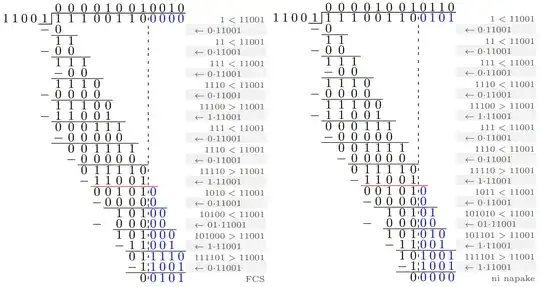
BTW, after finishing above code and compare results with showed example, I observe, that it has errors :-(.
Anyway, I hope that above code will be of help to someone.


