What are their uses and are they even standard?
Asked
Active
Viewed 2.6e+01k times


2 Answers
82
\left and \right are used for delimiters when they have to change the size dynamically depending on the content. Consider the following example:
\documentclass{article}
\usepackage{amsmath}


\begin{document}
Compare this:
 \begin{align*}
 \left(\sqrt{2}+\sqrt{3}\right)^2
            &=\left(\sqrt{2}\right)^2+2\times\sqrt{2}\times\sqrt{
                3}+\left(\sqrt{3}\right)^2\\
            &=2+2\sqrt{6}+3\\
            &=5+2\sqrt{6}
\end{align*}
with:
\begin{align*}
 (\sqrt{2}+\sqrt{3})^2
            &=(\sqrt{2})^2+2\times\sqrt{2}\times\sqrt{
                3}+(\sqrt{3})^2\\
            &=2+2\sqrt{6}+3\\
            &=5+2\sqrt{6}
\end{align*}
First one uses \verb|\left(| and \verb|\right)| and second one uses just \verb|(| and \verb|)|. I hope the difference is clear.

Just another example:
\[\left(\frac{1}{2}\right) \qquad (\frac{1}{2})\]

\end{document}

In this particular case, the (\sqrt{2}+\sqrt{3}) with \left and \right gives bit bigger parenthesis making it to look ugly (to some extent) as noted by Enrico. In such cases, proper variant of delimiters (\bigl and \bigr in this case) may be used to get the appropriate height.
For more details, refer to amsmath documentation - page 15, section 4.14 (texdoc amsldoc from command prompt). Here is a screen shot of the same:


David Carlisle
- 757,742
39
\left and \right are delimiter counterparts and TeX primitives, to be used with so-called "extensible delimiters" in math mode within the same group. This implies two things:
- If you use one, you have to use the other as well; and
- They have to be opened/closed at and within the same group level depth.
Common or typical uses include
\left\{...\right\}\left[...\right]\left(...\right)
although there is no requirement for the delimiters to be matching. For example, it is fine to use \left\}...\right(, just as long as you use both \left and \right. For example (to mimic amsmath's bmatrix environment),
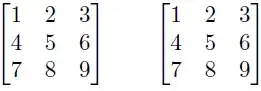
\documentclass{article}
\usepackage{amsmath}% http://ctan.org/pkg/amsmath
\begin{document}
\[
  \begin{bmatrix}
    1 & 2 & 3 \\
    4 & 5 & 6 \\
    7 & 8 & 9
  \end{bmatrix} \qquad
  \left[\begin{array}{@{}ccc@{}}
    1 & 2 & 3 \\
    4 & 5 & 6 \\
    7 & 8 & 9
  \end{array}\right]
\]
\end{document}
If you want to use only one of the two, you still need to include the counterpart, but this time with the argument .. That is, either \left. or \right., referred to as the null delimiter. TeX inserts a \nulldelimiterspace for these.
Extensible delimiters are ones that are comprised of a number of fixed and some variable-length parts. For some eye-candy, here's a visual of an extensible }:


-
you will probably not see this but how did you do the eye-candy delimiter thing? – Spirit_bird Aug 24 '21 at 10:56
-
@Spirit_bird: Look at the code:
symbol.tex. There you'll find the symbols set using\cmexcharwhere\newcommand{\cmexchar}{\usefont{OMX}{cmex}{m}{n}\selectfont\char}. To see the individual characters, read How do I know what symbols/characters are available in a font package? – Werner Aug 24 '21 at 15:25
\[.... – kiss my armpit Oct 14 '12 at 02:15(\sqrt{2}+\sqrt{3})the result with\leftand\rightis less good than without it (not to say wrong). – egreg Oct 14 '12 at 09:08\left...\rightwhen we should not use them, with examples. :-) – kiss my armpit Oct 14 '12 at 09:31