I can propose two solutions:
\documentclass{article}

%%% solution 1
\usepackage{amsmath}
\newcommand{\setmetera}[2]{\ensuremath{\genfrac{}{}{0pt}{}{#1}{#2}}}

%%% solution 2
\newcommand{\setmeterb}[2]{\ensuremath{%
  \vcenter{\offinterlineskip
    \halign{\hfil##\hfil\cr
            $\scriptstyle#1$\cr
            \noalign{\vskip1pt}
            $\scriptstyle#2$\cr}
  }}%
}

\begin{document}
This is common time: \setmetera{4}{4}

This is a ternary time: \setmetera{3}{4}

\bigskip

This is common time: \setmeterb{4}{4}

This is a ternary time: \setmeterb{3}{4}
\end{document}
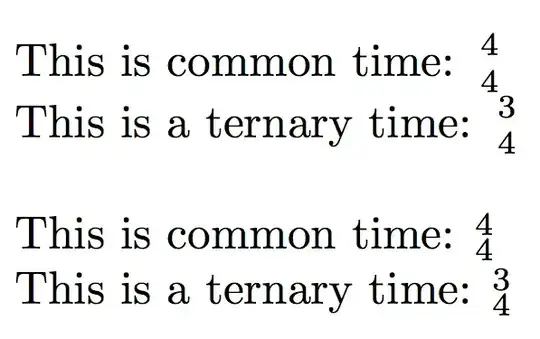
Some comments on the second solution
The definition of \setmeterb uses some low level TeX trickery. I use \ensuremath for being able to use \vcenter that will center the result with respect to the line (the "geometric center" will actually be slightly above the baseline).
In the \vcenter I set an alignment built with the primitive \halign, which avoids all the things LaTeX does with tabular in order to ensure equal spacing between rows, which is exactly what we don't want in this case where the two rows consist only of numbers; in particular the insertion of interline glue is disabled with \offinterlineskip. So the final trick is to set one centered column
\halign{\hfil#\hfil\cr ...}
and then add the two rows, separated by 1pt of white space. The # must actually be ## because we're using it in a definition.







\newcommand*\meter[2]{\resizebox*{!}{.7\baselineskip}{\meterfrac{#1}{#2}}}and then use\meter{4}{4}in the text. BTW:\begin{music}and\end{music}isn't actually needed here. – cgnieder Oct 19 '12 at 13:26Cused for4/4meter? (I understand that you want a general solution, I'm just making sure that I'm not missing some point.) – yo' Oct 19 '12 at 15:29Cmight be used, but it's less popular nowadays (though I think widely understandable) and I have never encountered this in normal text, only in notation (but I don't posses much experience in this field). – nuoritoveri Oct 19 '12 at 22:58