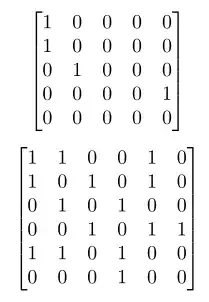
Here is one way to do it (with much room for improvement). Given a list of node relations:
\newcommand{\NodeRelations}{%
    (1,1),
    (1,2),
    (1,5),
    (2,1),
    (2,3),
    (2,5),
    (3,2),
    (3,4),
    (4,3),
    (4,5),
    (4,6),
    (5,1),
    (5,2),
    (5,4),
    (6,4)
}%
you use the MyMatrix environment and pass in dummy data:
\begin{MyMatrix}{\NodeRelations}
    - & - & - & - & - & - \\
    - & - & - & - & - & - \\
    - & - & - & - & - & - \\
    - & - & - & - & - & - \\
    - & - & - & - & - & - \\
    - & - & - & - & - & - \\
\end{MyMatrix}
which gets replaced with a 1 or 0:

Code:
\documentclass{article}
\usepackage{pgffor}
\usepackage{xstring}
\usepackage{collcell}
\usepackage{etoolbox}
\newcounter{RowCount}
\newcounter{ColCount}
\newcommand{\NextColumn}[1]{%
    \addtocounter{ColCount}{1}%
    \IfIsInNodeRelations{\arabic{ColCount}}{\arabic{RowCount}}{1}{0}%
}
\newcommand{\FirstColumn}[1]{%
    \setcounter{ColCount}{0}%
    \addtocounter{RowCount}{1}%
    \NextColumn{#1}%
}
\newtoggle{IsInNodeRelations}
\newcommand*{\IfIsInNodeRelations}[4]{%
    \global\togglefalse{IsInNodeRelations}%
    \foreach \Node in \NodeRelations {%
        \StrBetween{\Node}{(}{,}[\x]
        \StrBetween{\Node}{,}{)}[\y]
        \IfEq{\x}{#1}{%
            \IfEq{\y}{#2}{%
                \global\toggletrue{IsInNodeRelations}%
                \breakforeach%
            }{}%
        }{}%
    }%
    \iftoggle{IsInNodeRelations}{#3}{#4}
}
\newcommand{\NodeRelations}{%
    (1,1),
    (1,2),
    (1,5),
    (2,1),
    (2,3),
    (2,5),
    (3,2),
    (3,4),
    (4,3),
    (4,5),
    (4,6),
    (5,1),
    (5,2),
    (5,4),
    (6,4)
}%
\newcommand{\ExtractedX}{}%
\newcommand{\ExtractedY}{}%
\def\ExtractXY(#1,#2){%
    \xdef\ExtractedX{#1}%
    \xdef\ExtractedY{#2}%
}%
\newenvironment{MyMatrix}[1]{%
    % #1 = List of node relations
    \newcolumntype{F}{>{\collectcell\FirstColumn}c<{\endcollectcell}}%
    \newcolumntype{C}{>{\collectcell\NextColumn}c<{\endcollectcell}}%
    \setcounter{RowCount}{0}
    \setcounter{ColCount}{0}
    $\left[\begin{array}{F C C C C C}%
}{%
    \end{array}\right]$%
}%
\begin{document}
\begin{MyMatrix}{\NodeRelations}
    - & - & - & - & - & - \
    - & - & - & - & - & - \
    - & - & - & - & - & - \
    - & - & - & - & - & - \
    - & - & - & - & - & - \
    - & - & - & - & - & - \
\end{MyMatrix}
\end{document}