In a nutshell. Is there a relatively easy way of building characters out of parts of existing ones?
Rationale. (La)TeX linguists’ need for a wide palette of characters—for example, ⟨ɳ⟩ (U+0273), ⟨ɲ⟩ (U+0272), ⟨ʁ⟩ (U+0281), ⟨ɱ⟩ (U+0271), ⟨ə⟩ (U+0259)—is generally met by Rei Fukui’s tipa package. However, tipa provides no italic shapes and is limited to Computer Modern. Which causes problems. Publishers very often ask for a font other than Computer Modern, and there is a near universal convention that italics be used for in-text citation. The result is unsatisfying and visually unappealing (and frequently leads to publications in which there is a mishmash of fonts and/or font shapes). (Some publishers do have full sets of italic IPA fonts, but these are frequently specially commissioned and not freely available; e.g., OUP’s Minion set.)
Example. Here is the mixture of fonts and shapes you get by calling for a schwa via \textipa{@}, while using Times Roman:

To get around this, I’ve taken to getting rotating.sty to rotate an e:
\newlength{\schwawidth}
\newlength{\schwaheight}
\newcommand{\x}{%
    \settowidth{\schwawidth}{\it e}%
    \settoheight{\schwaheight}{\it e}%
    \makebox[\schwawidth][r]{%
    \raisebox{\schwaheight}{%
    \turnbox{180}{e}}}%
    }
Notice that this also gets reasonable kerning (which is the reason for defining \schwawidth and \schwaheight rather than using, what’s it called, a rotate box?):

The Question. This approach fails when parts of characters have to be assembled. Consider ⟨ɺ⟩ (U+027A). You can rotate a ⟨r⟩, as for schwa, and superimpose on an ⟨l⟩, but the tail of the ⟨l⟩ sticks out uncomfortably:

What you really need is to lop the top off an ⟨l⟩ and to stick it on the rotated ⟨r⟩ and then to have the result treated as a single character. Is there are simple way of doing this?
Update. The author of expex.sty reminds me of a trick I used to use in Word: covering parts of letters up with white boxes, replicable in TeX with pstricks.sty. Here is how you might get ⟨ɺ⟩ (U+027A) above:
\documentclass[12pt]{article}
\usepackage{rotating,mathptmx,pstricks}

\begin{document}

\newlength{\rwidth}
\newlength{\rheight}
\newcommand{\turnedr}{%
    \settowidth{\rwidth}{\it r}%
    \settoheight{\rheight}{\it r}%
    \makebox[\rwidth][r]{%
    \raisebox{\rheight}{%
    \turnbox{180}{r}}}%
    }
\def\cutr{\leavevmode\hbox{\turnedr}%
    \psframe*[linecolor=white](0,0)(-.15em,1.1ex)%
    \psframe*[linecolor=white](0,-.1ex)(-.24em,.2ex)%
    \psframe*[linecolor=white](0,-.1ex)(-.26em,.1ex)%
    }
\def\turnedlongr{\cutr\kern-.27eml}

\noindent \it
\verb|\cutr| --- \cutr \\
\verb|\turnedlongr| --- \turnedlongr \\
\verb|\l\turnedlongr d| --- l\turnedlongr d

\end{document}
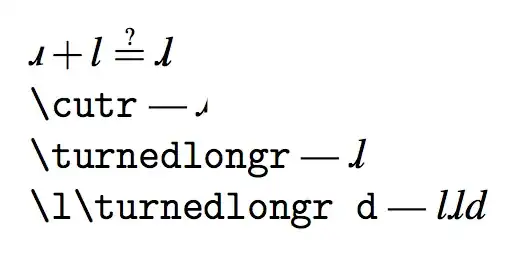
I doubt this will work for all letters, and I’m sure that purists will need to rinse their eyes after reading this...
Undertaking. If I make progress on this, I’ll start posting whatever characters I create/cobble/frankenstein on (something linked to) my webpage (which you can find by googling my name).
Notes. This question is quite general as:
- Many IPA characters are combinations of common characters (⟨j⟩+⟨n⟩=⟨ɲ⟩, ⟨m⟩+⟨j⟩=⟨ɱ⟩, etc.).
- The problem of mismatches doesn't just apply to Times italics: it affects italics in Computer Modern and roman in all other fonts.
This question started life as part of this question. Although a work around was found, the broad issue of lopping bits of existing characters (in that case, the crossbar from ⟨f⟩) remains.
\documentclass[12pt]{article}
\usepackage{rotating,mathptmx, tipa}

\begin{document}

\newlength{\schwawidth}
\newlength{\schwaheight}
\newcommand{\x}{%
    \settowidth{\schwawidth}{\it e}%
    \settoheight{\schwaheight}{\it e}%
    \makebox[\schwawidth][r]{%
    \raisebox{\schwaheight}{%
    \turnbox{180}{e}}}%
    }

\noindent \it
e\x e --- all Times italic\\
e\textipa{@}e --- Times italic with slanted Computer Modern schwa\\
\textipa{e@e} --- all Computer Modern slanted\\
\underline{e \footnotesize\x\ \normalsize\x\ \Large\x}\ \normalsize --- various sizes

\newlength{\rwidth}
\newlength{\rheight}
\newcommand{\turnedr}{%
    \settowidth{\rwidth}{\it r}%
    \settoheight{\rheight}{\it r}%
    \makebox[\rwidth][r]{%
    \raisebox{\rheight}{%
    \turnbox{180}{r}}}%
    }
\ \\
$\turnedr + l \stackrel{_?}{=} \turnedr\kern-.265eml$

\end{document}


