In his book The Elements of Typographic Style, Bringhurst presents a hexagonal pattern for geometrically constructing the elements of the page layout.
Question: Can the dimensions be simply extracted geometrically using TikZ, tkz-euclide, Metafont/post, or similar LaTeX packages? (Geometric elegance is key here, not just a brute force solution demonstrating that TeX is turing complete, and hence can solve the implicit problem.)
I originally thought that this would be a great example of the geometric methods available through, for example, tkz-euclide, but have been unable to come up with an explicit construction. Of course, one can follow the construction through to obtain an implicit set of equations with a unique solution which I have used to calculate the parameters in the following code, but can one solve the problem elegantly using the geometric methods found in these packages?
\documentclass{standalone}
\usepackage{tikz}
\usepackage{tkz-euclide}
\usetikzlibrary{decorations.pathmorphing}

\begin{document}
\begin{tikzpicture}[scale=5.2in/1cm/2]
    \path (0,0) coordinate[label=below:{ll}] (ll)
    -- (1,0) coordinate[label=below:{lr}] (lr)
    -- ++(60:1) coordinate[label=right:{r}] (r)
    -- ++(120:1) coordinate[label=above:{ur}] (ur)
    -- ++(180:1) coordinate[label=above:{ul}] (ul)
    -- ++(240:1) coordinate[label=left:{l}] (l)
    -- ++(300:1) coordinate (ll);
    \coordinate[label=below right:{a}]
                  (a) at (1.27106916798686, 0.469505571318668);
    \coordinate (tll) at (0.117300021398114, 0.294835256924744);
    \coordinate (tlr) at (0.798192881206518, 0.294835256924744);
    \coordinate (tur) at (0.798192881206518, 1.61553741320908);
    \coordinate (tul) at (0.117300021398114, 1.61553741320908);
    \coordinate[label=below:{x}] (x) at (0.435936138301, 0);
    \coordinate[label=above:{y}] (y)   at (0.689095323638, 1.73205080756888);
    \tkzInit[ymin=0,ymax=2,xmin=-0.5,xmax=2]
    \tkzInterLL(l,ur)(a,ul) \tkzGetPoint{A}
    \tkzInterLL(ll,y)(ul,a) \tkzGetPoint{B}
    \tkzInterLL(l,ur)(ll,y) \tkzGetPoint{C}
    \tkzInterLL(ll,a)(l,x) \tkzGetPoint{D}
    \tkzDefCircle[in](A,B,C) \tkzGetPoint{U} \tkzGetLength{rU}
    \tkzDefCircle[in](tll,tlr,D) \tkzGetPoint{L} \tkzGetLength{rL}

    % Locate page number
    \tkzDefShiftPoint[L](1,0){Lr}
    \tkzInterLL(L,Lr)(tur,tlr) \tkzGetPoint{pagenumber}

    % Locate running header
    \tkzDefShiftPoint[U](0,\rU pt){Uu}
    \tkzDefShiftPoint[Uu](1,0){Uur}
    \tkzInterLL(Uu,Uur)(y,r) \tkzGetPoint{header}

    \color{black};
    \draw (ll) -- (lr) -- (r) -- (ur) -- (ul) -- (l) -- cycle;
    \color{gray};
    \draw (ur) -- (l) -- (x) -- (r) -- (y) -- (ll) -- (a) -- (ul);
    \draw (l) -- (ur);
    \draw (tul) -- (tur) -- (tlr) -- (tll) -- cycle;
    \draw (ul) -- (ur) -- (lr) -- (ll) -- cycle;

    \tkzSetUpLine[color=gray]
    \tkzDrawCircle[R](U, \rU pt)
    \tkzDrawCircle[R](L, \rL pt)
    \tkzDrawSegments(Uu,header L,pagenumber)
\end{tikzpicture}
\end{document}
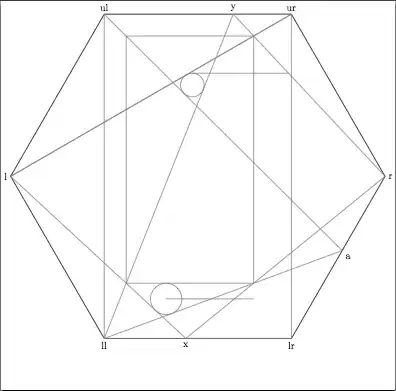
Update: To clarify the problem, in addition to the intersection constraints implicit in the picture, one must also impose that the textblock be rectangular with strict vertical/horizontal orientation. This, along with the constraints that the points lie within the hexagon (not somewhere outside) are enough to ensure that the solution is unique up to an overall scaling that is fixed by the roughly 5.2"x9" physical paper size used for Bringhurst's book. (As mentioned by @percusse, the hexagon gives an exact ratio 5.2:5.2*2*cos(30º) = 5.2:9.006664202....)
The construction can be completely specified with simple geometric intersections etc. if two numbers are specified. In particular, one can specify the fraction y along ul--ur and x along ll--lr (z.y=y[z.ul,z.ur] and z.x=x[z.ll,z.lr] in metapost notation).
The exact solution can be found algebraically to be:
q = (81 - √3186)^(1/3)
y = q/3 - 2 + 5/q ≈ 0.689095323637659465372247907...
x = (y^2 + 4*y + 3)/(-2*y^2 - 4*y + 18) ≈ 0.4359361383008273751170828497...
Additional consistent solutions exist, but the points x and y lie outside of the corresponding sides of the hexagon: this is the unique solution with the textblock lying within the page. Since these are solutions of cubic equations, I have my doubts that a complete solution lies within the linear solving abilities of Metapost, but think there still might be a nice geometric construction.
Reference: This answer to the question: Bringhurst chapter style in memoir


x,y, andaare implicitly defined by the geometric constraints in the picture and the constraints that the page and text-block are rectangular with vertical alignment. – mforbes Jan 08 '13 at 23:345.2inwide and9inhigh. This fixes all absolute scales. – mforbes Jan 09 '13 at 06:089in = 2*(5.2in*cos(30))so one dimen is enough for that but that doesn't render the solution unique. It looks like there must be at least one other characteristic dimension to fix the text area relative to the page. – percusse Jan 11 '13 at 03:26y-ris almost parallel toul-a(it is not),ais almost a midpoint oflr-r(it is not), 45º angles (there are not any) etc. The solution does not seem to have any simple properties, but @percusse I am pretty sure that the solution is unique. I will try to provide a proof later. – mforbes Jan 12 '13 at 17:01qis and how you get the algebraic solution forq,xandy? – Tobi Feb 10 '14 at 14:32qis just a number that makes the solution simpler. I found the algebraic solution by simply doing the vector algebra needed to construct the image and then solving the resulting equations using a symbolic algebra package like SymPy or Maple. When I have some time, I will write this all up as a tugboat article, but time has been a bit short... – mforbes Feb 10 '14 at 22:31qhave a geometrical meaning / representation in the image? – Tobi Feb 11 '14 at 15:05