If your two page spread has no floats, then you can simply store the content in a box, and split the box into two.
% The default layout
\setuplayout[cutspace=1in, backspace=1in, width=middle]

% The layout for left and right page. ConTeXt treats cutspace=0pt as a signal
% to set cutspace=backspace. So, I use cutspace=1sp (the smallest non-zero
% space in TeX.
\definelayout[leftpage] [cutspace=1sp, backspace=1in, width=middle]
\definelayout[rightpage][cutspace=1in, backspace=1sp, width=middle]

% A box to store the content
\newbox\twopagebox

% A frame to typeset the content.
\defineframed
    [twopageframe]
    [
      width=\the\dimexpr2\paperwidth-2\backspace,
      height=\textheight,
      align=normal,
      frame=off,
    ]

% An environment to gather the data, typeset it in a box, and then split
% the box.
%
% A buffer is not needed here, as we can directly typeset the material in
% a box.
\unexpanded\def\starttwopagemakeup
    {\grabbufferdata[twopagebuffer][starttwopagemakeup][stoptwopagemakeup]}

\unexpanded\def\stoptwopagemakeup
    {\setbox\twopagebox\hbox{\twopageframe{\getbuffer[twopagebuffer]}}%
     \page[right]%
     \setuplayout[leftpage]%
     \clip[nx=2, ny=1, x=1]{\copy\twopagebox}%
     \page
     \setuplayout[rightpage]%
     \clip[nx=2, ny=1, x=2]{\copy\twopagebox}%
     \page
     \setuplayout[reset]}

\setupbackgrounds[page][frame=on, framecolor=red]
% To visualize the page border

\starttext
  \dorecurse{6}{\input knuth \endgraf}
\starttwopagemakeup
  \chapter {Two page data}
  \dorecurse{6}{\input knuth \endgraf}
\stoptwopagemakeup
  \dorecurse{6}{\input knuth \endgraf}

\stoptext
which gives
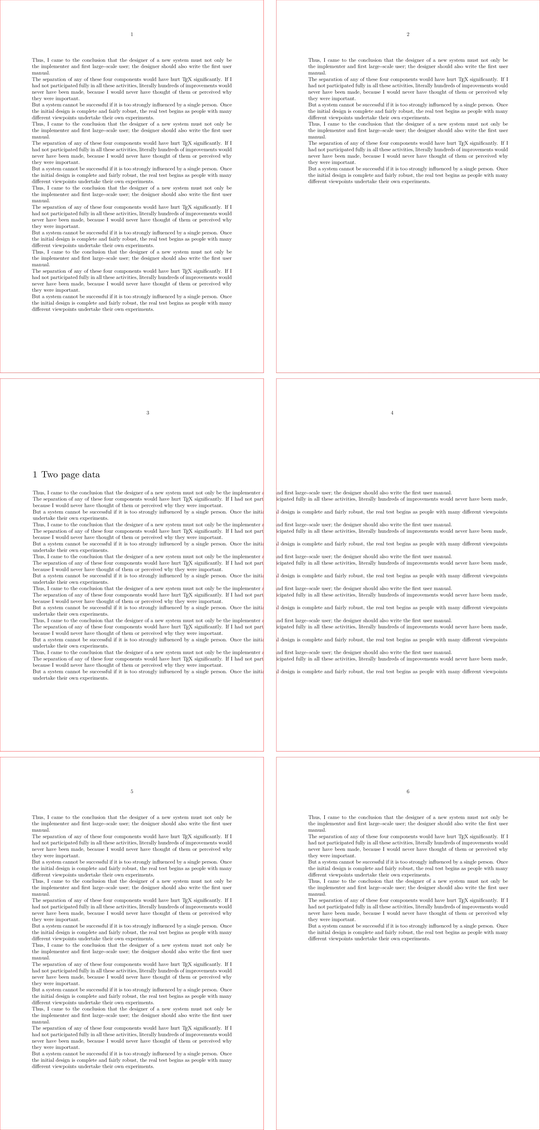
Note I have deliberately included space between the pages when combining the pages together to show the image here.
This solution only works for a single page. If you want support for multiple pages, then you need to store the content as a \vbox and keep \vspliting it until no material is left. For example,
% The default layout
\setuplayout[cutspace=1in, backspace=1in, width=middle]

% The layout for left and right page. ConTeXt treats cutspace=0pt as a signal
% to set cutspace=backspace. So, I use cutspace=1sp (the smallest non-zero
% space in TeX.
\definelayout[leftpage] [cutspace=1sp, backspace=1in, width=middle]
\definelayout[rightpage][cutspace=1in, backspace=1sp, width=middle]

% A box to store the content
\newbox\twopagebox
\newbox\contentbox

\unprotect
% An environment to gather the data, typeset it in a box, and then split
% the box.

\unexpanded\def\starttwopagemakeup
    {\setbox\contentbox\vbox\bgroup
        \hsize\the\dimexpr2\paperwidth-2\backspace\relax}

\unexpanded\def\stoptwopagemakeup
    {\egroup
     \typeset_all_pages}

\def\typeset_all_pages
    {\ifvoid\contentbox
       % Done
     \else\ifdim\ht\contentbox>\textheight
        \setbox\twopagebox\vsplit\contentbox to \textheight
           \typeset_one_page\twopagebox
           \typeset_all_pages
         \else
            \typeset_one_page\contentbox
         \fi
      \fi}

\def\typeset_one_page#1% box
   {\page[right]%
     \setuplayout[leftpage]%
     \clip[nx=2, ny=1, x=1]{\copy#1}%
     \page
     \setuplayout[rightpage]%
     \clip[nx=2, ny=1, x=2]{\copy#1}%
     \page
     \setuplayout[reset]}

\protect

\setupbackgrounds[page][frame=on, framecolor=red]
% To visualize the page border

\setuphead[chapter][page=] % Otherwise we get an extra page

\starttext
\starttwopagemakeup
  \chapter{One}
  \dorecurse{12}{\input knuth \relax}
\stoptwopagemakeup

\chapter{Normal Text}
\dorecurse{12}{\input ward \endgraf}


\stoptext
This uses low-level TeX (as splitting pages is effectively equal to writing an output routine). See TeX by Topic for details.


