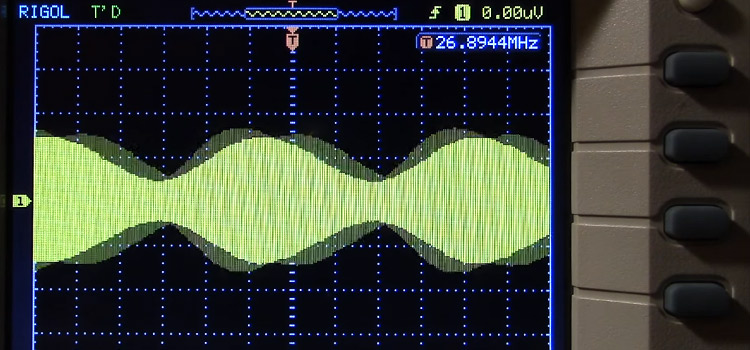
Known from communications theory timing-diagrams show signal variation in time.
Using this tag in a Latex context
The vast majority of questions raised here were about showing the development of a quantity in time. Use this tag for this purpose.
Just plotting a timescale, e.g. in a historical context, or a timeline in project management do not really qualify for this tag.
Some basic definitions
signal: a (measured) quantity, which can change, like voltage, force and similartime: is always an interval from start to finish, while the timescale can varydiagram: quantity on y-axis, time on x-axis
Brief introduction
Contemporary timing-diagrams are often made for digital signal, e.g. for purely logical electronic circuits like a control for traffic lights.
Not so many decades in the past timing-diagrams for signals were also widely used for analog signals, e.g. for a radio or TV-set.
Todays systems many times are mixed-signal, with some digital parts, and some analog parts. E.g. mobile phones are of this kind, receiving (whispering) analog GPS-signals hidden in noise, and (loud) digital signal processing on-top.
A good way to visualize a timing-diagram is looking at an oscilloscope, which also reveals that digital signals are just analog signals falling into certain ranges, which define logic levels.
Displayed content can vary, like:
- showing exact development in time (e.g. switching a circuit on or off)
- abstracting into ranges, where signals are expected to vary (e.g. to illustrate digital packages of information)
- focusing on certain aspects (e.g. rise- and fall-times of signal flanks)
Links
Questions on this site show some interesting examples illustrating the above:
- idealized exact signal-variation in time (digital)
- abstracted scheme, when data are expected to vary (digital)
- focusing on the analog aspect (rising flanks) of a digital signal
- some kind of a mixed-signal approach
- scheduling transfer of data packages in a network (protocol scheme)
- a more complex generalized timing-digram as it occurs in any CPU-related design (digital)
However, from a strict communications engineering point of view, this example does not qualify for this tag, as it's just a beam:
Some screenshots from osilloscopes:
- AM-modulation (analog), where a fast varying carrier signal (sine wave) has a low frequency audio signal superimposed
- some real-life timing of digital signals