13

I never really thought about it until after reading some of the questions in this forum.

What is the difference between hardwood and softwood. To clarify I am not interested in their applications but understanding where it comes from and how it is classified.

rob
  • 18,704
  • 9
  • 54
  • 129
Matt
  • 20,188
  • 41
  • 99
  • 202
  • 1
    Like most people, I am well aware of the definitions of hardwood and softwood, but I prefer to think in terms of hardwood and easywood. – Ast Pace Apr 27 '15 at 17:09

1 Answers1

17

Hardwood is usually from a deciduous tree and softwood is usually from a coniferous one. Hardwoods typically have a higher density (hence hardwood).

Seriously?

For the most part that is the general accepted (although broad) definition and yes there are several exceptions.

Little more than that please

Much like identifying wood species; determining if a particular wood is soft or hard depends on the kind of tree it came from. More specifically:

Hardwood

Comes from dicot angiosperm which mean the tree reproduces with flowers and most have broad leaves that are shed in response to natural climate change or drought. There are several species of evergreen that fit into this category as well. These evergreens are usually located in more tropical/subtropical zones.

Hardwood trees have large vessels for transporting water. These pores are responsible for the grain appearance in hardwood and are best seen under microscope.

Softwood

Almost all softwood comes from gymnosperm plants such as conifers or also known as coniferous trees. Where hardwood tree use flowers for reproduction softwood trees use seeds, such as cones. Conversely to hardwood, water and sap are transported via medullary rays and tracheids which can appear corrugated (like cardboard).

Comparison

As mentioned before, the best way to be sure is to examine the wood under microscope. In the hardwood you can see the "pores" shown as large holes (In the diagram below it is the picture on top.) Softwood does not have visible pores.
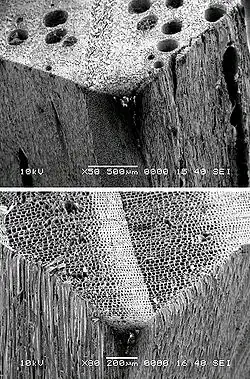
Wood Under Scope

Picture comes from Wikipedia

Notable exceptions

Just because a wood is classified as soft does not mean it is necessarily softer than a hardwood. There is a wide range of hardness when it comes to the many species of trees. I mentioned earlier that there are a couple of exceptions as far as the generic hardwood/softwood definition are concerned.

  • Balsa: Is actually a soft hardwood.

  • Yew: Is actually a hard softwood.

  • Bamboo: Considered a hardwood but classified as a grass.

More reading

In trying to keep scientific analysis out of this answer I refer keen readers to other more in depth sources of information. Always remember that the accuracy of Wikipedia should be taken with a grain of salt and cross verified where possible.

feetwet
  • 1,320
  • 3
  • 13
  • 38
Matt
  • 20,188
  • 41
  • 99
  • 202
  • 1
    Similarly, Poplar is a fast-growing hardwood that is often softer than pine. – keshlam Apr 10 '15 at 02:54
  • That's about the right of it. Hard and soft aren't necessarily hard and soft ;) And yes, bamboo is a grass. I love the look though ... I wonder how hard bamboo laminate panels are to work with. A few minor typos but not enough characters for an edit. – Daniel B. Apr 10 '15 at 17:02
  • 1
    I might change TL;DR to "Hardwood is usually from a deciduous tree and softwood is usually from a conifer, and don't necessarily represent the density("hardness") of the wood." layman's terms are important ;) – Daniel B. Apr 10 '15 at 17:06
  • @DanielB. Those suggestions seem good. I will have a look for trivial updates and see if there is something I messed up. – Matt Apr 10 '15 at 17:57
  • http://www.woodworkerssource.com/Bamboo.html Seems like it'd be pretty easy to work with and very easy to stain (I suppose because of the vasculature). Since it's a laminate product I wonder if it might have less issue with movement as well. – Daniel B. Apr 10 '15 at 18:35
  • 1
    @DanielB. I did find some silly mistakes (every always looks good to the one that wrote it.) and also tried to incorporate your overall definition where I felt it fit best. Thanks – Matt Apr 10 '15 at 18:45
  • @DanielB. I would love to be able to work with that caliber of bamboo. I have some that grows here in Canada but it is nothing like the ones you see in pictures. – Matt Apr 10 '15 at 18:49
  • next time you do some fixes, basla to balsa – Ast Pace Jul 14 '15 at 21:28
  • basswood is also very soft - similar to many softwoods. Look up tables for Janka wood hardness ratings to get quantifiable comparisons. – aaron Sep 07 '16 at 12:43