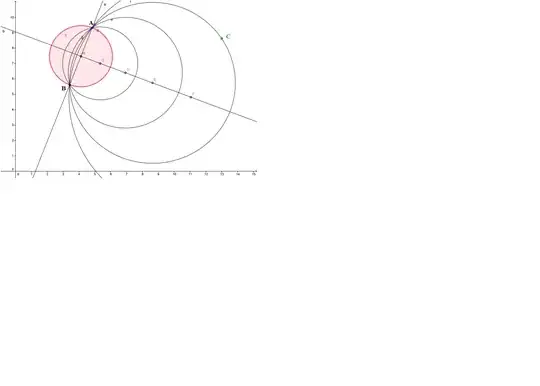
How can the equation be the equation of the required circles???
It described the family of circles passing through $A$ and $B$, and then picked the appropriate element from that family.
If you have a point $(X,Y)$ on a circle with center $(x,y)$ and radius $r$, its equation is
$$r^2=(X-x)^2+(Y-y)^2=X^2-2Xx+x^2+Y^2-2Yy+y^2$$
which is of the form $(X^2+Y^2)+aX+bY+c=0$ with $a=-2x,b=-2y,c=x^2+y^2-r^2$. So as long as $4c<a^2+b^2$ you can always turn an equation of this form back into a circle.
The equation of a line, on the other hand, is something like $dX+eY+f=0$. So if you combine them to $S+\lambda P=0$ you get
$$(X^2+Y^2)+(a+\lambda d)X+(b+\lambda e)Y+(c+\lambda f)=0$$
which again has the form of a circle equation. And since each individual term of the sum was zero for $A$ and $B$, their sum must be zero there as well. So you know that this will always be a circle through $A$ and $B$. And since you know it contains two real points, you don't have to worry about the $4c<a^2+b^2$ condition I wrote above, since if that were violated you'd have zero or imaginary radius, and couldn't have two real points located on the circle.
Why should the circle have AB as diameter
It doesn't really matter what circle you start with. You could take any circle passing through $A$ and $B$, although a different choice would lead to a different value of $\lambda$. But the one with the diameter is easiest to compute.
As a variant, you can play the same game with two different circles passing through $A$ and $B$, and do $S_1+\lambda S_2=0$. Then you'd get an equation which starts with $(1+\lambda)(X^2+Y^2)$ but since you could as well divide the whole resulting equation by $(1+\lambda)$ it would still be a circle. (Except if $\lambda=-1$, then you'd have a line instead, so that happens if $A,B,C$ are collinear.) The only problem is that if $C$ already lies on $S_2$, you'd get a division by zero. To avoid that you could write $\lambda S_1+\mu S_2=0$, and you could compute these as e.g. $\lambda = S_2(C)$ and $\mu = -S_1(C)$ to ensure that $C$ satisfies the combined equation.