Consider the ellipse with equation: $$\frac{x^2}{a^2} + \frac{y^2}{b^2} = 1$$ How do we prove the product of distances from the foci to any tangent line is $b^2$?
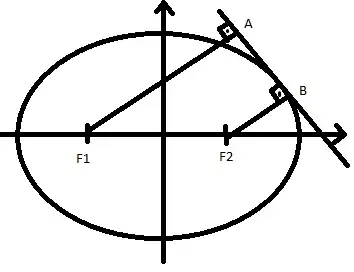
$$F_1A \cdot F_2B = b^2$$
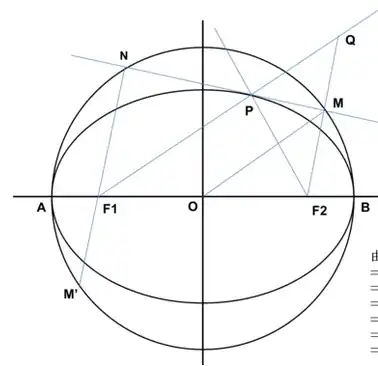
It is well know $$\angle QPM=\angle F_{2}PM,\Longrightarrow PQ=PF_{2},QM=F_{2}M$$ so $$OM//F_{1}Q\Longrightarrow OM=\dfrac{F_{1}Q}{2}=\dfrac{F_{1}P+F_{2}P}{2}=a$$ so $M,N\in\bigodot O$ so $F_{1}M'=F_{2}M$ so $$F_{1}N\cdot F_{2}M=F_{1}N\cdot F_{1}M'=F_{1}A\cdot F_{1}B=(a+c)(a-c)=b^2$$

Let' say that $A(x_0,y_0)$ is the point of intersection of the tangent $$\epsilon:\begin{array}[t]{l}\frac {x} {a^2} x_0+\frac y {b^2}y_0=1\\(b^2 x_0) x+(a^2 y_0)y -a^2b^2=0\end{array}$$ and the ellipse.
The distance between $F_1(-c,0)$ and $\epsilon$ is: $$d_1=\dfrac{\left|-c b^2 x_0-a^2b^2\right|}{\sqrt{b^4x_0^2+a^4y_0^2}}$$
Respectively, the distance between $F_2(c,0)$ and $\epsilon$ is: $$d_2=\dfrac{\left|c b^2 x_0-a^2b^2\right|}{\sqrt{b^4x_0^2+a^4y_0^2}}$$ Thus, we have:
$$d_1\cdot d_2\begin{array}[t]{l}=\cdots =\dfrac{\left|a^4b^4-b^4x_0^2c^2\right|}{b^4x_0^2+a^4y_0^2}=\dfrac{\left|a^4b^4-b^4x_0^2(a^2-b^2)\right|}{b^4x_0^2+a^4y_0^2}\\\\ \end{array}$$ However, from the initial equation of the ellipse, since $A(x_0,y_0)$ belongs to the ellipse, we can prove that: $$a^4b^4=a^2 b^4x_0^2+b^2a^4y_0^2$$ Making the substitution above, we have:
$$d_1\cdot d_2=\dfrac{\left|a^2 b^4x_0^2+b^2a^4y_0^2-b^4a^2x_0^2+b^6x_0^2\right|}{b^4x_0^2+a^4y_0^2}=\cdots=b^2$$

Some hints:

WLONG, we can represent any point on the given Ellipse as $x=a\cos A,y=b\sin A$
So, the equation of the tangent at $(a\cos A,b\sin A)$ will be $\dfrac{x\cdot a\cos A}{a^2}+\dfrac{y\cdot b\sin A}{b^2}=1$
$$\iff bx\cos A+ay\sin A-ab=0$$
The coordinates of the foci are $(\pm ae,0)$ where $e$ is the eccentricity
So, the distances will be $$\frac{|\pm ae\cdot b\cos A-ab|}{\sqrt{(b\cos A)^2+(a\sin A)^2}}$$ and consequently their product will be
$$=a^2b^2\cdot\frac{(1-e\cos A)(1+e\cos A)}{(b\cos A)^2+(a\sin A)^2} =a^2b^2\cdot\frac{(1-e^2\cos^2A)}{a^2(1-e^2)\cos^2A+a^2\sin^2A}=b^2$$
as $b^2=(1-e^2)a^2$


