1

By taking a line through $(1, 0)$ it is possible to find a point where the line crosses another point of $x^2 - 2y^2 = 1$. Then we could take a line that passes through the that point and find another point which intersects $x^2 - 2y^2 = 1$. We can repeat this as many times as we like. My question is, why does this procedure to infintly many different solutions to $x^2 - 2y^2 = 1$? I am only looking for integer solutions. Thank you.

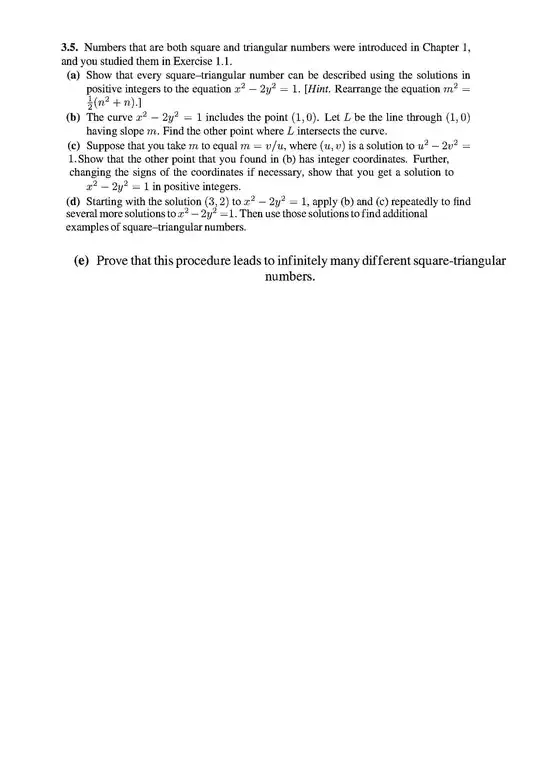
Edit: Here's a full question I'm working on if something is unclear. I'm struggling with part e).
Andrew
  • 245

2 Answers2

1

The Diophantine equation $x^2-2y^2=1$ has infinitely many integer solutions, see Pell's equation. We can start with $(x_1,y_1)=(3,2)$, and then set $ x_k + y_k \sqrt 2 = (x_1 + y_1 \sqrt 2)^k$ for $k\ge 1$.

How to use Pell's equation for square-triangular numbers, see here. It follows immediately that there are infinitely many different square-triangular numbers.

Dietrich Burde
  • 130,978
  • I know this method, but I am trying to prove that the method with line works also. – Andrew Apr 28 '15 at 18:26
  • Thank you for the link, but I am not familiar with those methods yet, that's why I'm trying to prove it only using the things I'm given. – Andrew Apr 28 '15 at 18:43
  • 1
    The geometric method also immediately gives you infinitely many solutions to $x^2-2y^2=1$, and then you only need an easy algebraic formula relating it to square-triangular numbers, i.e. $t_k=(P_{2k}+P_{2k-1}-1)/2$. – Dietrich Burde Apr 28 '15 at 18:47
  • But does it give infinitly many integer solutions? – Andrew Apr 28 '15 at 19:14
  • 1
    It gives all rational and integer solutions, hence infinitely many (which we know anyway, see my answer). – Dietrich Burde Apr 28 '15 at 19:22
0

Since we have a line, then it is on the form $y=ax+b$. This line pass through $(1,0)$, so the affine function became $y=ax-a=a(x-1)$. It remains you to insert the equation in $x^2 - 2y^2 = 1$. The last step is trivial.

  • Namely that there is no infinite solutions. The exercise puts a line through a circle of radius 1. It can therefore be 0, 1 or 2 solutions. –  Apr 28 '15 at 18:00