5

Here is the proof of the Kolmogorov Zero-One Law and the lemmas used to prove it in Williams' Probability book:
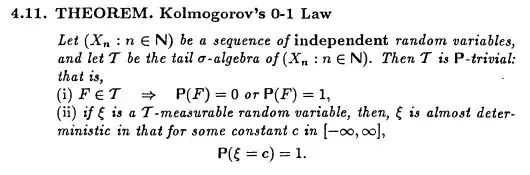
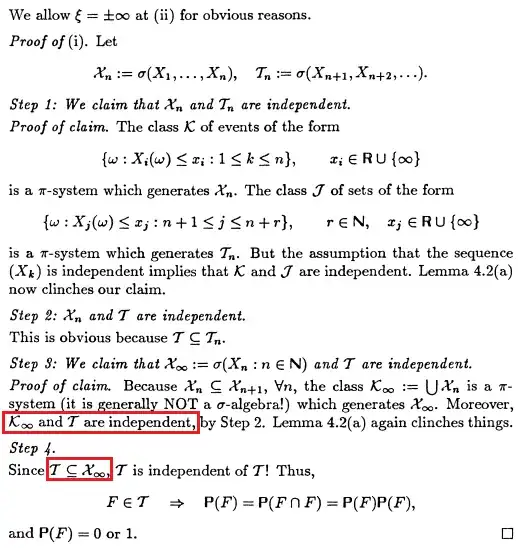
enter image description here enter image description here


Here are my questions:

  1. Why exactly are $\mathfrak{K}_{\infty}$ and $\mathfrak{T}$ independent? I get that $\mathfrak{K}_{\infty}$ is a countable union of $\sigma$-algebras that each are independent with $\mathfrak{T}$, but I don't see how exactly that means $\mathfrak{K}_{\infty}$ and $\mathfrak{T}$ are independent kind of like here.

  2. How exactly does one show that $\mathfrak{T} \subseteq \mathfrak{X}_{\infty}$?

That is, how exactly does one show that $\bigcap_{n \geq 0} \sigma(X_{n+1}, X_{n+2}, ...) \subseteq \sigma [\sigma(X_1) \cup \sigma(X_1, X_2) \cup ...]$?

Intuitively, I get it. I just wonder how to prove it rigorously.

What I tried:

Suppose $A \in \mathfrak{T}$. Then A is in the preimage of...I don't know. Help please?

BCLC
  • 13,459

1 Answers1

3

On 1):

Let $A\in \mathfrak{K}_{\infty}$ and $B\in\mathfrak{T}$.

Then $A\in \mathfrak{X}_n$ for some $n$ and since $\mathfrak{X}_n$ and $\mathfrak{T}$ are independent $\sigma$-algebra's we are allowed to conclude that $P(A\cap B)=P(A)\times P(B)$.

This proves that $\mathfrak{K}_{\infty}$ and $\mathfrak{T}$ are independent. Here $\mathfrak{K}_{\infty}$ is an algebra (hence closed under intersections) and $\mathfrak{T}$ is a $\sigma$-algebra. And based on this it can be shown that $\sigma(\mathfrak{K}_{\infty})$ and $\mathfrak{T}$ are independent $\sigma$-algebras.

On 2):

$\mathfrak{T}\subseteq\mathfrak{T}_1=\mathfrak{X}_{\infty}$

drhab
  • 151,093
  • Thanks @drhab except I don't think $\mathfrak{K}_{\infty}$ is a $\sigma$-algebra? :P Anyway, I'm guessing that they are independent $\pi$-systems. – BCLC May 29 '15 at 11:38
  • 1
    @BCLC Yes, you are correct. I repaired. – drhab May 29 '15 at 11:48
  • Interesting correction @drhab . Is it correct to say that algebras are $\pi$-systems but not vice-versa? – BCLC May 31 '15 at 15:08
  • 1
    That is correct. $\pi$-systems are not necessarily closed under complements. – drhab Jun 01 '15 at 08:10