How to prove this ? $$-\frac\pi2 = \lim_{x\to\infty}\sum_{n=1}^{\infty}(-1)^n \frac{x^{2n-1}}{(2n)! \ln 2n}$$
Asked
Active
Viewed 746 times
16


-
1I tried to typeset your equation more nicely. Please check if I did right. – martini Sep 04 '12 at 16:14
-
Personally, I'd put the $(-1)^n$ in the numerator. – Fly by Night Sep 04 '12 at 16:21
-
8What is the source? – Théophile Sep 04 '12 at 16:26
-
1You have to pick an infinity, I think: $x\to +\infty$ or $x\to -\infty$. Might seem pedantic, but $x\to\infty$ means something specific. (We often write $n\to\infty$, but there, $n$ is usually a natural number, and there is only "one" infinity it can go to.) – Thomas Andrews Sep 04 '12 at 16:30
-
5@ThomasAndrews: it looks rather straightforward to guess which infinity mick has in mind... – Fabian Sep 04 '12 at 16:34
-
5Unless I'm missing something here, the expression $,u\to\infty,$ is always understood as "$,u,$ going to (plus) infinity", otherwise it must specifically be added a minus sign: $,x\to -\infty,$ – DonAntonio Sep 04 '12 at 16:37
-
@Fabian Yes, as I said, it may seem pedantic, but it is important to get used to making clear distinctions when talking about limits. Not knowing OP, but based on the original posting formatting, I assumed he was inexperienced, and therefore would be helped by reminding him of the distinction. – Thomas Andrews Sep 04 '12 at 16:38
-
The source is me. In the original i typed +oo. I believe -oo would give + $\pi/2$ btw. ( its been a long long time since i came up with this lim ) Thanks for the Tex edit. I prefer the (-1) above too. – mick Sep 04 '12 at 16:41
-
lol its trivial that -oo gives the same result times -1. :) – mick Sep 04 '12 at 16:53
-
@mick Do you remember in what context you came up with this limit? This could help us figure out what tools could be relevant in finding the limit. – M Turgeon Sep 04 '12 at 17:39
-
1As often when you see x^a/log(x)^b its related to number theory. Although i did not give it that tag. It appeared to me in an attempt to prove the prime twins conjecture. It reappeared when trying to prove RH. ( related to spacing of zero's ). – mick Sep 04 '12 at 18:08
-
Numerically Wolfram seems to confirm that the limit is indeed $\frac{\pi}{2}$. The question is how to deal with the logarithm on the bottom. – Eric Naslund Sep 04 '12 at 18:11
-
Your question is the same as trying to show that $$\int_{0}^{\infty}\sum_{n=1}^{\infty}(-1)^{n}\frac{x^{2n}}{(2n)\left(2n\right)!\log(2n)}dx=\frac{-\pi}{2} $$ I am not sure how to do this, but I have seen similar integrals such as $$\int_{0}^{\infty}\sum_{n=1}^{\infty}(-1)^{n}\frac{x^{2n-2}}{(2n-1)!}dx=-\frac{\pi}{2} $$ which follows from basic complex analysis. Could you elaborate more on where this integral came from? – Eric Naslund Sep 04 '12 at 18:34
-
Surprisingly the formula is also in http://math.eretrandre.org/tetrationforum/showthread.php?tid=743 dated 7.Aug.2012 but was not discussed there. – Gottfried Helms Oct 04 '12 at 21:40
-
Not a surprise. I asked permission to post it here. Do I need to give credit to others in my questions ? – mick Oct 04 '12 at 21:45
1 Answers
29
Using
$$\int_0^\infty \left(2 n\right)^{-t} \mathrm{d} t = \frac{1}{\ln(2n)}$$
the sum becomes
$$
\sum_{n=1}^\infty (-1)^n \frac{x^{2n-1}}{(2n)! \cdot \ln(2n)} = \int_0^\infty \left(\sum_{n=1}^\infty (-1)^n \frac{x^{2n-1}}{(2n)! \cdot (2n)^t} \right)\mathrm{d}t
$$
Now, further using
$$
\int_0^\infty u^{t-1} \mathrm{e}^{-2 n u} \mathrm{d} u = \Gamma(t) (2n)^{-t}
$$
we rewrite the sum as a double integral:
$$
\sum_{n=1}^\infty (-1)^n \frac{x^{2n-1}}{(2n)! \cdot \ln(2n)} = \int_0^\infty \left( \int_0^\infty \frac{u^{t-1}}{\Gamma(t)}\mathrm{d}t \right) \frac{\cos\left(x \mathrm{e}^{-u}\right)-1}{x} \mathrm{d} u
$$
In the large $x$ limit, the main contribution to the integral comes from large $u$. For large $u$,
$$
\int_0^\infty \frac{u^{t-1}}{\Gamma(t)}\mathrm{d}t \approx \sum_{t=1}^\infty \frac{u^{t-1}}{\Gamma(t)} = \mathrm{e}^{u}
$$
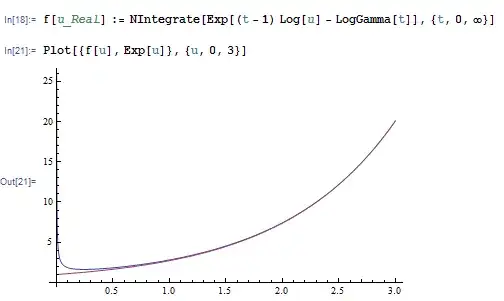
Thus: $$ \begin{eqnarray} \lim_{x \to \infty} \sum_{n=1}^\infty (-1)^n \frac{x^{2n-1}}{(2n)! \cdot \ln(2n)} &=& \lim_{x \to \infty} \int_0^\infty \mathrm{e}^{u} \frac{\cos\left(x \mathrm{e}^{-u}\right)-1}{x} \mathrm{d} u = \lim_{x \to \infty} \int_1^\infty \frac{\cos\left(x/w\right)-1}{x} \mathrm{d} w \\ &=& \lim_{x \to \infty} \int_{1/x}^\infty \left(\cos\left(\frac{1}{v}\right)-1\right) \mathrm{d} v = \int_{0}^\infty \left(\cos\left(\frac{1}{v}\right)-1\right) \mathrm{d} v \\ &=& -\frac{\pi}{2} \end{eqnarray} $$

Sasha
- 70,631
-
1Euh i did not get all those steps. It would be helpful if you explained what substitutions or partials you used. Also a plot is not a proof although i guess you know that and its not crucial to the proof. – mick Sep 04 '12 at 19:28
-
2
-
@mick Sorry for being sketchy. Large $u$ behavior of $\int_0^\infty \frac{u^{t-1}}{\Gamma(t)} \mathrm{d} t$ can also be obtained using Laplace's method. I used Euler-Maclaurin formula. Could you please tell me more precisely which steps you did not get. Those at the end of the post, or some others? – Sasha Sep 04 '12 at 19:37
-
-
@ Sahsha I feel silly for not understanding , but you already lost me at the double integral. blush – mick Sep 04 '12 at 19:55
-
4$$ \int_0^\infty \left( \sum_{n=1}^\infty (-1)^n \frac{x^{2n-1}}{(2n)!} \frac{1}{(2n)^t} \right) \mathrm{d} t = \int_0^\infty \left( \sum_{n=1}^\infty (-1)^n \frac{x^{2n-1}}{(2n)!} \frac{1}{\Gamma(t)} \int_0^\infty u^{t-1} \mathrm{e}^{-2n u} \mathrm{d} u \right) \mathrm{d} t = \int_0^\infty \int_0^\infty \frac{u^{t-1}}{\Gamma(t)} \left( \sum_{n=1}^\infty (-1)^n \frac{x^{2n-1}}{(2n)!} \mathrm{e}^{-2n u} \right) \mathrm{d} u \mathrm{d} t $$ The latter sum evaluates to $\frac{\cos(x \mathrm{e}^{-u})-1}{x}$. – Sasha Sep 04 '12 at 20:00
-
-
4@Mick This trick of summation by integral representation can be (partially) automated, esp. using multimensional residues - see my post here. – Bill Dubuque Sep 05 '12 at 17:14
-
-