0

Cornu Spiral

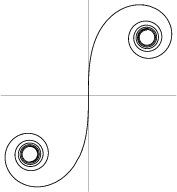
I am learning about plane curves and I am told that if the curvature $\kappa$ is a linear function of arc length $s$. i.e $\kappa = s$ we obtain the Cornu Spiral. I find this difficult to understand for the following reason:

If we take the $x$ axis in the above diagram to be arc length $s$ then, when $s$ is positive i.e the curvature is positive should the tangent vector to the curve be turning to the left?

It could be the case that if we start at the centre of the right hand spiral and then follow the curve then indeed the tangent vector is moving to the left and we have positive curvature. Is this the correct way to think of it? I think this is actually the correct way to think of it as when we get into the region of negative $s$ the tangent vectors to the curve move to the right. Is this correct?

2 Answers2

1

By accepted mathematical convention directions of x and y axes are taken as positive to the right and positive upwards from a reference origin respectively.

Slope $ \phi = \tan^{-1} dy/dx $

So accordingly such a convention is made to apply to next derivative as well. Curvature is defined as the rate of slope / rotation angle change or rate of change of tangent direction to a curve with respect to arc. It means that the counterclockwise (CCW) rotation adds to curvature and clockwise rotation decreases curvature.

In Cornu's spiral $ \kappa = d\phi/ds = a s, \phi = a s^2 /2 $ where $a$ is a constant. At origin curvature is zero.

If $a>0$ and has zero slope tangent to x-axis it curls up CCW in quadrant 1 with increasing curvature. And if tangent to y-axis it curls up CCW in quadrant 2. This is as you have sketched.

Similarly if $a<0, \, \phi = a s^2 /2 $ and has zero slope tangent to x-axis it curls down CW into quadrant 4 with high negative curvature. And if tangent to y-axis it curls to right CW in quadrant 1. Like the Cornu/Euler spiral here.

mr_e_man
  • 5,364
Narasimham
  • 40,495
0

There is perhaps some confusion here about the equation for a Cornu spiral. The natural form of a curve is one that is expressed in term of its arc length; it is independent of any coordinate system. The natural form of the Cornu spiral is correctly identified here as $\rho s=s/\kappa=\text{constant}$, where $\rho$ is the radius of curvature and $\kappa$ is the curvature. If you are interested in the tangent angle, $\theta$, then you have to know that

$$\theta=\int \kappa(s)ds$$

If you want to express the spiral in a coordinate system (here, I choose complex variables) then you need

$$z=\int e^{i\int \kappa(s)ds}ds =\int e^{i \theta(s)} ds$$

Generally, I use the canonical form

$$z(u)=\int_0^u e^{i \pi s^2/2} ds$$

where the factor $\pi/2$ puts the terminus of the spiral at $z=(1+i)/2$.

The Cornu spiral is frequently expressed in Cartesian cordinates in terms of the Fresnel integrals (see here: http://dlmf.nist.gov/search/search?q=fresnel). However, we have shown (as probably many others have) that the integral can be expressed in closed-form as follows

$$z(u)=\frac{1+i}{2} erf\left(\frac{1-i}{2} \sqrt{\pi} \cdot u\right)$$

This equation will allow you to calculate both negative and positive values of $u$ for a two-sided Cornu spiral. Here, you can see that as $u\rightarrow\infty$, $z\rightarrow\pm \frac{1+i}{2}$.

Cye Waldman
  • 7,524