10

Show that the first order differential equation $y'(x)=\sqrt{|y(x)|}$ with intial value $y(1/2)= 1/16$ has infinitely many solutions on the interval [−1, 1].

My thought were to show that this equation has two solutions (just by ansatz, or just looking at the interval $]0, 1]$ to get $y'(x) = \sqrt{|y(x)|}$) and deduce from that that there must be infinitely many solutions since the solution set forms a vector space. I've got a nagging feeling this isn't the way to go though. Can anybody give me a hint where to look?

glS
  • 6,818
  • Check if I entered the correct TeX syntax. There were symbols after $1/16$ that my browser could ont display. – Siminore Sep 19 '12 at 12:18
  • 3
    Better to say: "...has infinitely many solutions..." When you say it "has infinite solutions" we may think there are solutions with the value infinity or something. – GEdgar Sep 19 '12 at 12:56
  • Is $]0,1]$ in the question equal to $(0,1]$ or $0 < x \leq 1$? – enthu Aug 18 '14 at 11:26

1 Answers1

17

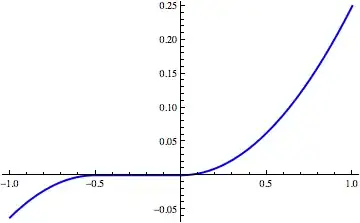
This is a classical example of non uniqueness due to the fact that the right hand side of the equation, $\sqrt{|y|}$, is not Lipschitz at $y=0$. You show this by direct computation. The equation is in separeted variables: $$ \frac{dy}{\sqrt{|y|}}=dt,\quad y(1/2)=1/16. $$ Integrating, and taking into account the absolute value, we see that $$ y(t)=\frac{t\,|t|}{4}=\begin{cases} t^2/4 & t\ge0,\\-t^2/4 & t<0, \end{cases} $$ is a solution. But for any $\tau\in(-1,0)$, the function $$ y_\tau(t)=\begin{cases} t^2/4 & t\ge0,\\0 & \tau<t<0\\-(t-\tau)^2/4 & t<\tau, \end{cases} $$ is also a solution. Below is the graph of $y_{-1/2}$.

Graph of $y_{-1/2}$

By the way, the set of solutions is not a vector space.