5

This is a minor curiosity that I've been wondering about. Suppose that we draw a closed curve in the plane and that this curve intersects itself several times, but never twice in one spot. We can knot the curve by traveling along the curve and assigning over- and under-crossings alternately as we reach each intersection. It seems, as I have been told, that this will never cause a contradiction, i.e. under and over crossings will always match up. Why is this case?

I am not too familiar with know nothing about knot theory. If there is a non-technical proof of this result, or perhaps a proof involving graph theory, that would be wonderful.

Below are some diagrams to illustrate what I mean
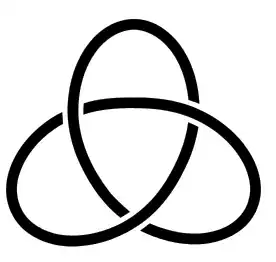
trefoil

A trefoil knot formed by assigning alternate over and under crossings.
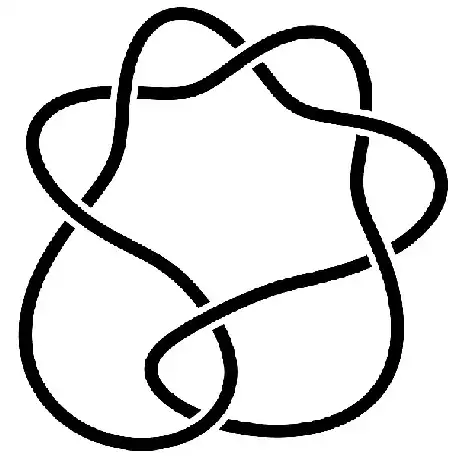
alternating knot

A more complicated alternating curve.

EuYu
  • 41,421
  • I take the question to mean, how do you know that the second time you come to a crossing you're guaranteed to be due for an over if you previously did an under there, and for an under if you did an over? – Gerry Myerson Oct 08 '12 at 02:57
  • @Gerry Myerson Precisely. Sorry if the question wasn't formulated well. – EuYu Oct 08 '12 at 02:58
  • 1
    A proof is given in the answer to this very similar question: http://math.stackexchange.com/questions/182971/warp-like-pattern-in-a-closed-curve – Jack Schmidt Oct 08 '12 at 03:29
  • @JackSchmidt Wow, that's quite the beautiful proof. Thank you for directing me to that question. – EuYu Oct 08 '12 at 03:34
  • @Gerry: oh. Somehow I did not understand the significance of the word "alternating." – Qiaochu Yuan Oct 08 '12 at 03:44

1 Answers1

2

Consider the loop formed by starting at some crossing and following a strand until you get back to that crossing. The loop may cross itself, and it may be crossed by other strands. Each time it crosses itself, it does so twice (once over, once under). Each starnd that crosses the loop does so twice. So all told, the loop does an even number of crossings between visits to the starting crossing. Thus, it always winds up being due for the correct kind of crossing when it gets back to the start.

Gerry Myerson
  • 179,216
  • A very nice parity argument. Thank you Gerry. – EuYu Oct 08 '12 at 05:06
  • Why does “ Each strand that crosses the loop does so twice” ? – Eric Ley Nov 27 '23 at 01:59
  • @Eric, a strand that starts outside the loop and crosses it is now inside the loop. It can't end inside the loop, it has to meet up with its beginning, which was outside the loop, so it has to cross the loop again to get outside. – Gerry Myerson Nov 27 '23 at 05:47
  • But this loop is not necessarily a simple closed curve on the plane, so what’s the meaning of “inside “ and “ outside”? – Eric Ley Nov 27 '23 at 06:06
  • @Eric, I wish you had brought this up eleven years ago, when I'm sure I knew exactly what I meant by what I wrote! I may have to think about this for a while, to get back to where I was then. – Gerry Myerson Nov 27 '23 at 06:22