9

Every knot gives rise to a number of 4-regular planar graphs - by regular projections onto the plane - which just have to be enriched by an over/under flag for every vertex to be able to reconstruct the knot from the graph.

What I wonder about:

Question 1: How can I tell which 4-regular planar graphs are possible knot graphs (neglecting the flag)? How are knot graphs characterized? Just like polyhedral graphs are characterized as exactly the 3-vertex-connected planar graphs?

One necessary condition is that the 4-regular planar graph has an Eulerian cycle (which it has in any case) which visits every vertex exactly twice.

Question 2: Is this condition sufficient?

[Added: I suspect that every Eulerian cycle of a 4-regular planar graph has to visit every vertex exactly twice, which means that every 4-regular planar graph fulfills the necessary condition. This implies that Question 2 reads "Is every 4-regular planar graph a knot graph?" Which I did not want to ask, originally.]

  • 1
    Indeed each Eulerian circuit of a four regular graph visits each vertex twice. Each pass through a vertex takes up exactly $2$ degree, so each vertex requires $2$ passes. It would seem that each $4$-regular graph is indeed a knot graph. This can be seen by travelling along the circuit and assigning crossings at each vertex. In fact, you can even represent this graph as an alternating knot. – EuYu Feb 22 '13 at 19:47
  • Forgot to mention that the above is obviously only for planar $4$-regular graphs. I am not sure on non-planar ones. – EuYu Feb 22 '13 at 19:52
  • But I only asked for planar 4-regular graphs: it's OK for me! – Hans-Peter Stricker Feb 22 '13 at 20:05
  • @EuYu Your comment looks like an answer to me. –  Feb 23 '13 at 04:57
  • You aren't counting links with $2$ or more components as knots, are you? If you aren't, then surely the graph has to be connected to be a possible knot diagram, but even that isn't sufficient. – Gerry Myerson Feb 23 '13 at 06:15
  • @Gerry: You are right, I should have mentioned connectedness. Can you give me an example of a connected 4-regular plane graph that is not a possible knot diagram? – Hans-Peter Stricker Feb 23 '13 at 08:44
  • 1
    If you don't insist on simple graphs, just take a projection of a simple link of two unknots. Depending on how you flag the crossings, you'll either get back that simple link, or two unlinked unknots. Actually, I'm having trouble seeing how you could take any projection of a link of more than one component and get a knot out of it. You can do it if you're allowed to do smoothing at a vertex, but if all you can do is over/under, it seems to me you wind up tracing each link separately. – Gerry Myerson Feb 24 '13 at 01:04
  • Hi, not sure if you're interested but there is also a mapping from 3-regular vertex-oriented graph to knot, as you can see here: http://math.stackexchange.com/questions/2110660/relation-between-iharas-zeta-and-any-knot-polynomial ... – draks ... Apr 04 '17 at 13:02

2 Answers2

3

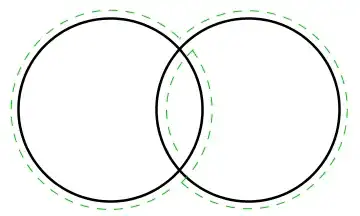
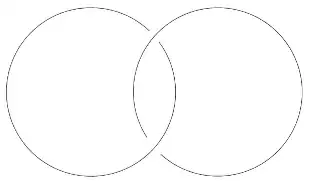
I am only going to give a definitive answer to question 2, and perhaps this is what Gerry was getting at. The answer is no, there are four regular planar graphs, with Eulerian Circuits which are not knots. My example, however, is a link, so it is not a resounding no. Consider the Hopf link.

The Hopf Link

Here is an Eulerian circuit on the corresponding graph.

The Link with an Eulerian Circuit

So, I think we might be able to enforce a condition on always taking the "middle" path on our Eulerian circuits, and that might be sufficient, or at least eliminate examples like this one. But I do not know enough graph theory to say how you would nicely characterize taking the middle path.

Also, do we need some finite condition, otherwise the infinite grid of the integer points in the plane might work? Or do Eulerian circuits imply finite?

N. Owad
  • 6,822
1

If G is a plane, 4-valent, 2-connected graph where all of its faces have a number of sides exactly divisible by 3, then G can't be the projection of a knot. For more details see: Jeong, Dal-Young. "Realizations with a cut-through Eulerian circuit." Discrete Mathematics 137.1 (1995): 265-275.